I got this from, guess who, Bill Mountjoy. The Colts and their offense are constantly being discussed. Obviously, they have great personnel with four very good receivers including their tight end, one of the best single backs in the league, and a $60 million quarterback to put them in the correct play every down. However, it is still worth analyzing a bit what they do.
Their favorite run play is the stretch play, also known as the outside zone. They are also extremely effective at play action passing off the stretch action, where Peyton Manning makes those great run fakes that the announcers go crazy about. (From what I can tell their favorite routes from their play action from the stretch are post/dig, double posts, and post/corner/post combinations).
Anyway, they run their stretch a bit differently, since instead having everyone step and reach playside and getting movement that way, they run a kind of "pin and pull" scheme, which at the college level the Minnesota Golden Gophers also run with great success.
The diagrams/explanation is not directly from the Colts but it is what they do.
Onward:
The Indianapolis Colts and The "Pin and Pull" Stretch Play
Intro
[In this terminology, the play is called "flex."]
FLEX is a strong side play.
The aiming point for the Single Back is 1 yard outside of the TE.
If the “A” is play side he is responsible for blocking the force (strong safety) defender.
If the “A” is aligned on the backside of the play he must start on an inside path and block the most dangerous pursuing defender After the exchange the QB will set-up like he does on PISTOL protection
If the “A” is in motion prior to the snap and we want him to block the force defender on the play side we will call FLEX BOSS.
BOSS means Back On Strong Safety
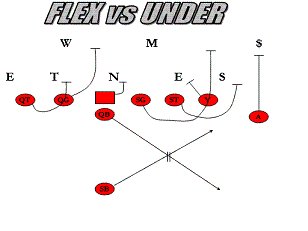
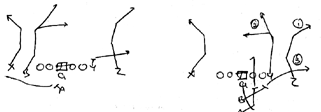
Against "Under"
If the Center can reach the Nose he will make a “YOU” call to the Strong Guard telling the Strong Guard to pull and block the M(ike) linebacker.
The Strong Tackle and Tight End will “TEX”. The TE must block DOWN and not allow any penetration. The Strong Tackle needs to pull and RUN TO REACH the S(am) linebacker.
Against "Loaded"
If the Center cannot reach the Nose he will make a “ME” call to the strong guard telling him to block the Nose and the Center will pull to block the M(ike).
The Strong Guard must block DOWN and not allow the Nose to penetrate.
The Strong Tackle and the TE will “TEX," as described above.
Against "Adjusted 4-3"
The Tight End is responsible for blocking the DE wherever he aligns.
The Strong Tackle is responsible for pulling and blocking the SLB’er wherever he aligns. Stay square and see the Sam linebacker during the pull.
The Center is responsible for blocking the Mike linebacker. The Quick Guard has a difficult block and must be prepared to SCRAMBLE block the Nose.
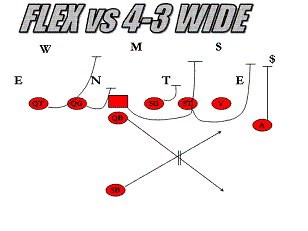
Against "4-3 Wide"
The Tight End is responsible for blocking the DE wherever he aligns. STEP-CROSS-STEP to reach the DE.
The Strong Tackle is responsible for pulling and blocking the Sam linebacker. Stay square and see the Sam linebacker during the pull - you could go around OR inside of the TE’s block.
The Center is responsible for blocking the Mike linebacker & the Quick Guard blocks the Nose.
Obviously Charlie Weis is not a run and shoot coach, and, having studied some of his New England stuff it does not really resemble much of the run and shoot packages. The more likely theory that his offense is sort of an amalgamation of common and traditional NFL tactics. Do it simple; do it well. Coach Mountjoy has pointed out some of the evolution in his offense that began when Weis coached with current Carolina coordinator Dan Henning, but I am not an expert.
Anyway, though, this quote was interesting from a recent press conference:
Q. Coach, after watching Saturday, this question begs to be asked: Did your career path ever intersect with Mouse Davis?
COACH WEIS: I did visit with Mouse Davis back in South Carolina when we had the run and shoot. We talked to Mouse Davis, we talked to John Jenkins not Father John Jenkins, by the way Mouse Davis, John Jenkins, those run and shoot guys. Yes, we went from the veer to the run and shoot at South Carolina. We spent some time with all of those run and shoot guys.
Q. Was influences of that evident on Saturday?
COACH WEIS: No. What you saw Saturday [ND did a lot of 5 wide stuff and quick three step passes], first of all, run and shoot always has a back in the backfield. It's either a two by two or three by one, which trips are spread; okay, that's number one. And you always have a run element, so empty (backfield) really doesn't come into play.
If you talk about the look passes [the one step hitch] and swings that we throw in the game, that's just an evolvement from check with me(s) that we've been running over the years.
I would not have thought that Weis had been involved with "the shoot," but it isn't susprising that he is well versed in lots of football offense. While studying the Run and shoot won't give you much insight into what Weis is doing now, it's still a sophisticated offense and an understanding of the run and shoot, why it worked so well and for so long, and some of the defensive reactions and reasons why it isn't as popular anymore (though most of the diehard shooters will tell you it is simply from a lack of commitment) is as good an introduction into the passing game and modern football as you're going to get.
Further, the first time I coached on a pass-first team was with a run and shoot squad: I coached receivers, slotbacks, and defensive ends (outside linebackers) on a small squad.
The best run and shoot resources are Al Black's book, listed on the right side of the menu. The chucknduck site has diagrams of the 6 main packages vs. the relevant defenses. Tommy Browder has a website with diagrams and explanations of the tradition R&S pass protection, screen game, etc (note the midi that plays when you go to it, I think that website is or is getting close to 10 years old).
Footnote: the "go" with its "middle read route" has become, in various forms, a staple of nearly every offense, and "the switch" is still maybe one of the most explosive pass plays you can put in. Ironically, the most vivid recent memory I have of "the switch" is that in the Super Bowl that the Rams lost to the Patriots, the Rams' TD that put them ahead to set up Brady (and Weis's) game winning field goal drive was a touchdown pass to Ricky Proehl on, you guessed it, the switch.
I got this from Coach Mountjoy. (As I get so many good things from him. BTW he will be speaking at the upcoming MEGA Clinic, I'd suggest to anyone who can to go.)
Mumme isn't having a wonderful season right now in his first season back in D-1, but it will give you pause to think that four offensive coaches from the 1997-1998 Kentucky staff are all Head Coaches: Mumme himself, Mike Leach at Texas Tech, Guy Morris at Baylor, and Coach Hatcher at Valdosta St. D-II (who is having arguably the best success of them all with a Nat'l title and currently undefeated).
Lots of coaches who email me and contact me ask about the passing game, and probably even more important than schemes are how to install it and practice it. This is one of the best explanations I've come across.
If you want to install the Airraid offense I would suggest buying the Valdosta tapes where they discuss drills and plays, using this practice plan, and contact the Texas Tech staff about visiting their spring practice and/or discussing football with them. You'll learn quite a bit. (Also, from what I understand BYU is basically running a form of the Airraid now, since their OC was from T. Tech).
HAL MUMME'S PRACTICE PLAN:
Practicing the Multiple Receiver Offense
Practice schedules and drills for the pass offense are not a lot different than those for the conventional offense but I believe a great deal of thought and preparation must be done to achieve success. In the “Air Raid” offense I have used for many years at several different levels certain nuisances have lent themselves to practicing well. I will detail these things in the article with hope it will help you.
Make Practice Consistent
The pass offense depends much on timing and chemistry between players i.e. QB and WR on route, this makes consistent practice a must. I always tried to erase doubt in the players’ minds as to what would be done in practice on any given day. I endeavored to make all the Mondays the same, all the Tuesdays the same, etc. By keeping a consistent practice schedule through each game week of the season our players could gear up mentally for the tasks to be accomplished in each segment of practice. To give an example, our individual drills were all done the same way and same segment of each day's work out. Consistent practice makes for consistent reps, which make for great reps, which makes for great play.
Practice Success
That old saying about you play like you practice is true. It was always my belief that five great reps of anything were worth more than ten mediocre reps. With this in mind, I encouraged our players to slow down their reps but to do them great. For example, if you have a QB and two WR working on the curl route don’t rush through the drill just so you can say you got ten reps. It will be a lot more productive to have the WR walk back between reps, take there time, and have five great curl routes each one perfect. Hustle is fine but is not the only ingredient. Practice successful reps even if it means fewer reps.
I never wanted to practice anything that a player could not visualize doing in a game. The successful coach should look at every drill - be it individual, group, or team type - and ask himself if this will happen in a game. If this answer is no, throw it out, it is wasted motion, which means lost time. The only resource that cannot be replaced is time. Knowing you can eliminate poor drills, look at the fruitful drills. Take each one and study how you can make them more game-like. For example, our “Air Raid” offense depended greatly on multiple sets, player groupings, and the no huddle attack. With those parameters, I decided to make all of our team offense drills more game-like by having the sideline coaches and players box painted on our practice field and requiring all our coaches and players to work and sub from where they would in the game on Saturday. This greatly enhanced the efficient use of subs and made delay of game penalties unheard of in our offense. I believe players will perform better in games if they can visualize what it will be like therefore practice game-like events.
Practice for the Unplanned Event
Every coach loves that play which happened just the way he drew it up. To be honest about it though, those are more rare than ordinary. This is particularly true in the pass offense. Practicing contingency football is very important. I would take each of our pass plays and draw up what would happen if our QB were forced to scramble to his right and then repeat the process with a scramble left. I would drill this about ten minutes per a week to make sure everyone knew where to go on the field if the QB scrambled right or left. I had landmarks for each receiver and the offense of line and running backs had specific duties. Our teams often made spectacular plays when the opponent’s defense played its best and forced our QB from the pocket. We turned our lemons into lemonade so to speak because we practiced the unplanned event.
Practice Organization is crucial to having an effective multiple receiver pass attack.
Practice Making the Big Play
Scores happen because players expect them to take place. I have certain things I want accomplished on each play from each player but the bottom line is to score. With that in mind, I made it mandatory that whomever ended up with the ball on any play had to cross the goal. In other words, our players scored on every play in practice, from individual drill right through team. I wanted all of the players to expect to score on every play. This takes some patience since the coach has to give the ball carrier time to return from the sprint to the goal. The results are worthwhile, as big plays can become habit.
Plan Success
All the practice habits described can be planned into workouts. The best time to plan workouts for the season is in the summer when the pressure is off. For this reason all of the workouts for the entire fall including bowl games or playoffs I planned in July. They were organized by day of the week and placed in a large binder to be used as needed on a daily basis. It was always amazing how few changes had to be made and how consistent our offense would become due to this planning. The most important time during the game week are the moments coaches spend with their players. By not having to devote daily time to planning practice schedules the coach has more time to spend with the players. Success can be planned well in advance.
Basic “Air Raid” Weekly Schedule-Season
Monday:
90 min. view previous game
30 min. dress-warm-up
40 min. special teams review
20 min. individual drills
30 min. walk through game plan
30 min. watch video of upcoming opponent
Tuesday:
30 min. watch video of upcoming opponent
15 min. warm-up
15 min. special teams/individual time for uninvolved
20 min. individual drills
10 min. group routes on air/OL individual drills
10 min. one on one DB-WR/inside drill
10 min. team screens
5 min. special teams
20 min. pass skel
25 min. team offense: coming off goal, open field, third and short, FGS
30 min. individual meet watch days work-out
Wednesday:
30 min. watch video of upcoming opponent
15 min. warm-up
15 min. special teams/individual time for uninvolved
20 min. individual
10 min. one on one DB-WR/inside drill
20 min. pass skel
55 min. team: goal line, red zone, third and long, open field, punt
Thomas Schelling, along with Robert Aumann, was honored this week with the nobel prize in economics for his work in Game Theory--or "interactive decision theory". An amazing mind, his books are also extremely readable (i.e. unlike much game theory, they do not overwhelm you with the mathematics).
Since he won I browsed around the web a bit, and, thanks to Marginal Revolution, here is a lecture he gave on the theory of self-restraint.
I suggest reading the essay, as it touches on a variety of interesting and at times troubling issues of self-restraint and individual and public choice. It addresses the boundaries of human capacity and consequences of our abilities and limitations when making decisions.
Schelling begins his lecture:
A few years ago I saw again, after nearly fifty years, the original Moby Dick, an early talkie in black and white. Ahab, in a bunk below deck after his leg is severed by the whale, watches the ship’s blacksmith approach with a red-hot iron which, only slightly cooled by momentary immersion in a bucket of water, is to cauterize his stump. As three seamen hold him he pleads not to be burnt, begging in horror as the blacksmith throws back the blanket. And as the iron touches his body he spews out the apple that he has been chewing, in the most awful scream that at age twelve I had ever heard. Nobody doubts that the sailors who held him did what they had to do, and the blacksmith too. When the story resumes there is no sign that he regrets having been cauterized or bears any grievance toward the men who, rather than defend him against the hot iron, held him at the blacksmith’s mercy. They were not protecting him from an involuntary reflex. And he was not unaware of the medical consequences of an uncauterized wound. Until the iron touched him he knew exactly what was afoot. It was a moment of truth. He was unmistakably all there. He made his petition in clear and understandable language. They had neither personal interest nor legal obligation to subject him to torture. And they disregarded his plea. When the iron struck he went out of his mind, still able, though, to communicate with perfect fidelity that all he wanted was the pain to stop. While the iron was burning his body we might declare him to have been not fully present, but until that instant it is hard to claim that he didn’t understand better than we do what the stakes were.
Ahab and his wound dramatize a phenomenon that, usually not so terrifying, all of us have observed in others and most have observed in ourselves. It is behaving as if two selves were alternately in command. A familiar example is someone who cannot get up when the alarm goes off. [He also mentions examples like how we do not keep candy or alcohol in the house because of expectation of our own future weakness. A poignant example he uses is someone who attempts suicide.]
I don't want to misconstrue Schelling's lecture--it gets much further afield than anything here--but while reading it I was struck with the classic two-self dichotomy that every offensive coordinator in football must deal with: the gameplanner and the playcaller. (We could even probably say the 1st quarter coach vs. the 4th quarter coach, but that is a different discussion.)
Posed with similar circumstances and problems, even the exact same level of information, the in-game you and the weekday you would likely give very different answers. Bill Walsh has often talked about the advantage of scripting plays and playcalling in detached, relaxed circumstances where logic can dictate vs. the insanity of a game situation.
One of the implications is that we must take turns as Ahab and as the crew, holding each other down to see us through what our immediate self vocally rejects. Even going so far as to override us when we are at our weakest. While not as dramatic as Moby Dick or even some of Schelling's other scenarios, it is an interesting view.
Further, a gameplan can be seen as a form of contract with our football team and the other coaches that guarantees that we will stick to what has been decided collectively and with the most information possible. While it is a blueprint for attacking your opponent it is also there to guard against you suddenly becoming Hal Mumme and throwing 50 times when, as a staff, you'd decided to be a lot more like Woody Hayes that game.
The obvious caveat is that a gameplan is contingency based, much of it depends on what your opponent does. But, a well crafted gameplan can still handle these scenarios and be created in a detached setting. In Schelling's language, created by your week-day self.
From a press Conference with Notre Dame Coach Charlie Weis:
[In response to a question on running back Darius Walker's running style]
But I can tell you what I used to tell [Patriot's receiver] Deion Branch after I had a big research study on (Marvin) Harrison a few years ago when Deion was a second year [in New England]. I noticed that Marvin, with all of his production, any time the hits were coming, he was going down. So after I thought about it for a while. I thought, this isn't the stupidest thing in the whole world to have your best guy, when he's about ready to get crunched, go ahead and make sure that doesn't happen.... there are times to take the hit and there are times not to take the hit.
The first important point is explicitly made: If you're talking about your best guy, there is logic to letting him go down or go out and bounds and avoid the big crunching hits. While we don't want to coach pansies, you also want to have the kid for the whole season. Injuries are a bigger threat to receivers than say offensive linemen because it is more difficult for them to play through injuries due to the nature of the position.
Second, which can be gleaned since his example was Marvin Harrison, most all production, at least a receiver's, is done before contact is made. This does not limit yards after the catch, but instead tells you that the focus is on running away from defenders rather than at them, either to run them over like Earl Campbell or try to individually juke every guy out, which is idiotic.
Instead, great receivers catch the ball, get upfield immediately, and try to score by splitting defenders. What do I mean by splitting defenders? Quite simply: run inbetween them. There are circumstances when you need to take the hit to the defender (sometimes on a slant all you can do is deliver the "forearm of doom" to the safety after the catch) but, usually, you score by running directly upfield right inbetween the corner and the safety for the long TD.
It's an often missed point. If you watch Sportscenter you will see that almost every short pass that goes for a TD involves a receiver bursting through a seam rather than trying to juke guy X, run through guy Y, spin off guy Z, and then finish by jumping over guy A. Notice I ran out of letters because doing this, even if successful, takes so long that the whole defense has time to show up. It happens occaisionally, but don't make it a habit.
Here is a message board response of mine about throwing versus man to man. Lots of the theory stuff is much more applicable to zones; vs. man you just have to beat people. (Though some of the best defenses can actually make you think they are in zone when they play man.)
While I agree that the mesh [two receivers shallow crossing at 6 yards, making a rub] is a great play vs man, it can take a little while to develop. I've definitely seen one or both receivers get jammed and the QB left with nowhere to go with the ball. I don't really think the Kentucky Shallow Cross Series is that inherently great versus press man. [an example play is here, more info can be found here. Both were mentioned in the discussion.]
I think shallow crosses work better versus loose man and zones where you can widen the linebackers. There aren't many rubs and the actual pass to the crosser is not always an easy throw against even a beaten defender; it's kind of is to the side and sometimes even over the defender.
[Another poster] mentioned Spurrier: I also remember watching his Coaching show once when he was at UF, and he said "if they play tight man you're eventually going to have to throw the slant route and the fade route." These are two routes that your receivers must learn to execute one-on-one. Can they beat the man over them?
Further, to help your guys vs press man the simplest thing to do is put your receiver off the ball, i.e. as a flanker. Vary who is on and who is off to give your guys better leverage. Also, simple motions can help too; tough to jam a guy who is in motion (look at Arena football, can't quite do that same thing but the principle applies).
Last, stacks, bunches, and rubs. I group them together but two receivers working together (the essence of the Kentucky mesh, but sometimes putting them to the same side is best) works great. Have them criss cross, follow release, rub, whatever works in your system.
If Purdue sees press man they will invariably go to a really simple combination: a slant by the outside guy with the slot running a fade. The slant runs his break off the hip of the guy running the fade, so they get a "rub". The receiver breaks his route pretty flat at first but then will bend it upfield after a couple steps (he doesn't want to get too far inside, it isn't an in route).
If you are going to install any play versus press man, this is the first and easiest. The QB will look for the slant first. If they manage to cover the slant then he will look for the fade route, looking to drop it over his outside shoulder. (if it is zone you can often still free up the slant in the undercoverage, or stick the fade vs a cover 2 safety, but it is best as a man play).
Remember what I quoted Spurrier saying? Slants and fades? On this play you do both and the ball gets out much quicker than the Kentucky mesh (3 steps vs 5).
If you have not yet read my earlier post on concepts I suggest reading that first before this one. Also, I suggest reading this thread on the Chucknduck passing forums.
Anyway, here is more about grouping pass concepts, this time (again via Coach Mountjoy) from Gene Dahlquist:
Another GOOD perspective on "PASSING GAME CONCEPTS" is from Gene Dahlquist (fine QB Coach at U of Texas under John Macovic - who also coached the KC Chiefs, & now coaching in NFL Europe - I believe):
CONCEPTS:
#1 - "PROGRESSIONS" = Reading progressions of receivers only;
#2 - "ONE ON ONES" = FINDING the BEST one on ones thru various types of pre-snap & post-snap reads.
#3 - "ISLOATIONS" - Just isolating 1 receiver on 1 defender on a PARTICULAR route.
#4 - "OPTIONS" - Prime receiver runs an "Option" route vs a defender (with a 4 or 5 way go).
#5 - "TWO AGAINST THE SIDELINE" (Hi/Lo off flat coverage). What I call a "2 Level Vertical Stretch".
#6 - "THREE AGAINST THE SIDELINE" - what I call a "3 Level Vertical Stretch"
#7 - "WORKING THE LEVELS" - three receivers vertically in the middle of the field (also a 3 level vertical stretch, but in mid 1/3 rather than outs. 1/3).
#8 - "THREE DEEP RECEIVERS VS TWO DEEP DEFENDERS" - horizontally stretching a 2 Deep Zone defense.
#9 - "FOUR DEEP RECEIVERS VS THREE DEEP DEFENDERS" - horizontally stretching a 3 Deep Zone defense.
#10 - "TWO RECEIVERS VS ONE DEFENDER UNDERNEATH" - horizontally stretching 1 undercoverage defender in 1/2 of the field.
#11 - "THREE RECEIVERS VS TWO UNDERNEATH DEFENDERS" - horizontally stretching 2 undercoverage defenders in 1/2 of the field.
#12 - "MAN/ZONE COMBINATIONS" - set one side of pattern to handle MAN & set the other side of the pattern to attak zone.
If you check this out, & the NORM CHOW "Concepts" posted earlier (above) - it is two different (& interesting) perspectives on "PASSING GAME CONCEPTS"!
NOTE: To MY way of thinking (CONSTANTLY trying to SIMPLIFY) - I would COMBINE many of the above into FEWER Concepts:
A) HORIZONTAL STRETCH (either INS/OUT OR OUTS/IN) would encompass #'s 8, 9, 10, & 11!
B) VERTICAL STRETCH would encompass #'s 5, 6, & 7!
C) OBJECT RECEIVER READ would encompas #'s 2, 3, & 4!
I wouldn't list #1 ("progressions") as a seperate "PASSING GAME CONCEPT" - because we have "progressions" in MOST of the concepts.
FINALLY - I think that #12 ("COMBINATIONS") is a GREAT concept!
First, anyone interested in a great discussion about understanding passes and how they affect defensive structure should check out this thread from the Chuck n Duck forums.
I want to give lots of credit to Coach Bill Mountjoy who posts on there, as he provided most of the most useful information:
...[Mike] Martz & [Joe] Gibbs are disciples of the [Don] Coryell offense.
You have Horizontal Stretches (Inside/Out, AND Outside/IN) with either 2 on 1, or 3 on 2 (USUALLY in 1/2 of the field - deep OR under).
You have Vertical Stretches with 3 on 2, or 2 on 1 (USUALLY in 1/3 of the field).
You have "Objective Receiver Concepts" (which is with ANY pass in which a specific receiver is primary - such as "OPTION ROUTES", ETC.).
You have read concepts (below) to facilitate the above: NOTE: "MOFO" = MOF OPEN; "MOFC" = MOF CLOSED).
QUARTERBACK READ SYSTEM: KNOW THE SITUATION PRE-SNAP LOOK THE DEFENSE – ANTICIPATE READ ON THE DROP – ADJUST THINK: PROTECTION/ADJUSTMENTS/PROGRESSION/TIMING/OUTLETS BEWARE OF THE MIDDLE OF THE FIELD LOOKS – MOFO/MOFC KNOW THE COVERAGE ELEMENTS: ZONE 3 DEEP MOFC/2 DEEP MOFO, etc
That's a handful. Quick notes:
Think of a football field as a flat, two dimensional plane. You attack a defense "horizontally" along a line on this plane. For example, in the All-curl, you are horizontally stretching 4 underneath defenders with 5 receivers all looking back at the QB (versus 3-deep. Versus cover 2 they now have 5 underneath defenders: one for every passing lane). Technically some of these receivers are at 3-5 yards and others are at 10, but it constitutes 5 passing lanes for only 4 defenders to cover.
This is what would be a called a "short [or intermediate] in-out horizontal stretch". The QB is reading inside to out (sit route to curl to flat), on a short horizontal stretch. The key is that you have isolated those 4 underneath defenders in a game they can't win: 4 vs 5.
However, to further facilitate reading these things easily, a coach will integrate a coverage key (here the drop of the middle linebacker) where he will then isolate himself into 1/2 of the field. Then, 5 on 4 becomes the more manageable 3 on 2.
First, it is an example of a "deep out-to-in vertical stretch". You want to run this versus 2-deep, so you are stretching 2 deep defenders with 3 deep receivers. The QB would then pick a side based on the safety key, and read outside in (corner to post). Again, if you can isolate the defenders at this level, it becomes the classic game they can't win: 2 covering 3.
Further, making the play effective is it is also a "hi/lo vertical stretch". In this case you hopefully, on each 1/3 half of the field, can isolate a single sideline defender (the squat-cornerback versus cover 2) who you can attack both high and low, or "hi/lo" with your corner route and your flat--both sideline routes. Essentially this is a 2 on 1.
The point here? You do not win football games and complete passes by creating "one-on-one matchups" unless you have superior talent at each position. You win them by getting a numerical advantage, where it is 5 on 4, or 2 on 1.
We prefer 2 on 1s and they are easier--simply look at the movement of one defender--but the practical problems of properly identifying that key defender and being confident no one else will get into the passing lane are not easy, so you go for 3 on 2, 4 vs 3, or 5 on 4.
This is intended for zones, but how do you attack man? I will save some of these ideas for another article, but suffice to say that many of the best coaches will:
1. Have the individual routes that attack the zone be effective versus man (corner routes, shallow crosses) 2. Integrate certain anti-man concepts within a zone stretching framework (such as the mesh or option routes) 3. Put man combinations to one side and zone combinations to the other. Many of the best NFL and College teams do this quite effectively, and it is still simple to do.
Conclusion
Many of you probably have questions about how a Quarterback actually goes about deciding who to throw to. Even if he has a 5 on 4 situation, how in the world does he quickly determine who to throw to? Coach Mountjoy provides an excellent and quick rundown below:
You can read defenders OR progressions. Examples below:
DISCUSSION OF PROGRESSION READS AND COVERAGE READS
I. PROGRESSION READS: A progression read is designed to have two or three choices of where to go with the ball. It is important to pre-read the coverage to give you an indication of the coverage, but more importantly, it’s knowing where the receivers are going to be with a progression read pattern called. This kind of read calls for throwing the ball with rhythm drops. You might get to the third receiver in the progression as soon as you hit your fifth step on the drop. So when you are stepping forward to throw, you can hit the third receiver in the progression on the same rhythm you would have if you were throwing to the first.
The limitations of progression reads are: A) There is a tendency to stare at the receiver that is first in the progression attracting other defenders
B) It is frustrating for coaches to watch because they could see the receiver you didn’t throw to was wide open (Coaches need to know the progression of the play as well as the QB); [i.e. QB threw it to the first read who was kinda/maybe open and #3 was uncovered].
C) You will lose patience or think that because you hit the first receiver in the progression he won’t be there when the play is called again. You must have patience and not make up your mind before the ball is snapped.
REMINDERS: 1. Have a plan when you get to the Line of Scrimmage. 2. Stay with the progression. 3. Don’t stare. 4. Progression reads are thrown with rhythm drops.
II. COVERAGE READS: Reading the coverage is normally done in the NFL looking at the pictures that are taken upstairs during the series (when the QB is on the sidelines). In High School & College – the Press Box Coaches do most of the work here. The QB can pre-snap read and get an idea of what might happen. He can see rotations and drops of defenders at the snap of the ball, but may not know what the coverage was. Reading the coverage is really looking at a defender or defenders. Based on what they do you will get to the correct receiver.
THE ADVANTAGES OF THIS KIND OF A READ ARE: 1. It eliminates the struggle of the progression read trying to determine who was more wide open. 2. It eliminates the QB from making up his mind before the snap (we shouldn’t do this regardless of if we Progression Read OR Read the Coverage). Read the defenders to get you to the right receiver in Coverage Reads. 3. It keeps the QB on the same page as the Coach because they both know the read and the goal of the play called. 4. It doesn’t matter what the coverage is because when you are reading properly you will be hitting the correct receiver. 5. You will not have to stare at your receivers (it will give you natural look offs). 6. You don’t have to know what the entire coverage is (you don’t have to see the whole field). NOTE: In our reads – “Progression” AND “Coverage” – we only read ½ the field Horizontally, or 1/3 of the field Vertically.
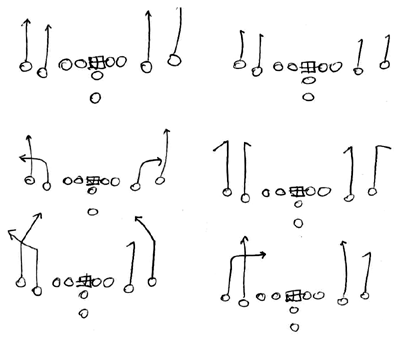
As discussed in the last article, sending all your receivers vertically is often very difficult to pattern read for zone defenders, safeties, as well as the very disruptive rovers/floaters. However, any quick look at the football landscape reveals that many, many teams successfully use lots of shallow crosses and flat routes. Given the discussion and some doodling on paper this is a surprise. These routes are almost silly: aside from being simple to jump and wall off for many defenders, they often give away what the one or two vertically releasing receivers will do.
However, my point is not that these routes are irrelevant, yet teams should be careful how they use them and it is possible that they are overused. For example, many coaches teach the passing game based on the reaction of one defender. For example, on the curl/flat combination shown below, the coach will say that if the linebacker widens with the flat, throw the curl. However, if the defense wants to, it can always double cover the curl and cover the flat one on one and take it away.
So, briefly, why do teams run these types of routes? Of first importance is who they are run against; often it is linebackers and safeties, who are weaker pass defenders. Second, the throws themselves are often easier than other throws, which can require more timing and the ability to squeeze the ball between defenders--many of these throws are simply underneath defenders.
Third, structurally, they are easy to understand and often easy to read. While this is a fear if the defense is too good, again, simplicity often favors the offense. If I send a player immediately to the flat, then I can quickly see the defense's reaction. If I send two receivers vertical it is not apparent to the QB who the D will eventually leave uncovered.
Lastly, while they (usually) are poor at threatening vertically, they can still be packaged together to create rubs, picks, and mismatches. Whether in the traditional bunch set or simply a shoot route by a running back versus a slower linebacker, we can all envision circumstances that make them effective. Therefore these routes, often better than 3 or 4 vertically releasing receivers are good at causing the defense to put itself in a numbers bind (I.E. three defenders to cover two receivers or four defenders to cover three receivers. This is what can win football games from a strategy point of view.) The point of this article is to show some of the right ways to use them and some of the proper considerations.
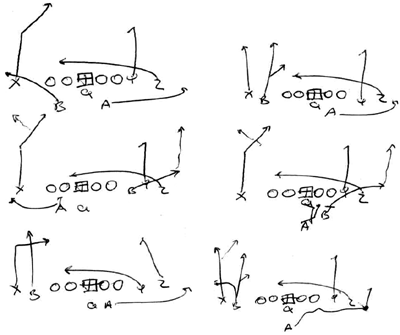
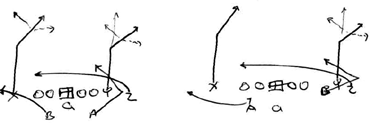
I'll begin with the shallow cross series as I have run it, which has a few variations and has come under a few names, including the West Coast "drive" concept, or just shallow cross in mine. It is a simple inside-out read for the QB, who reads the shallow cross, to a curl or in-breaking route, to the flat (or sometimes a wheel route). Sometimes there are backside reads as well, but for now I will just show it with a post route and a backside flat to control the outside linebacker for the crossing receiver.
In the lower left is how Purdue runs the play, which is basically the same even if the techniques are slightly different.
However, no matter how you dress it up, the play does not exist in a vacuum. In my earlier article I talked about the same plays being run from multiple formations. Yet, the D cannot be totally fooled if every time one guy comes in, another pushes vertical, and another goes to the flat. It simply becomes recognition and reaction for the defense; in other words they can pattern read you.
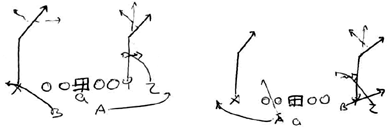
Quickly, I'll show a few other combinations of routes that look similar. First, the now famous mesh/snag/triangle route:
And the follow/angle combination:
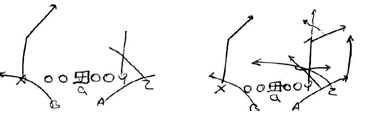
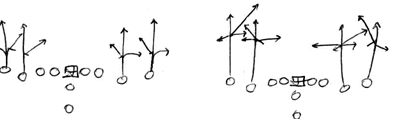
Shallow, snag, and follow (which is what I call them--insert Shakespeare's famous question here) form what I call the "Holy Trinity", which are imperative for any good passing team, particularly if you plan to use the bunch packages. Intuitively, you can see the advantage to using these together, but it becomes more apparent if I draw it first as what the stems look like on each play, and then as a branch of possibilities:
Since that looks a bit messy, here is each route individually:
The defense cannot pattern read anymore, because every play is like a kind of dynamic route tree. You've achieved the same equilibrium with these short routes as you had when all your receivers vertically released.
In this case you can still get double teamed, but they will be unable to jump the underneath routes for fear that a shallow may become a whip or that a shoot route may become a wheel or an angle route.
Conclusion
All this is part of making your offense cohesive. Again, no play exists in a vacuum. You do this for the same reason that you run draw plays or that you run your play action passes off of your favorite run plays instead of plays you don't even run. They keep the defense honest and make you difficult to defend. If I have five pass plays but they all look markedly different, I become easier to defend. If I can mix in all the formations, substitutions, and then, even if the defense accurately reads run or pass and can identify the receivers, yet still can't tell if there is a whip or a shallow coming, or a corner or a curl (or a post), then I have been successful.
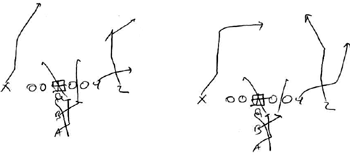
It doesn't really matter how you integrate it into your system, whether they are separate plays or tags or whatnot, but the important thing is to make it difficult for the D and easy to teach. For the last two diagrams I will show you how Spurrier integrates this same idea into his two favorite pass plays (which, to add to the confusion, are built off his favorite run play, the lead draw).
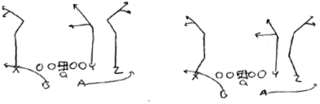
First, Spurrier loves the curl/corner read play, which I discussed in this article and the common dig/post pass, shown below:
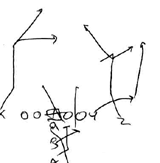
Laid on top of each other, it looks like this to the defense:
He's been doing this for years. Constant three way threats all around, the threat of multiple vertical receivers, including post and corner routes, are all staples of the Old Ball Coach's offense.
Pattern reading is one of the most crippling tactics a defense can employ against an unprepared or poorly organized pass offense. Even a successful passing team can suddenly find themselves unable to get anyone open. Think about what it is like trying to throw against your own defense when they all know your plays.
I was actually kidding: if your own defense can always identify what you're doing, then that is probably a sign that you need to rethink things. The issue is that as often as possible the defense should not know for sure where the receivers will wind up until the ball is actually thrown. This is done by making routes look alike.
The first thing is that your eligible receivers must learn how to explode off the ball and make every route look like they are going deep. If a receiver can explode and make the DB think he is going deep, and then has the skills to stop and change direction in two (or sometimes three) steps, then he can always get open versus one defender. Imagine a pass play with four (or five) vertically releasing receivers: each could go deep, stop, or go in or out at any time. Further, no single receiver can afford to be double teamed until the intentions of some of the other receivers have been given away, at which time the ball should already be thrown.
In fact, most 3-step drop passing games and many timing routes look just like this. Below are some diagrams of possible combinations and routes put together (some put together quite casually, not all are vouched for as great plays).
Drawing the route tree can be thought of as showing what it is like for a defensive back: he is backpedaling and he sees all the potential ways that receiver could go. However, if he can pattern read, even if he doesn't know with 100% probability what a receiver is going to do, if he can narrow it down to one or two things, then the offense is on a slippery slope downhill.
So, if defensive backs have a hard time pattern reading vertical releases, then what can they pattern read? Well, they read routes that immediately show where the receiver is going, as shown below:
I.E. Shallow crosses and flat and shoot routes. Or in other words: the bread and butter of many, many football teams' passing games.
Homer Smith wrote a few articles that very convincingly decimated the usefulness of some of these routes, particularly the flat route. You can threaten no more than one defender, who can always take it away. In the world of football strategy, this is not how you win football games. You win football games by isolating your players in one on one matchups that they can win and score against and occupying two defenders with one receiver, thereby creating those one on one matchups. Defenses will trade one for one every single time. Think about what bunching or stacking receivers is intended to do, or the multiple threats that tight ends and H-backs can present.
Moreover, these routes a) are easily covered or "squeezed" by the LBs, b) they usually signal exactly what the vertical releasing WRs are going to do (i.e. if the slot flies to the flat, then the corner knows he will only run a go or a curl, but will not run an out route), and c) does not threaten the deep coverage so the safeties can help double team the downfield receivers.
I used to be a bit more sceptical, but I think it is safe to say that the NFL, from a strategy standpoint, is obviously the most sophisticated football being played at any level. (Though certain strategies, such as many option football strategies, are deemed too risky because of injury to the quarterbacks.) There is simply so much more time, money, and experience at every level of the teams--from players to coaches to technical assistants, and there is too much incentive and reward for success for it not to be.
Thus, I think it would be a fair test to say that if these routes are as useless as they seem to be on paper under careful analysis, then someone would have realized this, whether explicitly removing them on purpose, or implicitly they would get phased out when they analyze piles of play results and use the most successful rotues and packages.
A quick scan of any NFL game will show you that lots and lots of shallow crosses and flat routes are being called, completed, and used successfully. While running the risk of asking the obvious (or simply making the simple complicated), but why?
The first, and probably most important reason, is that these routes are simply shorter and easier to complete than other quarterbacks. Most are less than 6 yards, compared with the vertical stem routes, which are 10-15 yards (at least) downfield, and, knowing that we can use the Pythagorean theorem to determine how far the pass actually needs to go, this could be a 15-25 yard difference between a 5 yard route and a 12 yard route. This is important both because of simple success rates, but also because football teams and quarterbacks are human, psychological beings, and I am a big believer in getting QBs established early with easy throws to get them comfortable.
Second, they do focus on the LBs and the undercoverage, who are often weaker defenders. This is a less strong reason because routes with vertical stems can and still do attack these underneath defenders, but there is no mistaking it with the shorter routes.
Lastly, while you do immediately lose deep threats from the route, you can still create new route trees off these pass releases, creating new uncertainty for defenders, which is what I will discuss in my next article.
To kill two birds with one stone, I will continue to elaborate on the topic of pass pattern adjustments that began with Spurrier and some other plays by discussing the three-verticals play, known as "787" or the corner/post/corner combination. This is a big-play pass play effective versus all coverages, primarily cover 2 man or zone.
In this play, here diagrammed from a base Pro-Set, the outside receivers will run post-corner routes, and the inside receiver, Y, will run a "middle-read" route, or "adjustable-8". The running backs will control the undercoverage with a shoot and a swing route. The outside receivers and the middle receiver have simple keys to help them adjust their routes based on the coverage and the leverage the defenders are using against them.
Below is some video of the Patriots running this play (though with tight splits for the receivers and flipped as I have it drawn up):
Keys for Outside Receivers The outside receivers are going to read the "two Bs" we emphasize to them every day: Bail or Bump. In this case bail is any coverage with the defender off 7 yards or more as long as he takes his read steps backwards.
Bail Technique
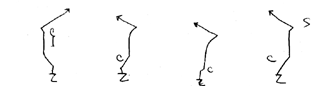
In this case the receiver will get a free release and will run a true post-corner route, as shown below. Beginning with the outside foot back, he will release vertical for 7 steps and should reach at least 10-12 yards. He will plant on his outside foot and break at a 45 degree angle to the post for three steps, looking back at the QB on the second. On his third step he will plant his inside foot hard, open his hips and break for the corner at a hard 45 degree angle.
As shown above, we teach that if the corner stays inside he will break hard for the near pylon. If the corner stays outside or quickly is back over top of him, he will drive his outside elbow and plant his outside foot flat to the LOS, and begin to come back for the football. If this happens he will catch it at 18-22 yards (this requires QBs without strong arms to have great timing). I will get back to the QB shortly, but the QB is instructed to "throw him open", and the receiver must get to the football, whether it is thrown upfield or back flat to the sideline.
Bump or Up Coverage
For bump coverage, the corner may employ several different techniques: he may align off and then step up (roll-up corner); play hard man inside or outside; or be in cover two, aligned outside and playing zone. Each is shown below:
Versus a roll-up corner, the receiver must abandon his vertical step-based stem and must instead stem inside to get proper leverage.
Against man he will abandon his steps and look for the quickest vertical release to a depth of 10-12 yards. The move at the top is the same, if abbreviated. He will sell the post, look at the QB, then break for the corner. If the receiver does not beat the bump coverage he will get back over top and push vertical.
Lastly, against a cover 2 corner, he will free release inside to a depth of 5-6 yards, then push to 10-12, stick his inside foot to the post to sell the safety, then break high to the corner. He will allow the QB's throw to get him to the open area.
Middle Route
The middle-read receiver will take the fastest vertical release he can. He does NOT want to get slowed by the second level players. He will get a pre-snap and a post-snap look at the middle of the field. If the middle of the field is open (MOFO - cover 2, 0) he will go for it. If it is closed (MOFC - 1, 3, 4) he will run a square-in route.
He will take the fastest release and push to a depth of 10-12. If he reads MOFO he will stick his outside foot and head for the nearest upright. He wants to catch the ball at 18-22 yards, and is expecting to get hit after he catches it.
If he reads MOFC he will plant hard at 10-12 and will stick his outside foot and make a 90 degree cut. If he reads zone he will try to make eye contact with the QB and find the window between the linebackers to catch the football. If he reads man he will burst and sprint away from his defender.
Undercoverage Control Routes
Here, they are RBs, but they can also be tight ends, wingbacks, H-backs, etc. They will run control routes. The shoot is a straight route to a depth of 3 yards, no wider than the numbers. The swing is a straight run out from their original position (5 yard depth) for 4-6 steps and then they will look over the inside shoulder. Will get no wider than the numbers and no deeper than the LOS.
QB Drop and Reads
This is a 5-step drop timing based play, so the offensive line must be able to hold their blocks. The QB will take a 5-step drop with a hitch step, keeping his eyes downfield.
His primary key is the weak safety. Even before he understands coverages he must be able to find the weak safety and watch his movement. On this play, if the weak safety goes weak (cover 2, or lines up as a middle safety and rotates weak) the QB will read strong (Z-1, Y-2, A-3). If the weak safety stays in the middle or rotates strong, then the QB will read weak (X-1, Y-2, B-3).
Notice the QB reads outside to in on this play. This is a timing route and the primary timing is between the QB and the corner route.
As shown above, once the QB determines which direction he is going it then becomes a strict progression read, where he actually is reading the receiver rather than the defender, looking for open grass. This is similar to my article on the all-curl route, where the QB keys the middle linebacker and then does a strict progression. This also helps with "throwing the receiver open", and has actually helped cut down interceptions, since the QB has a better idea of whether the receiver is actually "open" rather than the reaction of one particular defender.
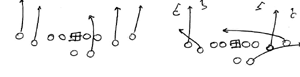
Below are diagrams versus various coverages, with the W/S circled:
Note: The QB needs to be be able to identify Cover 4. Since the play is designed to attack Cover 2 zone and man, and is very effective at it, you can expect the D to try to catch you by playing Cover 4--where they outnumber your deep receivers--and force an interception. With the W/S staying weak it indicates to the QB to go strong, which is good, but overall he wants to find the best outside matchup. We hope the middle route can control the safeties a bit, and the hard post-corner move can still get the outside receiver open. Regardless, this is not my favorite call versus Cover 4.
And below is video of the play as used by the Airraid teams. Courtesy of "otowncoach."
Conclusion and Other Uses
Below is a quick diagram of the play from a one-back formation, and the route shown for play action from the I-formation. It matters little to your players what wrinkles you add to it, but, as per my article on personnel and formations, it can matter a lot to the defense. The idea is to get you doodling; it can be aplied to lots and lots of situations.
This is one of my favorite passes. It is extremely adaptable to many offenses, formations, personnel, and situations. Furthermore, it is an aggressive pass play but also is very precise and can be well protected. It is not just a heave or throw without purpose. It is part of a well-crafted, timing-based passing attack.
Below is a chart describing the probability (based on a normal distribution) of gaining 10 yards in 3 plays, based on a particular play's expected gain/variance relationship (or three different plays with the same characteristics):
Chart courtesy of reader Brad Eccles.
You can muse on this for some time, but this is accounting for losses, as well. It shows the important relationship between risk and return but also demonstrates--looking at the steep slope for the results on the right hand side of the chart--that average or expected return has a huge effect, implying that higher return rather than conservative playcalling strategies are beneficial, even accounting for risks (standard deviation).
Quick caveats: This is highly abstract, and takes no account of down or distance or position on the field; what may have a low standard deviation or high return in one circumstance may not in another. Also, the standard deviation for higher returns may need to be higher than 20. I still am looking for a large enough set of data to analyze.
Lastly, and this is not a bad thing, is that the assumption of a normal distribution may be off, because I would imagine that returns for a football play are heavily skewed (i.e. in a single play it is more common to gain 30 or 40 yards than it is to lose 30 or 40 yards.). This may also work in the favor of aggressive playcalling, particularly if you can quantify turnover/field position risk.
Smart Football analyzes football's strategies, Xs and Os, and tactics, along with the theory and history supporting them. Chris Brown writes Smart Football, and he has been writing about football, in one form or another, since 2002. @SmartFootball (Twitter)









 Posts
Posts


