Smart Football has moved!

Please check out the new site, smartfootball.com. All future updates will be made there.

Thursday, March 16, 2006

How many concepts do you need in your passing game?

First, I apologize about posting infrequently. I promise to do better; I even have some good material saved up and in the planning phase. Onward.

Inspired by this thread from the Coach Huey X and O Board. Further, if you want to bone up on my specific definitions of concepts, check out this article.

Framing the Question:

"How much offense" and "How much passing" is a common question. I'll let others give their hard and fast answers. I think more interesting is how do you think about this question? Certainly over the course of many seasons one naturally may find out some equilibrium amount of offense, but most of our jobs do not have the security necessary to blindly experiment.

There are several questions you must ask when talking about "more or fewer" passing concepts.

1. How much will you put the ball in the air?
2. How many kinds of passing actions will you use?
3. How many concepts or schemes do you need under each?

How much do you want to put the ball in the air?

The first is the most important question. This is often a function of talent as much as anything else. To simplify, let's assume (I know unrealistically, but just for discussion) that you would always throw more if your talent could handle it. To me, the important question is not how good your receivers are. They are a concern, but more important by far is:

(a) how good are you at protecting your QB? (O-Line talent/technique)your ability to protect your QB (o-line), and
(b) Your QB's ability to read defenses and issues of accuracy, timing, and arm strength.

Thus, Receivers are a secondary question. Typically, if you can protect and have a good QB, receivers will take care of themselves. If you have gamebreakers on the outside but cannot handle much of the 5-step stuff, then you still can work to get the ball to them on screens, quicks, etc.

This is important because you do not want to practice and do not want to waste time installing what you won't run. So before you know "how much 5-step" or "how many concepts" you need to know how much you'll be putting the ball in the air, since the #1 rule of offense organizationis to not practice what you don't use and do practice what you do run, regardless of what you carry in your playbook.

How many kinds of passing actions will you use?

The second question is what kinds of passing actions. Are you a dropback team with draws and screens as your counters (Airraid/Texas Tech/Hal Mumme style), or more action passes, boots and sprint outs (spread teams, some run-oriented team), or maybe just a few pop passes and quicks from your veer sets. This depends on your types of talent and what will be your staple runs, etc. QB factors are key, like height, footspeed, comfortability out of the pocket, etc.

How many concepts or schemes do you need under each?

Finally, you've got some kind of rough breakdown of what will be your strengths. Week to week it will vary based on defense and opponents' weaknesses. (Since pre-season you look at your absolute abilities, but for a given opponent it is all about comparative advantages against your opponents. For example, you might be the worst running team in your district, but your opponent has an even worse rush defense and is geared for your pass, thus you beat them by running the ball. This little sidenote is too broad to explore here.) Anyway, over time this breakdown should correlate with what your strengths are. So let's say you're a 50% passing team, with about 40% of your passes being quick 3-step, 40% play action or sprint outs and bootlegs, and 20% 5-step passes. You can assume somewhere like 50 plays a game.

This means you're only going to throw 5-step passes about FIVE times a game (50% of your plays = 25, 20% of this = 5). You certainly don't need more than five 5-step concepts for a given game since you don't want to practice passes you won't run. More like you only need two or three at most.

This is important to help you frame your offense. The last few seasons I've thrown it around 25 times a game, with between 12-17 per game being 5-step straight dropback concepts (partially because my base play action are my same 5-step concepts). Since this is a big chunk of my offense and constituted an even bigger chunk of my yardage total I run more concepts than many, but these numbers still only justify six or so concepts. This still only leaves passes being run two or at most three times.

What about colleges and other passing teams?

It's helpful to think of the Airraid guys, they purportedly run about seven or eight, but really more like 12-15 concepts (often gloss over the basic concepts that they do run). Looking at Texas Tech with Mike Leach, who throws 55-60 times a game, still has a similar ratio of running each play 3-4 times. So by that math, about 3.5 pass attempts for every one pass concept, if you throw it 25 times you should only have SEVEN total passes, including boots, 3-step, and 5-step.

By that logic I run way too many concepts. So, the short answer if you're extrapolating from Texas Tech, less is probably more. The R&S guys have like five passes. Of course, each R&S package is like 4 or 5 plays; each Tech play is just one.

Conclusion

If you work backwards from your ability to protect and ability to throw, next to the types of throws that will work, then when you have a rough idea of how much you'll throw the ball and how many times you'll run boot and how many times you'll drop back for 5-step, you can then use a ratio of 2-3 attempts for every one pass play as a metric to give some guidance.

Note: The 2-3 times is over a season. For example if you play a Cover 2 team, you'll throw smash, 3-verticals, and double slants maybe 4 times each in a game and Curl/flat and all-hitch almost never. Then versus a Cover 1 and Cover 0 man and blitzing team, you'll run mesh 4-6 times that game, and then versus a zone team you'll only use it a few times. So it's not a hard and fast rule that you'll run each concept 2-3 times each game, just over time.

Further, this too is better suited to its own discussion, but the other concern when answering the question "How many pass concepts do I need?" is you need answers to everything you are likely to face. You typically need a Cover 3 beater, a Cover 2 beater, and a Cover 4 beater, some man beaters (2 and 1) and some anti-blitz (both screens and upfield "take-a-shot" passes).

Lastly, my two favorite pass plays are absolutely integral: draw and screen. Find any way you can to run them.


---------------------

ADDENDUM:
Right after posting I went to the Jerry Campbell football message board and came across this thread. Jerry Easton, Bill Mountjoy and others type out their response to the question "How much do you need in your passing game?" Since I gave the theoretical answer below, I figured I'd paste what Bill Mountjoy says he ACTUALLY does (at the High School level). Visit the thread (and contribute to the comments here or any of the two threads) if you want more.

BASE DROPBACK PASS SYSTEM:

PERSONNEL GROUPINGS = 2 TE/2 WR/1 RB, AND, 1 TE/3 WR/1 RB (both from 2x2 & 3x1 configurations):

1. 2 PASS PROTECTIONS at most (7 man pro = 3 free releases & 2 check releases; AND, 8 man pro = 2 free releases & 3 check releases) = a BASE/BOB type, & a TURNBACK type.

2. 3 THREE STEP dropback passes (I.E.: "HITCH"/"FADE"/"SLANT")

3. 5 FIVE STEP dropback passes (I.E.: "SMASH"/"CURL-FLAT"/"DOUBLE OUTS"/"POST"/"POST/CORNER")

4. "TAGS" off of the above for variety (can vary greatly as needed)

5. At least 1 SCREEN, & 1 DRAW.

6. Be able to handle: BLITZ-MAN/3 DEEP/2 DEEP (I KNOW there is more - but it all boils down to THIS).

7. QUALITY (execution) of the above = more important than MORE quantity!

8. SIMPLE READ CONCEPTS FOR QB (based upon "progressions of reveivers):

----A) INSIDE/OUT HORIZONTAL STRETCH (3 vs 2 or 2 vs 1) WORK 1/2 of field horizontally.

----B) OUTSIDE/IN HORIZIONTAL STRETCH (3 vs 2 or 2 vs 1) WORK 1/2 of field horizontally.

----C) LONG TO SHORT VERTICAL STRETCH (3 vs 2 or 2 vs 1) WORK 1/3 of field vertically.

----D) OBJECT RECEIVER READ (looking for a specific receiver for a specific reason).


9. PHILOSOPHY VS BLITZ IMPORTANT (BELOW):


A) Our philosophy vs the blitz are to call plays in one of two categories that are good vs. either:

1. BLITZ MAN, AND COVER 2 (MOFO), OR
2. BLITZ MAN, AND COVER 3 (MOFC).


B) WE DO NOT AUDIBLE TO DIFFERENT PROTECTIONS BECAUSE:

1. NEVER KNOW WHEN THEY ARE GOING TO COME (CAN BLUFF BLITZ & BACK OUT TO ZONE OR, THEY MAY COME).
2. QB NOT ALWAYS EQUIPPED TO SEE IT THE WAY YOU WANT HIM TO.
3. NOT ENOUGH GAME CLOCK TO AUDIBLE.
4. THEREFORE, WE NEED CALLS THAT ARE GOOD VS EVERYTHING.
5. USE 2 PLAY HUDDLE CALLS, OR “CHECK WITH ME AT THE LINE” – PLAYS THAT DO NOT CHANGE THE PROTECTION CALLED IN THE HUDDLE. THEY FIT INTO ONE OF THE CATEGORIES IN A) ABOVE.


C) AVOID “HOTS” BY USING 7 OR 8 MAN PROTECTION (BE SIMPLE ATTACKING BLITZ SO WE CAN SPEND MORE TIME ON GOOD FUNDAMENTALS – THIS LEADS TO BETTER EXECUTION). REASONS WE DON’T USE “HOT” RECEIVER(S):

1. QB DOESN’T SEE IT – HE GETS HIT!
2. QB SEES IT BUT RECEIVER DOESN’T!


D) MENTAL APPROACH VS BLITZ:

1. NOT “OH, NO – THEY’RE GOING TO BLITZ – I’M GOING TO GET HIT”, BUT:
2. “OH BOY” – IT’S A BLITZ – WE HAVE A CHANCE FOR A BIG PLAY”!!!


SUMMARY: “KISS” (KEEP IT SIMPLE – THE MORE EFFICIENT YOU ARE, THE MORE YOU MOVE THE CHAINS AND SCORE POINTS)!

Monday, February 06, 2006

The Zone Blitz, Max Pro, and the Super Bowl

ESPN.com's Len Pasquarelli wrote:

"Fooling opposing passers is a strong suit for [Steeler's Defensive coordinator Dick] LeBeau, of course, and there were some occasions, especially in the second half, when Hasselbeck appeared flummoxed. The surprising part is that LeBeau called only a handful of standard zone-blitz defenses against Seattle's passing game.

Pittsburgh blitzed early but, as LeBeau pointed out, the Seahawks were using "max" protection blocking schemes, and "we didn't see anything good that could come from just constantly banging our heads against a wall."

Typical of LeBeau, though, he saved one gambit, one of the most basic zone blitzes, for a critical moment. It came on Seattle's penultimate possession of the game, with Seattle scrambling to scrape back into the contest. On a third-and-8 play from the Pittsburgh 47-yard line, LeBeau called for a "corner fire," and Deshea Townsend roared through a gaping hole to dump Hasselbeck for a five-yard loss, forcing a punt.

On the zone-blitz, linebacker Joey Porter dropped into coverage rather than rushing, and that forced Hasselbeck to hold the ball a count longer than he normally might. Townsend was into the backfield like a heat-seeking missile.

"A great call, perfect timing, one of the oldest zone blitzes we've got, but still a goody," Townsend said after the game. "That's the thing about [LeBeau], he knows when to spring something we haven't used on an opponent. But he also knows he can trust us to deliver. I mean, there we were Saturday night in the hotel, walking through a new coverage that he just drops on us at our team meeting. And we work on it for four or five hours and, for something we've never played before, we get it hashed out. I guess he kind of figured 'better late than never,' and I'm glad he did, because it worked great for us tonight."


I noticed that the Steelers were very selective about their zone blitzes and that Seattle was determined not to go to the Indianapolis route and get trammeled by unblocked Joey Porters on every other play. This corroborates my theory and the Bruce Arians article I quoted saying that you have to max pro vs. the zone blitz, contrary to all the guys recently who keep saying that the Colts and others should have gone five wide. This results in simply more hits on the QB. You can just as easily--if not more easily--let 2-3 receivers find the zone voids and let the other 2-3 guys check out underneath after you've protected your QB. A perfect example was this year's bowl game between Oklahoma and Oregon. Oklahoma had a very mediocre year, Oregon a great one, but Oregon could NOT move the ball and lost because they were obsessed with going 5-wide vs. Oklahoma's man and zone blitzes where their young QBs took shot after shot and they never broke anyone free.

In the article LeBeau, who practically invented the zone blitz, flatly admitted that max (7 and 8 man) protection got them out of zone blitzing. Remember, this is how the Steelers got to the Super Bowl in the first place. It took a further great defensive effort and excellent calls by LeBeau to keep pace, and this was against a Seattle offense scared to death of the zone blitz. Earlier in the article Hasselbeck said:


"You know, it got to the point where I was taking chances, and that was just a poor decision," Hasselbeck said. "It was a chance I shouldn't have taken. I kind of got fooled by the move one guy made [in the secondary], and it was a bad play."

Fooling opposing passers is a strong suit for LeBeau, of course, and there were some occasions, especially in the second half, when Hasselbeck appeared flummoxed. The surprising part is that LeBeau called only a handful of standard zone-blitz defenses against Seattle's passing game. "


This is the strength of the zone-blitz. It is weak against max-pro because there are large zone voids and weaker defenders in pass coverage. Yet, the QB gets impatient, even an NFL guy like Hasselbeck. Instead of hitting his check-downs when they kept him protected he forced too many throws. Sometimes the strength of the scheme is not that it confuses the opponent but merely that it frustrates them. To defeat it you must be both sound and patient.

Saturday, January 07, 2006

Has the spread offense reached its apex?

I will discuss a bit of facts about the rise of the spread offense including its various pass and run elements (heavily abridged, each individual chain has its own history), and argue that it has morphed from an equalizing offense, one used by less talented programs to level the playing field, to one that merely amplifies the latent talent, so talented teams can expose mismatched defenders but there are now fewer opportunities for less talented teams and the spread may not be well situated for these "up-and-coming" programs now that it is so popular. At the lower levels it will remain and can continue to thrive where it is well coached as a tool to highlight talented athletes, particularly as more and more good athletes grow up throwing the football and becoming effective passers. The Pros are likely to never catch on to "the zone read" and such plays, just as the traditional option is not widespread in the pros either. Last, the days of the spread as "the next big thing" are over. It is the classic case that when the public at large realizes what's going on and every TV commentator is discussing how innovative you are, you are no longer innovative and someone new is soon to be annointed the next "genius."

Introduction

As an astute commentator pointed out, all four of the BCS bowl winners ran some version (actually a very similar version) of the spread offense. I am not sure if Texas once lined up with two backs in the backfield (not counting Vince Young!). All but Penn St rushed for significantly more than 200 yards in those spread sets, and few would argue that Penn St is not a physical team and they might have been the least spread of all the winners. Of the other teams in the BCS, Pro-Style offensive teams like USC and Notre Dame ran lots of "spread stuff," and in ND's case I think it actually hurt them since their offensive line had difficulty pass protecting.

The zone read was on full display throughout the bowl season. In the West Virginia-Georgia game the TV ran some great shots of the play and explained well who is being read and the idea behind the play. They obviously had lots of examples of great blocking and running to make a believer of nearly anyone. Of course that game featured innovator and Johnny Appleseed of the spread-run game Rich Rodriguez (Tulane, Clemson, and WVU, who spread his knowledge first hand to teams like Northwestern and others who themselves have propogated the offense), but the BCS title game was the crescendo, with a quarterback dependent offense run by maybe its best triggerman ever. Vince Young's performance is well chronicled, with 30 completions in 40 pass attempts (with virtually zero yards after the catch for Texas's receivers) and 200 yards rushing. Last year Alex Smith became the number one pick as a run-pass threat under now-Florida Coach Urban Meyer, who himself won his first bowl-game at Florida. Meyer is considered one of the "gurus" of the spread-O, yet he was a relative neophyte to the offense before going to Bowling Green in 2001, when he studyied and adapted some of the Northwestern and Rodriguez run schemes along with the Louisville Cardinals passing game when John L. Smith (now Michigan St HC), Bobby Petrino (Louisville HC) and Scott Linehan (Miami Dolphins OC) were coaching there.

The offense's rise has been meteoric. I was inundated with questions and articles on Urban Meyer's O and the spread option game were always some of the most trafficked ones on the blog. Next season the schemes will be even more prevalent, especially at the HS level. But where next?

The Pros

Eventually all offenses are tested in the NFL. The final verdict on any scheme or philosophy is eventually tested, chewed up, synthesized, and sent back under the 24 hour/365 day scrutiny that is professional football. Time, money, technology, and the best football minds always level a verdict. Other offenses can survive at lower levels (and often can be more successful than what the Pros themselves do with their more sophisticated passing games and less success of deception based offenses like the Wing-T), but the book will be written at the pro level, or at least adapted by it. The Run and shoot had its weaknesses exposed (primarily the zone blitz) but it also had its best aspects co-opted by nearly every offense. Its mark is real, if subtle.

The difference with the spread offense though is that, unlike the run and shoot or many other "philosophy" offenses, it actually came from the Pros, or at least the spread roots reach back further in the Pros than even at many colleges. The one-back attack as practiced by Dennis Erickson, Mike Price, etc goes back to the old Jack Neuimeier (sp?) offense, but the zone running game and 3 and 4 receiver sets and the shotgun goes back to the Gibbs Redskins, the Buffalo Bills K-Gun, and even the Don Coryell or Sid Gillman offenses. The reason is simple: that's where the quarterbacks were. Dan Fouts, Marino and these other guys were the best players on their teams and coaches as diverse as Coryell and Don Shula had offenses designed to be both quarterback friendly and dependent. (I'm ignoring for the moment the Bill Walsh lineage, but his concepts I think were co-opted a bit later and integrated into the "modern Pro offense" which I think is really a combination of the Walsh West Coast scouting, preparation, timing, etc and the one-back offenses, some of the concepts pre-date as well as post-date Walsh's reign.)

Further, the "spread" is not so different than what the Pros currently do. Watch Texas Tech and they will run the "mesh" six ways from Sunday. Watch the Colts, and they will run it a bunch too. The big question then becomes, what about all this spread-to-run business?

The question has two answers. One, many teams already do this, as evidenced by how many teams are one-back oriented. Watch the top running teams in the NFL: the Chiefs, Broncos, and the like, and they will spread to run a good percentage of the time. Even the Redskins, a power team, like to use lots of motion and multi-receiver sets to get the D thinking pass before using H-backs to kick out, pull, or lead into the hole.

The second question is, what about the quarterbacks? The Falcons have been one of the best rushing teams in the NFL for the past few seasons, due in no small part to Michael Vick. They run lots of bootleg with him off of the outside zone and inside zone runs, for the same reason that Texas or West Virginia run the zone read: to get double-teams on the playside and either make the backside defensive end stay home or pay with a big QB run. Yet, the Falcons haven't gone to the zone-read. Vick has been injured at times. We see big rushing days by a Donovan McNabb or even good runs by a Jake Plummer, but where are the 100 yard rushing days we have seen from Vince Young, Troy Smith, or even guys like Alex Smith or Northwestern's old QB Zak Kustok?

First, the common argument against this is the team speed of the NFL defenses. The spread works best when you have great one-on-one matchups. Texas and Ohio St. are so dangerous because they force you to "pick your poison" and leave one-on-one either the receivers, RBs, or the QB. USC played at least one and mostly two safeties deep nearly the whole game. When Pete Carroll did blitz he often brought zone blitzes--surprisingly afraid of getting beat deep by the outside receivers of Texas. Consequently Young picked them apart but also ran the ball so well. The argument is at the pros the speed of the defense can nullify some of this. The Pro safeties can defend the deep ball and stick your QB for no gain.

I think the better argument though is simply the nature of the league. The problem isn't only that those safeties can range the whole field, it is that when they hit your QB they send him to the hospital. The NFL already can't keep their signal callers healthy for a whole season: McNabb and Vick have both constantly battled injuries, but so have far less mobile QBs like Chad Pennington, Rex Grossman, Culpepper, etc. Can you imagine the Colts, with Peyton Manning--all $50 million+ of him--running a QB run of any kind with that much at risk? No first down is worth losing your franchise.

The harsh fact is that financially, Vince Young costs the school just as much as his backup: one scholarship. Even more, Peyton Manning, Brady, McNabb, these guys are your team for 10+ years. At most you get four years from a college QB. More likely you get two seasons. The "spread" may actually make Vince Young's decision to go to the Pros for him. Were he to return, could he request that the coaches not run him as much, to reduce his likelihood of injury? Keep another guy in to protect him more so he doesn't take as many shots? The spread has always given up shots to its QBs; the good ones just get the ball out first.

At the Pro level these risks are unacceptable, with fan-bases, cap room, and playoff hopes all riding on their signal caller.

Big-Time College

Certainly next year it will be everywhere. The big issue though is what do the small teams do now? It used to be that you could "get good" by being a spread team. In just the last four years Urban Meyer resuscitated two programs and cashed in at Florida, in no small part by being a "spread guy." When Ohio St and Texas are running the same offense as you and scoring 50 points, how can you sell yourself as being "different" and "wide open"?

Being spread is simply no longer enough. Some of the most inept offensive performances I've seen this year were by "spread teams." I watched Oregon get dismantled with their spread O in the bowl game, as they went 5-wides a majority of the time. This is an unwise move when the defense has five covermen who can cover your receivers man to man and when their front 4 or 5 can break a guy free vs. your OL nearly everytime. They had far more success and were less predictable when they added TEs and RBs and used more misdirection and/or power. Their OC is Gary Crowton, another spread guru from the Louisiana Tech days who had a mediocre Pro stint and an up-and-down campaign at BYU.

Purdue this year, a staple of spread offenses and hero who went from perpetual loser to Rose Bowls and Big 10 contention, continued their downward offensive spiral, as their defense, which had continued to prop them up over the past few years collapsed as well. Purdue over the past few seasons has run into the same problem Oregon had. In the beginning, when they started spreading four and five wides even Michigan or Ohio St did not have five good covermen. Now even Minnesota, Iowa, Wisconsin and the like all have 6 or 7 good ones. Result? Lots of 3 and 4 yard passes and even more plays with five receivers out and zero open.

The offense has arguably become the opposite of an equalizer, it has become an amplifier: if you are talented you can really rack up the points because no one can cover Vince Young, Ted Ginn or the like one-on-one, but if you're not, you just get sacked and no one gets open. Purdue even tried to add the spread option stuff this year but an offensive line that could not get movement and a lack of playmakers stunted the offense's production.

I think the O has reached its apex as savior. Coaches are not going to get fat contracts anymore based on being "spread." There will be holdouts and the good coaches, Rodriguez and the like, are going to continue to win games and move the ball because they are great teachers and believe in what they do, but something else is going to have to be "the rage." (If I had to predict something I would have said the jet/fly offense, but it has not caught on as much as I'd thought, and its success appears inversely proportional to team speed. I saw a youth team score 50 with it, HS teams are winning championships, College teams have already begun to drop it after LSU scored twice on it in the Nat'l championship game, and I saw two pro teams run it this year, both for loss of yardage.)

Lower Levels/HS, etc

It's harder to predict where this will go, as I can guarentee 20 years from now there are going to be some "true spread teams" and "spread run teams" lingering just as there are successful double-wing, wing-t, run and shoot, and splitback veer teams. Well coached and coordinated offenses will continue to be successful. I also think that putting your best player at the "Vince Young QB" spot is a great way to win football games. The days of having an I-back and just feeding your best guy carries and having a statue at QB who throws 5 passes a game is (mercifully!) about over.

Why is that? This is a whole other discussion, but the big reason I think is the proliferation of information on good quarterbacking. Instead of one or two kids who can throw a decent spiral and a couple guys around a city who know a few decent QB drills, now there are books, manuals, videos etc for parents, kids, coaches alike. Lots of kids, from inner-city to suburban can learn the fundamentals of quarterbacking. There is no reason that "athletes" can't throw the ball, at least well enough for HS. There might be issues that arise later in College or the Pros with complex coverages, but if I had a 4.5 guy who could throw a bit running my offense, I guarentee you I can win some games.

Further, the "spread" and the "zone read" do force the defense to account for all 11 men. The safeties must step up for the QB, as he is another threat, thus putting either your RB running against reduced fronts, or receivers one-on-one. This is logical and good football. Again though, as teams get better at defending it, can the team with 19 kids on varsity run this as an equalizer? Uncertain. It is unlikely to help as much as maybe it has in the past.

Conclusion

This was meant as a brief overview. The "spread" can be many different things, but it is not so new. This is probably why it is both so effective and why its rise (and predicted decline) has been so fast.

The big issues are that no longer can I be "different" from the other teams in my conference or in the state by being a spread guy. Second, teams see it more and can defend better. It still is a great way to highlight great players, and, being so QB intensive, a great player can be extremely effective, particularly at the lower levels. At the Pros, too much money and the risk of injuries appear too great to put total emphasis on the QB, as there already exists so much. Great players may come along though and prove me wrong, but Walter Peyton with a cannon running QB for a team, even if he wins a title, may or may not disprove my theory.

Wednesday, December 28, 2005

St. Louis Rams Shallow Cross Concepts

While not as prolific as they were just a few years ago, the Rams under offensive coordinator and head coach Mike Martz were maybe the best passing offense of all time. They set a gazillion scoring and passing records, and now teams like the Chiefs and Cardinals run their offense verbatim and others like the Bengals run extremely similar schemes. The offense itself goes way back to the Don Coryell and Sid Gillman days, as interpreted by guys like Ernie Zampese and Norv Turner.

The vertical passing game is well documented and very important (in fact they run the 3-vertical I link to in the previous post), but the shallow cross has been a great tool for them to hit passes underneath the fast dropping linebackers and to get good matchups with speed receivers getting rubs and running away from man to man for big play potential.

The Rams integrate the shallow cross into four main concepts: drive/cross-in combo (same side), hi-lo (shallow/in opposite sides), mesh, and the choice.

Running the Route

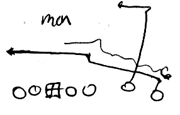
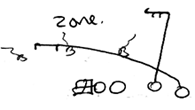
The route is designed to be run at a depth of 5-6 yards. It is mandatory that it at least crosses the center, and often can be caught on the opposite side of the field (in fact many pro-teams use the shallow as a way to attack and control the opposite flats). Here is the route shown vs. both man and zone and some coaching points:


1. First step is directly upfield. Vs. press man stutter step and get inside position.
2. Rub underneath any playside receivers inside of you.
3. Initially aim for the heels of the defensive linemen
4. Cross center. Aim for 5-6 yards on opposite hash.
5. Read man or zone (described below)
6. Vs. zone settle in window facing QB past the center-line (usually past the tackle). Get shoulders square to QB, catch the ball and get directly upfield.
7. Vs. man staircase the route (shown above, push upfield a step or two) and then break flat across again and keep running. No staircasing when running mesh.

Reading man or zone: After your initial step, eye the defenders on the opposite side of the centerline. Two questions: who are they looking at? and what does their drop look like?

If they are looking at the receivers releasing to their side and turning their shoulders to run with those receivers, it is probably man (on mesh look if they are following the opposite receiver).

If they are dropping back square and looking at either the QB or at you, it is probably zone. Expect to settle. Even if it is zone and there is nothing but open space, keep running; we'd rather hit a moving receiver than a stationary one.

Now, onto the concepts themselves.

Drive/Shallow-in

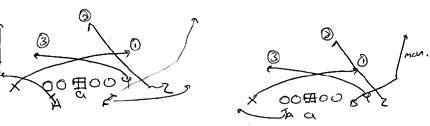
The first is the "drive" concept, as taught in the west coast offense. You can find a great article on the classic form of the play common to west coast offense teams here. Here is a diagram below:


This is the most versatile of all the shallow-cross routes, and my personal favorite. The in route is run at 14-15 yards (can shorten to 10-12 for H.S.) and the corner is a 14 yard route (can also be shortened to 10-12).

The Rams typically use two different reads on the play, depending if it is man or zone. Against man the read is shallow->in->corner (RB dump off). Against zone it is a hi-lo: corner (or wheel), in, to shallow.

The shallow and sometimes a quick flat are good options built in against blitz, and the play can be run from many formations, including the bunch.

Below are some variants. On the right, is incorporating an angle route into the play, and it always gets read inside to out. On the left, the play is run from a balanced one-back set, and the backside can have almost any two-man combination used. Below the smash is shown, but it could be curl/flat, out/seam, post-curl, or any other combination. Typically a pre-snap or post-snap determination can be made based on man/zone or whether the coverage rotates strong.


Hi/Lo

The hi/lo shallow concepts is similar to how Texas Tech/Mike Leach and the other Airraid gurus run their shallow series. For more info, try the link. Below is what the Rams do.


The in route is at 15 yards as is the post route. Both can be shortened to 10-12 for lower levels. The frontside corner is run at 15 and is only thrown vs. certain man looks.

The base read is in->shallow->RB dump-off. (As a footnote, Texas Tech reads it always shallow->in->RB. I think this is probably the better read for lower levels QBs, since it ensures they will get the ball off quickly and get a sure completion, only throwing the route over the middle when the defenders maul/jump the shallow.)

Also, versus quarters coverage the Rams like to look through the In to the Post route. The idea is that if the safety jumps the In they can hit the post up top behind him. Typically the weak safety (to in/post side) is watched on the early part of the drop, and if he comes up for whatever reason (probably to cover when a blitz is on!) the post becomes the #1 read.

The pass on the right is read the exact same, just some of the responsibilities are switched.

Mesh

The mesh route has extensive literature and discussion on it and the intricasies of the meshing receivers can be found elsewhere. The basic gist is that two receivers cross over the middle getting a rub, which is very effective versus man. Sometimes it also can be a horizontal stretch against zones with four underneath men. Martz has adjusted the play so instead of a frontside corner hi/lo read or even a post to take the top off like Norm Chow likes, he has the Z receiver running a curl at 12 yards over the center. What happens then is it floods the underneath zones with four defenders to cover five receivers, just like on all-curl. So it is a very effective man and zone play. Also, almost always at least one of the two receivers threatening the flats will run a wheel route, giving a deep option.


The QB will get a pre-snap read for the wheel route, basically checking to see if a LB has him in man and/or if the deep defender to that side might squeeze down with no immediate deep threat. The read is then right to left, X-Z-Y, or shallow, in, shallow. Again, as before, the shallows will look to settle vs. zone but they need to get a little wider here. Also, as explained elsewhere for the mesh the Y sets the top of the mesh at 6 yards and X comes underneath at 5. It is best if they can cross going full speed, but must navigate the LBs and undercoverage (and the ref!). If all is covered vs. zone the ball can be dropped off to the flat to the RB or tight end/H-back.

Choice

The Rams call the play with numbers and will tag either the post/middle read or the shallow so I'm not sure what they call it, but the play is adapted from the old run and shoot choice route. The choice route has been successful for teams for years, and the Rams are only happy to incorporate its concepts.

However, while the choice is typically read from the single receiver side over, the Rams read it opposite, with the single receiver side the late read and the middle-read the primary. The play is really intended as a spring to a slot receiver or RB in the seam with the ability to read on the fly.


They change the reads up for the post/seam pattern here run by F and H, but essentially it is similar to the middle read on the 3-vertical play, where he reads MOFO or MOFC and looks to attack the deep middle against open coverage and break flat across underneath a deep middle safety. The Rams also give him the option to break it off against blitzes and, in the case of getting H out in the second diagram, versus "wide" coverage (i.e. a LB squatting outside waiting for him to go to the flat) he can stick it at the LOS or just beyond and run an angle back inside (it helps to have Marshall Faulk!).

The read is post-read->shallow->comeback/flat read. So if they squeeze the post-read the shallow is next and then the QB works the comeback and the flat off a hi/lo read. In the second diagram the seam just clears out or breaks off his route if there is a blitz.

I suggest against having hot reads and sight adjustments to both sides combined with a multi-direction read route unless you are the St. Louis Rams. It is still an excellent play if you keep at least 6 in to block and let the shallow be the hot read, or you can even run it as a 7 man protection if you take away the backside comeback route.

Conclusion

That's a brief overview of the various ways they go about it and the reads. A HS team needs one, maybe two ways of doing this. Lots of teams have been successful using some of these. Florida State won a championship and Charlie Ward a Heisman trophy running the drive version, where if the D dropped off and covered the shallow, swing, and curl, he ran a draw. All of these are high percentage throws. Remember: speed in space! It's a motto that scores points and wins games.

Corner Routes/3-Verticals

Just wanted to mention that I watched the bowl game between Arizona St and Rutgers, and Arizona St used the 3-vertical play at least 10 if not 15 times. Rutgers runs a lot of Cover 2 (HC Schiano came from Miami where he did the same thing) and this is maybe the best play against it. They ran it from all kinds of sets, from gun, with play action, etc. ASU racked up over 600 yards of offense and I swear at least 200 or 250 and several TDs came off this one pass play. Check out this old article I did on the play here.

Tuesday, December 06, 2005

Norm Chow on Playcalling

Grabbed this from this article here. But this was too good so it got its own article. We all like to discuss coverages, etc but this is extremely true:


We are going to try to take advantage of what the other team is doing on defense. During the course of a game, with the sophistication of defenses, coverages are disguised and the use of zone blitzes and fire blitzes become very hard to beat. We’d be lying if we said we sat up in the box and knew what coverages were being run. What we try to do is take a portion of the football field, the weak flat for example, and we will attack that until we can figure out what the defense’s intentions are. Then we try to attack the coverage that we see. It is very difficult to cover the whole field. We are not going to try to fool anybody. We are going to take little portions of the field and try to attack them until the defense declares what it intends to do.


That is wisdom right there. First, to admit that you can't stand back and make magical judgments about what the defense is doing or what its intentions are. Second, the proper response is to try to turn the game into something manageable--i.e. attacking these "portions" of the field with mirrored reads, flood routes, etc.

Here's another good one:

Number one, we are going to protect the quarterback. If you decide to rush seven, we will block seven. If you decide to rush 10, we will try to block 10. We are going to try to protect the quarterback. Lance and Roger spend a lot of time picking up blitzes and that is the basic tenet that we have. You may be better than we are, but schematically we will try to protect the quarterback.


How often is this forgotten! I am a spread guy, I have roots of the pro-spread, the run and shoot, and there is a fact that the defense can always bring one more than you can protect, but protection first is the proper mindset. Hot routes are not what you build your offense on and you do not declare that you are a four wide team and that this fact is immutable. You have the ability to adapt to different defensive responses and protect your kid back there who is trying to find receivers without getting his head taken off.

Airraid Info

I'm pretty swamped the next couple of weeks, so I'll do the "lazy blogger" technique and post some links and info, this time all about the Airraid offense, in honor of the Mike Leach article that came out yesterday.

If you want to learn more I suggest checking out the Valdosta St/Chris Hatcher tapes on the Airraid offense and routes for the Y receiver/tight end.

Practice, Drills, Teaching:

Nike Coach of the Year Clinic - Hal Mumme (1999)
Nike Coach of the Year Clinic - Mike Leach (1998) - Great article
Hal Mumme Practice Plan

Schemes and articles:

Hal Mumme Clinic Notes - Shallow Cross Series
Valdosta St - Chris Hatcher - Crossing Routes
Texas Tech - 4 Verticals Package

Playbooks

Valdosta St - Spring Playbook
Chucknduck Site - Airraid (from 1999 Oklahoma Playbook)

Remember, they got much of their offense from BYU's offense from the 80s and, even today has lots of similarities with what Norm Chow did at BYU, NC State, and Southern Cal.

Norm Chow - BYU Passing Game Article - Great Article!
Chucknduck - BYU Passing game
Playbook - BYU 1995

Last, here are Norm Chow's reads for his passing plays (see the Chucknduck link for quick reference to diagrams). The reads for the Airraid are very similar, if not the same in all respects.


NORM CHOW POST SNAP READS – “60 SERIES”

“61 Y OPTION” – 5 step drop. Eye Y and throw it to him unless taken away from the outside by S/S (then hit Z), OR inside by ILB (then hit FB). Don’t throw option route vs. man until receiver makes eye contact with you. Vs. zone – can put it in seam. Vs. zone – no hitch step. Vs. man – MAY need hitch step.

“62” MESH – 5 step drop. Take a peek at F/S – if he’s up hit Z on post. Otherwise watch X-Y mesh occur – somebody will pop open – let him have ball. Vs. zone – throw to Fullback.

“63” DIG – 5 step drop and hitch (7 steps permissible). Read F/S: X = #1; Z = #2; Y OR HB = #3.

“64” OUT– 5 step drop. Key best located Safety on 1st step. Vs. 3 deep look at F/S – if he goes weak – go strong (Z = #1 to FB = #2 off S/S); if he goes straight back or strong – go weak (X = #1 to HB = #2 off Will LB). Vs. 5 under man – Y is your only choice. Vs. 5 under zone – X & Z will fade.

“65” FLOOD ("Y-Sail") – 5 step drop and hitch. Read the S/S. Peek at Z #1; Y = #2; FB = #3. As you eyeball #2 & see color (F/S flash to Y) go to post to X. Vs. 2 deep zone go to Z = #1 to Y = #2 off S/S.

“66” ALL CURL– 5 step drop and hitch. On your first step read Mike LB (MLB or first LB inside Will in 3-4). If Mike goes straight back or strong – go weak (X = #1; HB = #2). If Mike goes weak – go strong (Y = #1; Z = #2; FB = #3). This is an inside-out progression. NOT GOOD vs. 2 deep 5 under.

“67” CORNER/POST/CORNER ("Shakes") – 5 step drop and hitch. Read receiver (WR) rather than defender (Corner). Vs. 2 deep go from Y = #1 to Z = #2. Vs. 3 deep read same as “64” pass (Will LB) for X = #1 or HB = #2. Equally good vs Cover 2 regardless if man OR zone under.

“68 SMASH” SMASH– 5 step drop and hitch. Vs. 2 deep look HB = #1; FB = #2 (shoot); Z = #3. Vs. 3 deep – stretch long to short to either side. Vs. man – go to WR’s on “returns”.

“69 Y-CROSS/H-Option – 5 step drop - hitch up only if you need to. Eye HB: HB = #1; Y = #2. QB & receiver MUST make eye contact vs. man. Vs. zone – receiver finds seam (takes it a little wider vs. 5 under). Only time you go to Y is if Will LB and Mike LB squeeze HB. If Will comes & F/S moves over on HB – HB is “HOT” and will turn flat quick and run away from F/S. Otherwise HB runs at his man to reinforce his position before making his break.


That should give plenty of insight into the Airraid! If you want to learn more than this, contact Texas Tech and/or Valdosta St. Both are quite generous with their time (I think Leach even has a session for HS coaches in the sprin). The best (and some might say only) way to learn an offense is to visit and watch them put it in.

Additional materials would be the Valdosta videos, and actually Norm Chow has a great video floating around about his offense, from back in the BYU days.

Friday, December 02, 2005

Reading the "square" to determine coverage

I didn't invent this, but thought I'd pass it along. Sorry that I don't have any diagrams, those would help. From what I remember a lot of this came from Lindy Infante, but it's been used by lots of great passing coaches for a long time. This deescription is close to what I've always taught:

POST-SNAP READS (“READING THE SQUARE”):

The most important area for determining secondary coverages is the middle of the field about 15 to 25 yards deep and about 2 yards inside of each hash. We call this area the “square”.

We normally read the “square” in our drop back passing game. Reading the “square” becomes necessary when it is impossible to determine what the coverage they are in before the snap or to make sure of secondary coverage after the snap.

In reading the “square” the QB simply looks down the middle of the field. He should not focus on either Safety but see them both in his peripheral vision.

A) If neither Safety shows up in the “square”, and both are deep, it will indicate a form of Cover 2. A quick check of Corner alignment and play will indicate whether it is a 2/Man or 2/Zone. If neither Safety shows up in the “square” and both are shallow, it will indicate a Cover 0 (blitz look).

B) If the Strong Safety shows up in the “square”, this will indicate a Cover 3 rolled weak or possibly a Cover 1.

C) If the Weak Safety shows up in the “square”, this will indicate a strong side coverage. It could be a Cover 3 or a Cover 1. If the coverage is Cover 3, it could be a Cover 3/Sky (Safety), or a Cover 3/Cloud (Corner), depending on who has the short zone.

NOTE: When either of the Safeties shows up in the “square”, the best percentage area to throw the ball in is the side that he came from! If NEITHER of the Safeties show up in the “square” – throwing the ball into the “square” is a high percentage throw.

Wednesday, November 16, 2005

Colts Stretch Play

I got this from, guess who, Bill Mountjoy. The Colts and their offense are constantly being discussed. Obviously, they have great personnel with four very good receivers including their tight end, one of the best single backs in the league, and a $60 million quarterback to put them in the correct play every down. However, it is still worth analyzing a bit what they do.

Their favorite run play is the stretch play, also known as the outside zone. They are also extremely effective at play action passing off the stretch action, where Peyton Manning makes those great run fakes that the announcers go crazy about. (From what I can tell their favorite routes from their play action from the stretch are post/dig, double posts, and post/corner/post combinations).

Anyway, they run their stretch a bit differently, since instead having everyone step and reach playside and getting movement that way, they run a kind of "pin and pull" scheme, which at the college level the Minnesota Golden Gophers also run with great success.

The diagrams/explanation is not directly from the Colts but it is what they do.

Onward:

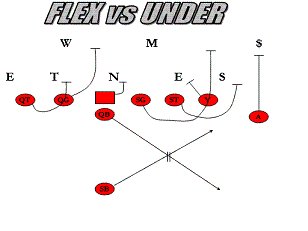
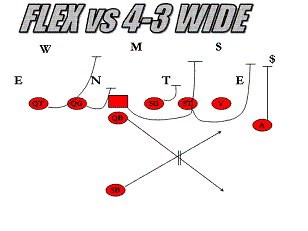
The Indianapolis Colts and The "Pin and Pull" Stretch Play

Intro

[In this terminology, the play is called "flex."]

FLEX is a strong side play.

The aiming point for the Single Back is 1 yard outside of the TE.

If the “A” is play side he is responsible for blocking the force (strong safety) defender.

If the “A” is aligned on the backside of the play he must start on an inside path and block the most dangerous pursuing defender
After the exchange the QB will set-up like he does on PISTOL protection

If the “A” is in motion prior to the snap and we want him to block the force defender on the play side we will call FLEX BOSS.

BOSS means Back On Strong Safety

Against "Under"


If the Center can reach the Nose he will make a “YOU” call to the Strong Guard telling the Strong Guard to pull and block the M(ike) linebacker.

The Strong Tackle and Tight End will “TEX”. The TE must block DOWN and not allow any penetration. The Strong Tackle needs to pull and RUN TO REACH the S(am) linebacker.

Against "Loaded"


If the Center cannot reach the Nose he will make a “ME” call to the strong guard telling him to block the Nose and the Center will pull to block the M(ike).

The Strong Guard must block DOWN and not allow the Nose to penetrate.

The Strong Tackle and the TE will “TEX," as described above.

Against "Adjusted 4-3"


The Tight End is responsible for blocking the DE wherever he aligns.

The Strong Tackle is responsible for pulling and blocking the SLB’er wherever he aligns. Stay square and see the Sam linebacker during the pull.

The Center is responsible for blocking the Mike linebacker. The Quick Guard has a difficult block and must be prepared to SCRAMBLE block the Nose.

Against "4-3 Wide"


The Tight End is responsible for blocking the DE wherever he aligns. STEP-CROSS-STEP to reach the DE.

The Strong Tackle is responsible for pulling and blocking the Sam linebacker. Stay square and see the Sam linebacker during the pull - you could go around OR inside of the TE’s block.

The Center is responsible for blocking the Mike linebacker & the Quick Guard blocks the Nose.

Wednesday, November 02, 2005

Charlie Weis - Run and Shooter?

Obviously Charlie Weis is not a run and shoot coach, and, having studied some of his New England stuff it does not really resemble much of the run and shoot packages. The more likely theory that his offense is sort of an amalgamation of common and traditional NFL tactics. Do it simple; do it well. Coach Mountjoy has pointed out some of the evolution in his offense that began when Weis coached with current Carolina coordinator Dan Henning, but I am not an expert.

Anyway, though, this quote was interesting from a recent press conference:

Q. Coach, after watching Saturday, this question begs to be asked: Did your career path ever intersect with Mouse Davis?

COACH WEIS: I did visit with Mouse Davis back in South Carolina when we had the run and shoot. We talked to Mouse Davis, we talked to John Jenkins not Father John Jenkins, by the way Mouse Davis, John Jenkins, those run and shoot guys. Yes, we went from the veer to the run and shoot at South Carolina. We spent some time with all of those run and shoot guys.

Q. Was influences of that evident on Saturday?

COACH WEIS: No. What you saw Saturday [ND did a lot of 5 wide stuff and quick three step passes], first of all, run and shoot always has a back in the backfield. It's either a two by two or three by one, which trips are spread; okay, that's number one. And you always have a run element, so empty (backfield) really doesn't come into play.

If you talk about the look passes [the one step hitch] and swings that we throw in the game, that's just an evolvement from check with me(s) that we've been running over the years.


I would not have thought that Weis had been involved with "the shoot," but it isn't susprising that he is well versed in lots of football offense. While studying the Run and shoot won't give you much insight into what Weis is doing now, it's still a sophisticated offense and an understanding of the run and shoot, why it worked so well and for so long, and some of the defensive reactions and reasons why it isn't as popular anymore (though most of the diehard shooters will tell you it is simply from a lack of commitment) is as good an introduction into the passing game and modern football as you're going to get.

Further, the first time I coached on a pass-first team was with a run and shoot squad: I coached receivers, slotbacks, and defensive ends (outside linebackers) on a small squad.

The best run and shoot resources are Al Black's book, listed on the right side of the menu. The chucknduck site has diagrams of the 6 main packages vs. the relevant defenses. Tommy Browder has a website with diagrams and explanations of the tradition R&S pass protection, screen game, etc (note the midi that plays when you go to it, I think that website is or is getting close to 10 years old).

Footnote: the "go" with its "middle read route" has become, in various forms, a staple of nearly every offense, and "the switch" is still maybe one of the most explosive pass plays you can put in. Ironically, the most vivid recent memory I have of "the switch" is that in the Super Bowl that the Rams lost to the Patriots, the Rams' TD that put them ahead to set up Brady (and Weis's) game winning field goal drive was a touchdown pass to Ricky Proehl on, you guessed it, the switch.

Tuesday, November 01, 2005

Hal Mumme's Airraid Practice Plan

I got this from Coach Mountjoy. (As I get so many good things from him. BTW he will be speaking at the upcoming MEGA Clinic, I'd suggest to anyone who can to go.)

Mumme isn't having a wonderful season right now in his first season back in D-1, but it will give you pause to think that four offensive coaches from the 1997-1998 Kentucky staff are all Head Coaches: Mumme himself, Mike Leach at Texas Tech, Guy Morris at Baylor, and Coach Hatcher at Valdosta St. D-II (who is having arguably the best success of them all with a Nat'l title and currently undefeated).

Lots of coaches who email me and contact me ask about the passing game, and probably even more important than schemes are how to install it and practice it. This is one of the best explanations I've come across.

If you want to install the Airraid offense I would suggest buying the Valdosta tapes where they discuss drills and plays, using this practice plan, and contact the Texas Tech staff about visiting their spring practice and/or discussing football with them. You'll learn quite a bit. (Also, from what I understand BYU is basically running a form of the Airraid now, since their OC was from T. Tech).


HAL MUMME'S PRACTICE PLAN:

Practicing the Multiple Receiver Offense

Practice schedules and drills for the pass offense are not a lot different than those for the conventional offense but I believe a great deal of thought and preparation must be done to achieve success. In the “Air Raid” offense I have used for many years at several different levels certain nuisances have lent themselves to practicing well. I will detail these things in the article with hope it will help you.

Make Practice Consistent

The pass offense depends much on timing and chemistry between players i.e. QB and WR on route, this makes consistent practice a must. I always tried to erase doubt in the players’ minds as to what would be done in practice on any given day. I endeavored to make all the Mondays the same, all the Tuesdays the same, etc. By keeping a consistent practice schedule through each game week of the season our players could gear up mentally for the tasks to be accomplished in each segment of practice. To give an example, our individual drills were all done the same way and same segment of each day's work out. Consistent practice makes for consistent reps, which make for great reps, which makes for great play.

Practice Success

That old saying about you play like you practice is true. It was always my belief that five great reps of anything were worth more than ten mediocre reps. With this in mind, I encouraged our players to slow down their reps but to do them great. For example, if you have a QB and two WR working on the curl route don’t rush through the drill just so you can say you got ten reps. It will be a lot more productive to have the WR walk back between reps, take there time, and have five great curl routes each one perfect. Hustle is fine but is not the only ingredient. Practice successful reps even if it means fewer reps.

I never wanted to practice anything that a player could not visualize doing in a game. The successful coach should look at every drill - be it individual, group, or team type - and ask himself if this will happen in a game. If this answer is no, throw it out, it is wasted motion, which means lost time. The only resource that cannot be replaced is time. Knowing you can eliminate poor drills, look at the fruitful drills. Take each one and study how you can make them more game-like. For example, our “Air Raid” offense depended greatly on multiple sets, player groupings, and the no huddle attack. With those parameters, I decided to make all of our team offense drills more game-like by having the sideline coaches and players box painted on our practice field and requiring all our coaches and players to work and sub from where they would in the game on Saturday. This greatly enhanced the efficient use of subs and made delay of game penalties unheard of in our offense. I believe players will perform better in games if they can visualize what it will be like therefore practice game-like events.

Practice for the Unplanned Event

Every coach loves that play which happened just the way he drew it up. To be honest about it though, those are more rare than ordinary. This is particularly true in the pass offense. Practicing contingency football is very important. I would take each of our pass plays and draw up what would happen if our QB were forced to scramble to his right and then repeat the process with a scramble left. I would drill this about ten minutes per a week to make sure everyone knew where to go on the field if the QB scrambled right or left. I had landmarks for each receiver and the offense of line and running backs had specific duties. Our teams often made spectacular plays when the opponent’s defense played its best and forced our QB from the pocket. We turned our lemons into lemonade so to speak because we practiced the unplanned event.

Practice Organization is crucial to having an effective multiple receiver pass attack.

Practice Making the Big Play

Scores happen because players expect them to take place. I have certain things I want accomplished on each play from each player but the bottom line is to score. With that in mind, I made it mandatory that whomever ended up with the ball on any play had to cross the goal. In other words, our players scored on every play in practice, from individual drill right through team. I wanted all of the players to expect to score on every play. This takes some patience since the coach has to give the ball carrier time to return from the sprint to the goal. The results are worthwhile, as big plays can become habit.

Plan Success

All the practice habits described can be planned into workouts. The best time to plan workouts for the season is in the summer when the pressure is off. For this reason all of the workouts for the entire fall including bowl games or playoffs I planned in July. They were organized by day of the week and placed in a large binder to be used as needed on a daily basis. It was always amazing how few changes had to be made and how consistent our offense would become due to this planning. The most important time during the game week are the moments coaches spend with their players. By not having to devote daily time to planning practice schedules the coach has more time to spend with the players. Success can be planned well in advance.

Basic “Air Raid” Weekly Schedule-Season

Monday:

90 min. view previous game

30 min. dress-warm-up

40 min. special teams review

20 min. individual drills

30 min. walk through game plan

30 min. watch video of upcoming opponent

Tuesday:

30 min. watch video of upcoming opponent

15 min. warm-up

15 min. special teams/individual time for uninvolved

20 min. individual drills

10 min. group routes on air/OL individual drills

10 min. one on one DB-WR/inside drill

10 min. team screens

5 min. special teams

20 min. pass skel

25 min. team offense: coming off goal, open field, third and short, FGS

30 min. individual meet watch days work-out

Wednesday:

30 min. watch video of upcoming opponent

15 min. warm-up

15 min. special teams/individual time for uninvolved

20 min. individual

10 min. one on one DB-WR/inside drill

20 min. pass skel

55 min. team: goal line, red zone, third and long, open field, punt

30 min. individual meet watch days work-out

Thursday:

20 min. team meet watch previous days team video

10 min. individual meet study opponents

15 min. warm-up

35 min. special teams/individual for uninvolved

10 min. individual

10 min. team scramble drill

55 min. team game plan

10 min. sideline sub special teams

No meetings after practice

Friday:

Travel and meetings

Saturday:

Game

Sunday:

Off

Tuesday, October 11, 2005

Thomas Schelling and Gameplanning vs. Playcalling

Thomas Schelling, along with Robert Aumann, was honored this week with the nobel prize in economics for his work in Game Theory--or "interactive decision theory". An amazing mind, his books are also extremely readable (i.e. unlike much game theory, they do not overwhelm you with the mathematics).

Since he won I browsed around the web a bit, and, thanks to Marginal Revolution, here is a lecture he gave on the theory of self-restraint.

I suggest reading the essay, as it touches on a variety of interesting and at times troubling issues of self-restraint and individual and public choice. It addresses the boundaries of human capacity and consequences of our abilities and limitations when making decisions.

Schelling begins his lecture:

A few years ago I saw again, after nearly fifty years, the original Moby Dick, an early talkie in black and white. Ahab, in a bunk below deck after his leg is severed by the whale, watches the ship’s blacksmith approach with a red-hot iron which, only slightly cooled by momentary immersion in a bucket of water, is to cauterize his stump. As three seamen hold him he pleads not to be burnt, begging in horror as the blacksmith throws back the blanket. And as the iron touches his body he spews out the apple that he has been chewing, in the most awful scream that at age twelve I had ever heard. Nobody doubts that the sailors who held him did what they had to do, and the blacksmith too. When the story resumes there is no sign that he regrets having been cauterized or bears any grievance toward the men who, rather than defend him against the hot iron, held him at the blacksmith’s mercy. They were not protecting him from an involuntary reflex. And he was not unaware of the medical consequences of an uncauterized wound. Until the iron touched him he knew exactly what was afoot. It was a moment of truth. He was unmistakably all there. He made his petition in clear and understandable language. They had neither personal interest nor legal obligation to subject him to torture. And they disregarded his plea. When the iron struck he went out of his mind, still able, though, to communicate with perfect fidelity that all he wanted was the pain to stop. While the iron was burning his body we might declare him to have been not fully present, but until that instant it is hard to claim that he didn’t understand better than we do what the stakes were.

Ahab and his wound dramatize a phenomenon that, usually not so terrifying, all of us have observed in others and most have observed in ourselves. It is behaving as if two selves were alternately in command. A familiar example is someone who cannot get up when the alarm goes off. [He also mentions examples like how we do not keep candy or alcohol in the house because of expectation of our own future weakness. A poignant example he uses is someone who attempts suicide.]


I don't want to misconstrue Schelling's lecture--it gets much further afield than anything here--but while reading it I was struck with the classic two-self dichotomy that every offensive coordinator in football must deal with: the gameplanner and the playcaller. (We could even probably say the 1st quarter coach vs. the 4th quarter coach, but that is a different discussion.)

Posed with similar circumstances and problems, even the exact same level of information, the in-game you and the weekday you would likely give very different answers. Bill Walsh has often talked about the advantage of scripting plays and playcalling in detached, relaxed circumstances where logic can dictate vs. the insanity of a game situation.

One of the implications is that we must take turns as Ahab and as the crew, holding each other down to see us through what our immediate self vocally rejects. Even going so far as to override us when we are at our weakest. While not as dramatic as Moby Dick or even some of Schelling's other scenarios, it is an interesting view.

Further, a gameplan can be seen as a form of contract with our football team and the other coaches that guarantees that we will stick to what has been decided collectively and with the most information possible. While it is a blueprint for attacking your opponent it is also there to guard against you suddenly becoming Hal Mumme and throwing 50 times when, as a staff, you'd decided to be a lot more like Woody Hayes that game.

The obvious caveat is that a gameplan is contingency based, much of it depends on what your opponent does. But, a well crafted gameplan can still handle these scenarios and be created in a detached setting. In Schelling's language, created by your week-day self.