Q: What killed the Run and Shoot? Why don't you see "the shoot" anymore in the NFL or major college football?
A: First, you have to distinguish between the "Run and Shoot" as a specific, delineated system, and the individual Run and Shoot "concepts" or routes. And I'm not just referring to spreading with four wide receivers. I'm referring to the specific "Choice," "Go," "Switch," and the broader design of the system.
The first answer is that even if the "the Shoot" is dead, the Concepts live. This is so whether any of their current benefactors would admit it (or, in some instances, whether they even realize they are using run and shoot concepts). Indeed, the concepts are here to stay. Mike Martz with the Rams and now the Lions consistently use forms of Choice and Switch. Petrino at Louisville (we shall see in Atlanta) has used a couple R&S concepts. Even Charlie Weis at Notre Dame uses a play very similar to the Georgia concept. Moreover, the famous four verticals so common today where the slot receiver reads the coverage to attack the seam or the deep middle was largely developed and expanded upon by the R&S. Everyone who seriously considers passing offense should study the Run and Shoot.
The Shoot as a specific, delineated system with the four wide receivers (or two split ends and two slots), a single back, half-rollouts, certain run plays, the protections, the screen, and the like was countered. Offenses responded and have disguised their run and shoot philosophies by calling them different things and showing different looks. There is nothing magical (or surreptitious) about that; it is the West Coast philosophy and it is a good one. The reason people question this is because, for a time, the Run and Shoot had nearly unparralleled success.
As the typical story goes, the zone blitz killed the R&S. The preface to this story is that for twenty years, the Run and Shoot did not get blitzed. Well, it did, but Run and Shoot teams (like the U of Houston) would score 60 or 70 on those teams, and the NFL teams that tried it would give up after a quarter or half touchdowns raining from the sky.
How do you employ a four-wide pass-happy attack that was blitz proof for twenty years? And then why did it suddenly get blitzed out of existence?
The history of the Shoot is a lesson to all offensive coaches, and this same principle can be applied by all manenr of offensive coaches, and is often applied by coaches like Joe Gibbs and teams like the Indy Colts in the use of Tight ends and H-Backs.
The R&S used the RB in the protection. The quarterback would do a half-roll to one side, the line would do a kind of sprint-out/turnback protection, and the runningback would often block the defensive end or end man on the line of scrimmage to the half-roll side. About 8-10 times a game, however, the running back would block the DE for a 1001 count, and then slide off and release for a screen pass as his linemen got downfield to block for him. Against an all-out blitzing team, no one covered him because he had already engaged a defender, so everyone assumed he was in the protection, they would rush upfield, and the runningback would release out into the open field.
It becomes a study in game theory and reading and reacting. So defenses responded to this tactic. They had to keep at least one safety or another defender back to spy the RB. Why does this mean no blitzing? If the RB is able to block the end man on the line of scrimmage while another player must sit back and not blitz, simply to see whether or not the RB releases on a screen. The net result was that R&S teams rarely, if ever, saw Cover 0 blitzing man defenses. They could always release four receivers, block with six (assuming their six could block the other teams' six) and not face any overload blitzes.
Enter the zone blitz. Back in his days with Texas A&M, Bob Davie was an innovator. Against run and shoot teams like the University of Houston, he would run his 3-4 defense, blitz his outside LBs (thus forcing the RB to stay in and block), and drop off defensive linemen and interior linebackers so he could still play zone with six to eight defenders. As a result the R&S's protection and formation scheme broke down. They blocked with six, had the running back on a bad matchup with a good OLB, faced an unblocked rusher, but the defense still had 6-8 guys in coverage, so the R&S's "hot reads" and breakoffs did not work either. The run and shoot finally had to adapt. Sure they could do things like certain quick breakoffs and other gadgets, but free rushers and seven guys in coverage was a losing battle for the QB.
So it was not merely "disguising coverages," (as Run and Shoot QBs and receivers were well coached and could still find the voids or the single man), or the blitzing (as shown above, Run and Shoot teams could defeat the blitz), it was the defensive combination of always being able to always get an unblocked rusher, eat the RB, and run a disguised zone that eventually rattled and slowed down the "pure" Run and Shoot.
So did the R&S die? In a sense. Even those who still swear by it, like Hawaii's June Jones, both do not run the same "Shoot" in exact form, have changed their protections, and remain bitterly secretive regarding the system, fearing another breakdown.
But in another, perhaps larger sense, the Shoot is stronger than ever. More teams and more teams use its concepts. And, for a "dead offense," it still stirs up quite a bit of discussion, no?
Monday, July 02, 2007


Passing Concepts
I've had a few questions recently regarding passing concepts. For a primer, here are a few previous posts on the subject:
Organizing Pass Plays as Concepts
Further Note on Concepts
Packaging Concepts
A: Passing concepts are intended as a tool and a framework to attack defenses. I put up multiple approaches to show that there isn't one hard and fast way to go about it, and to demonstrate that it's just a way of thinking about passes that can improve your approach. I think you can keep the number of concepts fairly small.
I will note that I think there is something to Norm Chow's "oblique" or "triangle" concepts, (which really is just the combination of a hi/low and a horizontal stretch). So my advice is to just tinker with it and come up with a framework that works for you. On one level, I'm convinced that there are really only three "concepts" - vertical stretches (hi/lo), horizontal stretches (in/out or out/in), and man concepts (rubs, option routes, or just plain old routes good against man). Then from there you break them down further (two level or three level vertical stretches; 1-2 in/out reads or 1-2-3; triangles which are both 1-2 hi/lo and 1-2 in/out reads).
In the end, it's about finding a way to structure your offense so that it (a) makes sense, (b) is tight and efficient with a core set of plays, with the best way of achieving this being to eliminate duplicative concepts, and (c) gives you a quick framework to draw upon when attacking defenses.
Organizing Pass Plays as Concepts
Further Note on Concepts
Packaging Concepts
Q: I have some questions concerning different passing concepts. Unsurprisingly, I've found many different opinions concerning number of concepts and names for them. I've heard some coaches say that every passing play falls into one of four different concepts, including: vertical stretch, horizontal stretch (outside in, inside out), flood concept, or a single receiver concept. However, I did read the Norm Chow article on your website and saw how there are coaches who believe there are many more than that. This seems confusing. For example, some coaches have a "Quick Game" concept. How can that be a single concept when most of the plays in the quick game use a different concept? In our quick game we have a four verts play that is a vertical stretch concept. [Ed Note: Is it really a vertical stretch? Or a "deep horizontal stetch" on the F/S?] I am aware that a single play can have more than on concept in it and I understand that different coaches have different names for the same plays/routes/concepts etc. I am just looking for some more clarification on ways to tell which category a certain passing play fits.
A: Passing concepts are intended as a tool and a framework to attack defenses. I put up multiple approaches to show that there isn't one hard and fast way to go about it, and to demonstrate that it's just a way of thinking about passes that can improve your approach. I think you can keep the number of concepts fairly small.
I will note that I think there is something to Norm Chow's "oblique" or "triangle" concepts, (which really is just the combination of a hi/low and a horizontal stretch). So my advice is to just tinker with it and come up with a framework that works for you. On one level, I'm convinced that there are really only three "concepts" - vertical stretches (hi/lo), horizontal stretches (in/out or out/in), and man concepts (rubs, option routes, or just plain old routes good against man). Then from there you break them down further (two level or three level vertical stretches; 1-2 in/out reads or 1-2-3; triangles which are both 1-2 hi/lo and 1-2 in/out reads).
In the end, it's about finding a way to structure your offense so that it (a) makes sense, (b) is tight and efficient with a core set of plays, with the best way of achieving this being to eliminate duplicative concepts, and (c) gives you a quick framework to draw upon when attacking defenses.
Wednesday, January 31, 2007
Norm Chow - Reads and Concepts
This is from Norm Chow in 2002 (@ NC State when he had Phillip Rivers at QB): You can see that on SOME of these - he mixes 2 or even 3 concepts within 1 pass.
To better understand this post check out the BYU plays/numbers here, and compare these routes. He used these same routes at USC and NC State and still does in the NFL.
1. "QUICK GAME CONCEPT" = entire 3 step drop series ("50 SERIES") except for "4 Verticals".
2. "QUICK VERTICALS CONCEPT" = 3 step game with 4 verticals.
NOTE: "60 SERIES" = 5 step drop (SOME but very little 7).
3. "HORIZONTAL STRETCH CONCEPT"
----A) 61 Y Choice
----B) 66
----C) 64
4. "HORIZONTAL STRETCH - RUB CONCEPT"
----A) 62 = MESH ROUTES
5. "DEEP HORIZONTAL STRETCH CONCEPT"
----A) 67
6. "DEEP HORIZONTAL STRETCH - HI/LO CONCEPT"
----A) 68 = SMASH )
7. "VERTICAL STRETCH - HI/LO CONCEPT"
----A) 63
8. "FLOOD - OBLIQUE - HI/LO CONCEPT"
----A) 65
9. "HI/LO - OBLIQUE STRETCH CONCEPT"
----A) 69
These passes (the "50 Series", and "61 thru 69") were the same he used at BYU
He was also experimenting with things he called:
A) "HORIZONTAL - TRIANGLE STRETCH CONCEPT"
B) "HI/LO - RUB CONCEPT"
C) "SNEAK - RUB - HI/LO CONCEPT"
THESE (ABOVE) were used on some "TAGS" that aren't in the base passes listed above (WHICH CAN BE FOUND IN JUST ABOUT ANY OF HIS BYU BOOKS).
The QB READS on the "60 Series" (his "bread & butter") were:
NORM CHOW POST SNAP READS – “60 SERIES”
“61 Y OPTION” – 5 step drop. Eye T.E. and throw it to him unless taken away from the outside by S/S (then hit Z), OR inside by ILB (then hit FB). Don’t throw option route vs. man until receiver makes eye contact with you. Vs. zone – can put it in seam. Vs. zone – no hitch step. Vs. man – MAY need hitch step.
“62” - MESH – 5 step drop. Take a peek at F/S – if he’s up hit Z on post. Otherwise watch X-Y mesh occur – somebody will pop open – let him have ball. Vs. zone – throw to Fullback.
“63” - DOUBLE-IN (split end post, Y-10 yard in, Z-15-18yd dig) – 5 step drop and hitch (7 steps permissible). Read F/S: X = #1; Z = #2; Y OR HB = #3.
“64” – SPEED OUTS - 5 step drop. Key best located Safety on 1st step. Vs. 3 deep look at F/S – if he goes weak – go strong (Z = #1 to FB = #2 off S/S); if he goes straight back or strong – go weak (X = #1 to HB = #2 off Will LB). Vs. 5 under man – Y is your only choice. Vs. 5 under zone – X & Z will fade.
“65” – Y-SAIL/STRONG FLOOD - 5 step drop and hitch. Read the S/S. Peek at Z #1; Y = #2; FB = #3. As you eyeball #2 & see color (F/S flash to Y) go to post to X. Vs. 2 deep zone go to Z = #1 to Y = #2 off S/S.
“66” – ALL-CURL- 5 step drop and hitch. On your first step read Mike LB (MLB or first LB inside Will in 3-4). If Mike goes straight back or strong – go weak (X = #1; HB = #2). If Mike goes weak – go strong (Y = #1; Z = #2; FB = #3). This is an inside-out progression. NOT GOOD vs. 2 deep 5 under.
“67” – 3-VERTICAL/DOUBLE CORNERS- 5 step drop and hitch. Read receiver (WR) rather than defender (Corner). Vs. 2 deep go from Y = #1 to Z = #2. Vs. 3 deep read same as “64” pass (Will LB) for X = #1 or HB = #2. Equally good vs Cover 2 regardless if man OR zone under.
“68 SMASH” – SMASH - 5 step drop and hitch. Vs. 2 deep look HB = #1; FB = #2 (shoot); Z = #3. Vs. 3 deep – stretch long to short to either side. Vs. man – go to WR’s on “returns”.
“69 HB OPTION” – Y-SAIL - 5 step drop - hitch up only if you need to. Eye HB: HB = #1; Y = #2. QB & receiver MUST make eye contact vs. man. Vs. zone – receiver finds seam (takes it a little wider vs. 5 under). Only time you go to Y is if Will LB and Mike LB squeeze HB. If Will comes & F/S moves over on HB – HB is “HOT” and will turn flat quick and run away from F/S. Otherwise HB runs at his man to reinforce his position before making his break.
NOTE: BLITZ AUDIBLES IN “60 SERIES” when we want “Y” to enter in protection on widest rusher (S/S or OLB) his side: “MAX PRO”.
1. “67 Stay”
2. “63 Stay” – gives X on post if F/S lines up strong on Y.
3. “62 Stay” – gives Z on post if F/S aligns weak on HB.
To better understand this post check out the BYU plays/numbers here, and compare these routes. He used these same routes at USC and NC State and still does in the NFL.
1. "QUICK GAME CONCEPT" = entire 3 step drop series ("50 SERIES") except for "4 Verticals".
2. "QUICK VERTICALS CONCEPT" = 3 step game with 4 verticals.
NOTE: "60 SERIES" = 5 step drop (SOME but very little 7).
3. "HORIZONTAL STRETCH CONCEPT"
----A) 61 Y Choice
----B) 66
----C) 64
4. "HORIZONTAL STRETCH - RUB CONCEPT"
----A) 62 = MESH ROUTES
5. "DEEP HORIZONTAL STRETCH CONCEPT"
----A) 67
6. "DEEP HORIZONTAL STRETCH - HI/LO CONCEPT"
----A) 68 = SMASH )
7. "VERTICAL STRETCH - HI/LO CONCEPT"
----A) 63
8. "FLOOD - OBLIQUE - HI/LO CONCEPT"
----A) 65
9. "HI/LO - OBLIQUE STRETCH CONCEPT"
----A) 69
These passes (the "50 Series", and "61 thru 69") were the same he used at BYU
He was also experimenting with things he called:
A) "HORIZONTAL - TRIANGLE STRETCH CONCEPT"
B) "HI/LO - RUB CONCEPT"
C) "SNEAK - RUB - HI/LO CONCEPT"
THESE (ABOVE) were used on some "TAGS" that aren't in the base passes listed above (WHICH CAN BE FOUND IN JUST ABOUT ANY OF HIS BYU BOOKS).
The QB READS on the "60 Series" (his "bread & butter") were:
NORM CHOW POST SNAP READS – “60 SERIES”
“61 Y OPTION” – 5 step drop. Eye T.E. and throw it to him unless taken away from the outside by S/S (then hit Z), OR inside by ILB (then hit FB). Don’t throw option route vs. man until receiver makes eye contact with you. Vs. zone – can put it in seam. Vs. zone – no hitch step. Vs. man – MAY need hitch step.
“62” - MESH – 5 step drop. Take a peek at F/S – if he’s up hit Z on post. Otherwise watch X-Y mesh occur – somebody will pop open – let him have ball. Vs. zone – throw to Fullback.
“63” - DOUBLE-IN (split end post, Y-10 yard in, Z-15-18yd dig) – 5 step drop and hitch (7 steps permissible). Read F/S: X = #1; Z = #2; Y OR HB = #3.
“64” – SPEED OUTS - 5 step drop. Key best located Safety on 1st step. Vs. 3 deep look at F/S – if he goes weak – go strong (Z = #1 to FB = #2 off S/S); if he goes straight back or strong – go weak (X = #1 to HB = #2 off Will LB). Vs. 5 under man – Y is your only choice. Vs. 5 under zone – X & Z will fade.
“65” – Y-SAIL/STRONG FLOOD - 5 step drop and hitch. Read the S/S. Peek at Z #1; Y = #2; FB = #3. As you eyeball #2 & see color (F/S flash to Y) go to post to X. Vs. 2 deep zone go to Z = #1 to Y = #2 off S/S.
“66” – ALL-CURL- 5 step drop and hitch. On your first step read Mike LB (MLB or first LB inside Will in 3-4). If Mike goes straight back or strong – go weak (X = #1; HB = #2). If Mike goes weak – go strong (Y = #1; Z = #2; FB = #3). This is an inside-out progression. NOT GOOD vs. 2 deep 5 under.
“67” – 3-VERTICAL/DOUBLE CORNERS- 5 step drop and hitch. Read receiver (WR) rather than defender (Corner). Vs. 2 deep go from Y = #1 to Z = #2. Vs. 3 deep read same as “64” pass (Will LB) for X = #1 or HB = #2. Equally good vs Cover 2 regardless if man OR zone under.
“68 SMASH” – SMASH - 5 step drop and hitch. Vs. 2 deep look HB = #1; FB = #2 (shoot); Z = #3. Vs. 3 deep – stretch long to short to either side. Vs. man – go to WR’s on “returns”.
“69 HB OPTION” – Y-SAIL - 5 step drop - hitch up only if you need to. Eye HB: HB = #1; Y = #2. QB & receiver MUST make eye contact vs. man. Vs. zone – receiver finds seam (takes it a little wider vs. 5 under). Only time you go to Y is if Will LB and Mike LB squeeze HB. If Will comes & F/S moves over on HB – HB is “HOT” and will turn flat quick and run away from F/S. Otherwise HB runs at his man to reinforce his position before making his break.
NOTE: BLITZ AUDIBLES IN “60 SERIES” when we want “Y” to enter in protection on widest rusher (S/S or OLB) his side: “MAX PRO”.
1. “67 Stay”
2. “63 Stay” – gives X on post if F/S lines up strong on Y.
3. “62 Stay” – gives Z on post if F/S aligns weak on HB.
Friday, January 12, 2007
Rock-Paper-Scissors, Edgar Allan Poe, and Play Selection
Despite the lofty title, this post focuses on the narrow topic of calling the right play in a football game. Coaches spend an enormous amount of time studying film, determining tendencies, creating gigantic scouting reports for each opponent, and then distributing them to their other coaches and to players who do not read them. Barely sleeping is a badge of honor, particularly at the highest levels, we are sure that more work equals more success.
This is surely true, but how is time best spent? And how should the entire idea of "play-calling" be thought of? Despite all the time spent on preparation, when asked most playcallers, such as Notre Dame's Charlie Weis, say that playcalling is "more art than science." If so much of it is gut feeling and chance during the game, then maybe the better strategy is to get some sleep during the week. I'm kidding, as I put a high premium on preparation, but can active playcalling do more harm than good? And what are the boundaries to knowledge and insight into what the other guy is going to do? Is it ever better to pick your call or choice randomly? Don't we already do that quite often?
Poe's Purloined Letter
In Edgar Allan Poe's the Purloined Letter, a character recounts a story of a young man who excels at game called "odds and evens," more popularly known as "matching pennies." The game is a two-strategy version of rock-paper-scissors: Each player secretly turns their coin to heads or tails and then both reveal their choices simultaneously; if the pennies match (both heads or both tails) then one player gets a dollar, if they do not match then the other player gets the dollar. As told in the story, the young man quickly sizes up his opponents, gains a psychological advantage, and amasses a fortune by outguessing his opponents.
I suppose all playcallers think themselves like the young man, but most are probably more similar to the suckers. But here's the rub: The suckers could nullify the young man's psychological advantage.
How?
By choosing randomly. If the suckers put no thought into whether they chose heads or tails, they would do better than if they tried their best to outthink him. They would break even--a fantastic result against the world's greatest matching pennies player--an unnatural genius who, according to the story, would go through lengthy Sherlock Holmsian deductions to determine if his opponent was going to choose heads or tails.
This is a breath-taking result. But it is also scary--would I be better off picking my plays entirely randomly?
Rock-Paper-Scissors and the Bend-But-Don't-Break-Defense
Playcalling, at least oversimplified, is a lot like matching pennies, or--for a more common game--rock-paper-scissors. If I choose rock and you choose scissors, I get a first down. If I choose rock and you choose rock, I maybe gain a couple yards. If I choose rock and you choose paper--whoops, I just got sacked and maybe fumbled too.
A lot of football games come down to who has the bigger rocks and scissors (more talent), but tough, highly competitive games really do come down to whether you picked paper vs. his rock or vs. his scissors. But how many supposedly great calls were just luck? Probably a lot. We try to make educated guesses, but there's something to be said for going random.
Let me backtrack for a moment. John Wooden, the best basketball coach ever, talked a great deal about focusing on his team. Norm Chow, now offensive coordinator with Tennessee, mentioned how very often he really does not know what the other team is even running right then, and it would be hubris to act like he always knew. When a playcaller says that it is more art than science, he's really just saying that he's out there making (educated) guesses, but guesses nonetheless. Wooden's insight about focusing on his team is that time is best spent byfocusing on what you can control: developing your own talents and self-scouting--to avoid situations where you do become predictible.
The message? When you're scouting you're looking for sure things. Times when you know the other team is going to blitz, or is going to run that one screen pass they like or whatnot, and the best thing you can do to win games is make sure that you don't have any of these true "tendencies" that your opponent can act on. The fact that the other team knows you run it 37.4% of the time on 3rd and 4 1/2 on your own 43 is simply not useful information because it doesn't materially narrow their decision-making. If they know you only run it 3.74% of the time, that is material.
To carry the metaphor, you help yourself the most by preventing your opponent from ever knowing that if you lose twice in a row, you always shoot rock. You may still lose three in a row, but you've given him no advantage. Again, this is powerful. Even if you are playing the world's greatest playcaller or rock-paper-scissors champion, you can still break even, and then wait for those rare times when you know they are going to blitz, or come out with scissors, and hopefully carry the day.
So what's that about the bend-but-don't-break? Imagine: You are playing rock-paper-scissors. Whoever wins gets $1, if you shoot the same no one gets anything, but if rock wins over scissors, the winner get $10. What will this do to the game? Anyone with any sense is going to try to play rock more often than anything else and rarely, if ever, play scissors. If you shoot scissors you can win $1, break even, or lose $10. If you shoot rock you can lose $1, break even, or win $10.
This is the theory behind the bend-but-don't-break defense (and to some extent the more wide-open offenses). The idea is that if you play a gambling type defense, you may win more than you lose, but when you guess wrong, you give up a TD or a big play. The bend-but-don't break will concede by giving up many short passes and runs, and hope not to give up the big play. I am not saying this is a superior strategy, and in fact may be a long-run loser, but it's important to understand the theory. The person practicing that defense recognizes that they will probably be wrong more than they are right, but they think it will be worth it in the long-run--the risk is acceptable to them.
Application
This "mixed strategy" thinking is not meant to supplant gameplanning. (Offensive Coordinator: "Sorry Coach, I'm not doing any work this week, Chris's website told me to just go out there and 'wing it.'" Head Coach: "You're fired.") Indeed, much of gameplanning should fit into your estimates of what will and won't be successful, and then you can engage in a bit of the decision to run or pass I detailed in this post.
What it does is it gives you a place to start. You should have a general equilibrium strategy based on your talent and what you emphasize going in week to week. You can hope to be a 50/50 run/pass on 1st and 10 team, with focuses on quick and intermediate passes and power runs. This is your so-called "identity" and your practices will focus there because it is what you do the most. Then you "kink-it," or skew your weekly plan to the things the defense is weakest against. Who do we run against? What coverages will we see the most? Do they blitz a lot?
Another important application is the "intelligent" mixed-strategy. For example, you face a team that runs the gamut of coverages: Cover 1, 2, 3 and 4 and man and zone and every kind of blitz and they also drop 8 guys into coverage sometimes. But you notice that if you line up in a "trips formation" they will only play Cover 1 or 3, then you have significantly improved your chances. You still don't know for sure if they will be in Cover 3 or 1, or if they will or won't blitz, but you r mixed strategy has been narrowed to a better range of possibilities.
Yet, most teams know their own weaknesses. Most defenses match their weakest defenders with their strongest, not content to let half their defense get run over every week. Further, you get into that neverending mental game: I want to throw quick routes because he likes to blitz. But he knows I know he likes to blitz, so maybe I will throw off deeper drops because his defenders will be looking for my quick passes. But then maybe he knows that I know that he knows that I know he likes to blitz, and thus will blitz anyway countering my counter. And so on. Do I have any special proficiency for this? What if the defensive coordinator is straight out of the Purloined Letter? Remember Norm Chow: if you are so certain of what the other team will do or you have a true read on the opposing coach, it's probably just you being arrogant.
Conclusion
Imagine you are a wing-T youth coach, and you have only three plays: the dive, the bucksweep, and the waggle (bootleg). You can win a lot of games simply by selecting those three plays practically at random; each perfectly counters the other. Then, every so often, you'll see that moment when you know that the waggle will be there. The corners are coming up for the run, the receiver has a mismatch, you know the QB will break contain, so you call it--TD.
Simplified, this is where gameplanning, play-calling, and deception all intersect. Although I've focused on play-calling from the sidelines, I recognize that in modern football playcalling differs from rock-paper-scissors in that it is not a static, simultaneous "now show it" game.
In football you call the play, then show a formation--thus narrowing the range of possibilities--then the play begins, and with good recognition both the offense and defense can react to what the defense is doing and put themselves in position to win. Many very good offenses try to "cheat" on good playcalling by calling everything from the line of scrimmage, and the run and shoot and the triple option try to "cheat" even further by putting a premium on "reading the defense" to make themselves right all the time. Many good defenses operate on similar principles. The important thing to remember for now is that deception and duplicity are your best weapons to prevent this kind of targeting, and once you've done that, you tilt the advantage back in your favor, and the "mixed strategy" reemerges as your best course. And again, if you can limit their strategies by formation or design, then you can improve your mixed strategy by being able to choose the things that defeat their known range of possibilities, rather than than having to be totally random.
This is surely true, but how is time best spent? And how should the entire idea of "play-calling" be thought of? Despite all the time spent on preparation, when asked most playcallers, such as Notre Dame's Charlie Weis, say that playcalling is "more art than science." If so much of it is gut feeling and chance during the game, then maybe the better strategy is to get some sleep during the week. I'm kidding, as I put a high premium on preparation, but can active playcalling do more harm than good? And what are the boundaries to knowledge and insight into what the other guy is going to do? Is it ever better to pick your call or choice randomly? Don't we already do that quite often?
Poe's Purloined Letter
In Edgar Allan Poe's the Purloined Letter, a character recounts a story of a young man who excels at game called "odds and evens," more popularly known as "matching pennies." The game is a two-strategy version of rock-paper-scissors: Each player secretly turns their coin to heads or tails and then both reveal their choices simultaneously; if the pennies match (both heads or both tails) then one player gets a dollar, if they do not match then the other player gets the dollar. As told in the story, the young man quickly sizes up his opponents, gains a psychological advantage, and amasses a fortune by outguessing his opponents.
I suppose all playcallers think themselves like the young man, but most are probably more similar to the suckers. But here's the rub: The suckers could nullify the young man's psychological advantage.
How?
By choosing randomly. If the suckers put no thought into whether they chose heads or tails, they would do better than if they tried their best to outthink him. They would break even--a fantastic result against the world's greatest matching pennies player--an unnatural genius who, according to the story, would go through lengthy Sherlock Holmsian deductions to determine if his opponent was going to choose heads or tails.
This is a breath-taking result. But it is also scary--would I be better off picking my plays entirely randomly?
Rock-Paper-Scissors and the Bend-But-Don't-Break-Defense
Playcalling, at least oversimplified, is a lot like matching pennies, or--for a more common game--rock-paper-scissors. If I choose rock and you choose scissors, I get a first down. If I choose rock and you choose rock, I maybe gain a couple yards. If I choose rock and you choose paper--whoops, I just got sacked and maybe fumbled too.
A lot of football games come down to who has the bigger rocks and scissors (more talent), but tough, highly competitive games really do come down to whether you picked paper vs. his rock or vs. his scissors. But how many supposedly great calls were just luck? Probably a lot. We try to make educated guesses, but there's something to be said for going random.
Let me backtrack for a moment. John Wooden, the best basketball coach ever, talked a great deal about focusing on his team. Norm Chow, now offensive coordinator with Tennessee, mentioned how very often he really does not know what the other team is even running right then, and it would be hubris to act like he always knew. When a playcaller says that it is more art than science, he's really just saying that he's out there making (educated) guesses, but guesses nonetheless. Wooden's insight about focusing on his team is that time is best spent byfocusing on what you can control: developing your own talents and self-scouting--to avoid situations where you do become predictible.
The message? When you're scouting you're looking for sure things. Times when you know the other team is going to blitz, or is going to run that one screen pass they like or whatnot, and the best thing you can do to win games is make sure that you don't have any of these true "tendencies" that your opponent can act on. The fact that the other team knows you run it 37.4% of the time on 3rd and 4 1/2 on your own 43 is simply not useful information because it doesn't materially narrow their decision-making. If they know you only run it 3.74% of the time, that is material.
To carry the metaphor, you help yourself the most by preventing your opponent from ever knowing that if you lose twice in a row, you always shoot rock. You may still lose three in a row, but you've given him no advantage. Again, this is powerful. Even if you are playing the world's greatest playcaller or rock-paper-scissors champion, you can still break even, and then wait for those rare times when you know they are going to blitz, or come out with scissors, and hopefully carry the day.
So what's that about the bend-but-don't-break? Imagine: You are playing rock-paper-scissors. Whoever wins gets $1, if you shoot the same no one gets anything, but if rock wins over scissors, the winner get $10. What will this do to the game? Anyone with any sense is going to try to play rock more often than anything else and rarely, if ever, play scissors. If you shoot scissors you can win $1, break even, or lose $10. If you shoot rock you can lose $1, break even, or win $10.
This is the theory behind the bend-but-don't-break defense (and to some extent the more wide-open offenses). The idea is that if you play a gambling type defense, you may win more than you lose, but when you guess wrong, you give up a TD or a big play. The bend-but-don't break will concede by giving up many short passes and runs, and hope not to give up the big play. I am not saying this is a superior strategy, and in fact may be a long-run loser, but it's important to understand the theory. The person practicing that defense recognizes that they will probably be wrong more than they are right, but they think it will be worth it in the long-run--the risk is acceptable to them.
Application
This "mixed strategy" thinking is not meant to supplant gameplanning. (Offensive Coordinator: "Sorry Coach, I'm not doing any work this week, Chris's website told me to just go out there and 'wing it.'" Head Coach: "You're fired.") Indeed, much of gameplanning should fit into your estimates of what will and won't be successful, and then you can engage in a bit of the decision to run or pass I detailed in this post.
What it does is it gives you a place to start. You should have a general equilibrium strategy based on your talent and what you emphasize going in week to week. You can hope to be a 50/50 run/pass on 1st and 10 team, with focuses on quick and intermediate passes and power runs. This is your so-called "identity" and your practices will focus there because it is what you do the most. Then you "kink-it," or skew your weekly plan to the things the defense is weakest against. Who do we run against? What coverages will we see the most? Do they blitz a lot?
Another important application is the "intelligent" mixed-strategy. For example, you face a team that runs the gamut of coverages: Cover 1, 2, 3 and 4 and man and zone and every kind of blitz and they also drop 8 guys into coverage sometimes. But you notice that if you line up in a "trips formation" they will only play Cover 1 or 3, then you have significantly improved your chances. You still don't know for sure if they will be in Cover 3 or 1, or if they will or won't blitz, but you r mixed strategy has been narrowed to a better range of possibilities.
Yet, most teams know their own weaknesses. Most defenses match their weakest defenders with their strongest, not content to let half their defense get run over every week. Further, you get into that neverending mental game: I want to throw quick routes because he likes to blitz. But he knows I know he likes to blitz, so maybe I will throw off deeper drops because his defenders will be looking for my quick passes. But then maybe he knows that I know that he knows that I know he likes to blitz, and thus will blitz anyway countering my counter. And so on. Do I have any special proficiency for this? What if the defensive coordinator is straight out of the Purloined Letter? Remember Norm Chow: if you are so certain of what the other team will do or you have a true read on the opposing coach, it's probably just you being arrogant.
Conclusion
Imagine you are a wing-T youth coach, and you have only three plays: the dive, the bucksweep, and the waggle (bootleg). You can win a lot of games simply by selecting those three plays practically at random; each perfectly counters the other. Then, every so often, you'll see that moment when you know that the waggle will be there. The corners are coming up for the run, the receiver has a mismatch, you know the QB will break contain, so you call it--TD.
Simplified, this is where gameplanning, play-calling, and deception all intersect. Although I've focused on play-calling from the sidelines, I recognize that in modern football playcalling differs from rock-paper-scissors in that it is not a static, simultaneous "now show it" game.
In football you call the play, then show a formation--thus narrowing the range of possibilities--then the play begins, and with good recognition both the offense and defense can react to what the defense is doing and put themselves in position to win. Many very good offenses try to "cheat" on good playcalling by calling everything from the line of scrimmage, and the run and shoot and the triple option try to "cheat" even further by putting a premium on "reading the defense" to make themselves right all the time. Many good defenses operate on similar principles. The important thing to remember for now is that deception and duplicity are your best weapons to prevent this kind of targeting, and once you've done that, you tilt the advantage back in your favor, and the "mixed strategy" reemerges as your best course. And again, if you can limit their strategies by formation or design, then you can improve your mixed strategy by being able to choose the things that defeat their known range of possibilities, rather than than having to be totally random.
Tuesday, January 09, 2007
TTech's 31-point Comeback and the Hot Hand Theory
As most of you know, Texas Tech came back from 31 down with 7 minutes to go in the third quarter to beat Minnesota. What was amazing to me, as I watched the game, was that despite the short time frame, the entire thing happened almost sleepily. The "comeback" appeared like some odd mixture of luck and manifest destiny. Minnesota did not really lose the game like most teams who give up huge comebacks do. Indeed, Minnesota should be a team designed to control second half leads: they have an impressive running game and a methodical passing game to complement it. Minnesota did not turn the ball over in the second half, and got a number of first downs. Tech did not get particularly good field position, either. The most frantic moment of the entire game was Tech's 90+ yard drive to kick a 52-year field goal, and even that still seemed surprisingly serene.
So what was the deal? What does a 31 point comeback look like? Was Tech a better team that shot itself in the foot in the first half? Did Minnesota collapse? Did the players give up? Did the coaches get "conservative" as many commentators like to say? How does a team score 7 points in one half and 31 points in a quarter and a half, and then another TD in overtime?
Football Offense and the "Hot-Hand" Theory
The entirely "rational" me wants to say that the simple answer is statistical variance: What appears as "streakiness" or a "hot-streak" is no more than random events happening to occur in a bunched pattern rather than spread out--an entirely expected result. Flip a coin fifty times. The coin probably will not land on heads neatly two times followed by two tails followed by a heads, followed by a tails, followed by three heads, followed by another two tails and then two heads in a fairly even pattern. No, instead you'll see "oddities" like fifteen heads in a row followed by twelve tails.
There actually is an entire field of study dedicated to this idea regarding sports, investing, and other facets of life and it is called the "hot hand fallacy." (See also here, and here.) Surely we've all experienced and witnessed the "hot streak" or the "cold streak" in basketball where a shooter has a poor half and then literally can't miss in the second. We see the swing in momentum, the crowd cheering or silenced, the shooter's swagger, his confidence, his teammates feeding him the ball, and his confidence to shoot it from anywhere on the court with a hand in his face.
Except that is an illusion. At least according to researchers Gillovich, Vallone, and Tversky: If you're a 40% field goal shooter for the season, you're pretty much a 40% shooter all the time, even if in one game you shot 20-22 and another 1-15. It evens out over time. The difference is just chance.
This same logic applies to football, and to no offense in football more than Texas Tech's. Clearly, over the last several years Tech's offense has been one of the most productive in football. It's been well documented that Leach's offense often sputters for a quarter or two before exploding to score points at an almost ridiculous pace. So maybe the comeback wasn't such an aberration. 44 points is not so abnormal for them--what's the difference if they had scored those touchdowns on every other drive over the course of the entire game, rather than scoring them all in the second half?
This is an attractive answer to me (though probably repulsive to many) and I think sheds a lot of light on Tech's so-called "streaky" offense. This is an empowering thought, and in many ways the fact that the coaches and players believe that at core the offense will "come around" and "play like normal" helps them stay relaxed and able to excute. I think it is also a lesson to playcallers, coaches, and players to stay patient, understand the plan, and to think about the big picture. It also puts individual quarters, plays, and games in perspective. A very good QB can have a very bad half or quarter that is little more than "bad luck" in a very real and scientific sense. It exposes media and opposing coaches as nearsighted and uninformed when they watch Tech have a bad series or half and deride Leach's "gimmick" offense, ignoring the years of incredible productivity.
They shouldn't be surprised at this kind of result. Leach's offense is designed to take on the big-boys and win shootouts, not to protect leads. Even if your completion percentage is 65% and you average six yards per rush, it's not hard to string 6 or 9 poor or mediocre plays together. That's three series' and on some days that's an entire half of football.
But is this really the answer? After the game, Mike Leach was in tears. Glen Mason was fired. The players talked about heart, commitment, believing, etc. Which is it?
Performing Under Pressure
The answer is probably a bit of both. Some later studies have claimed that the hot-hand theory is real when you focus on less experienced athletes. Tiger Woods has shot so many golf balls in so many pressure and non-pressure situations that his chance of making a putt is the same whether it is a putt to par after shooting five poor shots to win the Masters or if it is the same putt for practice on the putting green--even if he himself thinks otherwise. But for Bill Woods, local insurance agent, the hot hand is probably real.
High School kids and college kids, including Tech's sophomore quarterback, are probably going to rise and fall and experience the psychological effects in a very real sense. They're too pronounced to ignore, and the young or inexperienced athletes don't have Tiger Woods's countless repetitions. I think few would argue that Tech's sophomore quarterback would have been able to recover to perform as he did in the second half had this game occured in the middle of the season, and this win will likely further his and the whole team's ability to just keep playing and treat it like any other situation.
One thing that is unique to Tech is something Dick Vermeil mentioned while announcing the game: If ever there was a team designed to come back from 31 down, it is Tech. They literally had to change nothing in their offense. They are always trying to score, get first downs, be patient and methodical, and put pressure on the defense. Were the tables turned, Minnesota is not designed to do the same. So this affects the percentages. Even if the percentages of throwing completions down 31 are the same as they are up 31, they are probably different for Minnesota because they would be facing entirely different defenses than they are used to and executing plays thay do not use or practice as much.
The upshot of all this is simply that, particularly from an offensive standpoint, you practice to remove emotion and to remove the hot hand effect. You want to be Michael Jordan looking at the game winning free throw like it is just the 156th free throw after a routine practice. I think what made Leach come to tears after the game is that everyone on the team--coaches, player, fans--went about their business as usual. Tech didn't come back by launching hail marys, running trick plays (not to take anything away from Boise--who outplayed and outcoached OU for the entire game), grabbing turnovers or even really getting lucky breaks. Everyone bought into the system and the program, did their job, played smart football, and performed.
I think what brought Leach to tears is the realization that, for young kids in the hyperbolic football world, sometimes it's brave and valiant simply to do your job.
Addendum:
This game was aired on the NFL Network, which most people do not get. The NFL has however put the entire game online in streaming real video here. I wish more networks would do this. (ESPN anyone? I have to download their video every time I go to their site whether I want to or not but I've never seen them put a game online in its entirety like this.)
So what was the deal? What does a 31 point comeback look like? Was Tech a better team that shot itself in the foot in the first half? Did Minnesota collapse? Did the players give up? Did the coaches get "conservative" as many commentators like to say? How does a team score 7 points in one half and 31 points in a quarter and a half, and then another TD in overtime?
Football Offense and the "Hot-Hand" Theory
The entirely "rational" me wants to say that the simple answer is statistical variance: What appears as "streakiness" or a "hot-streak" is no more than random events happening to occur in a bunched pattern rather than spread out--an entirely expected result. Flip a coin fifty times. The coin probably will not land on heads neatly two times followed by two tails followed by a heads, followed by a tails, followed by three heads, followed by another two tails and then two heads in a fairly even pattern. No, instead you'll see "oddities" like fifteen heads in a row followed by twelve tails.
There actually is an entire field of study dedicated to this idea regarding sports, investing, and other facets of life and it is called the "hot hand fallacy." (See also here, and here.) Surely we've all experienced and witnessed the "hot streak" or the "cold streak" in basketball where a shooter has a poor half and then literally can't miss in the second. We see the swing in momentum, the crowd cheering or silenced, the shooter's swagger, his confidence, his teammates feeding him the ball, and his confidence to shoot it from anywhere on the court with a hand in his face.
Except that is an illusion. At least according to researchers Gillovich, Vallone, and Tversky: If you're a 40% field goal shooter for the season, you're pretty much a 40% shooter all the time, even if in one game you shot 20-22 and another 1-15. It evens out over time. The difference is just chance.
This same logic applies to football, and to no offense in football more than Texas Tech's. Clearly, over the last several years Tech's offense has been one of the most productive in football. It's been well documented that Leach's offense often sputters for a quarter or two before exploding to score points at an almost ridiculous pace. So maybe the comeback wasn't such an aberration. 44 points is not so abnormal for them--what's the difference if they had scored those touchdowns on every other drive over the course of the entire game, rather than scoring them all in the second half?
This is an attractive answer to me (though probably repulsive to many) and I think sheds a lot of light on Tech's so-called "streaky" offense. This is an empowering thought, and in many ways the fact that the coaches and players believe that at core the offense will "come around" and "play like normal" helps them stay relaxed and able to excute. I think it is also a lesson to playcallers, coaches, and players to stay patient, understand the plan, and to think about the big picture. It also puts individual quarters, plays, and games in perspective. A very good QB can have a very bad half or quarter that is little more than "bad luck" in a very real and scientific sense. It exposes media and opposing coaches as nearsighted and uninformed when they watch Tech have a bad series or half and deride Leach's "gimmick" offense, ignoring the years of incredible productivity.
They shouldn't be surprised at this kind of result. Leach's offense is designed to take on the big-boys and win shootouts, not to protect leads. Even if your completion percentage is 65% and you average six yards per rush, it's not hard to string 6 or 9 poor or mediocre plays together. That's three series' and on some days that's an entire half of football.
But is this really the answer? After the game, Mike Leach was in tears. Glen Mason was fired. The players talked about heart, commitment, believing, etc. Which is it?
Performing Under Pressure
The answer is probably a bit of both. Some later studies have claimed that the hot-hand theory is real when you focus on less experienced athletes. Tiger Woods has shot so many golf balls in so many pressure and non-pressure situations that his chance of making a putt is the same whether it is a putt to par after shooting five poor shots to win the Masters or if it is the same putt for practice on the putting green--even if he himself thinks otherwise. But for Bill Woods, local insurance agent, the hot hand is probably real.
High School kids and college kids, including Tech's sophomore quarterback, are probably going to rise and fall and experience the psychological effects in a very real sense. They're too pronounced to ignore, and the young or inexperienced athletes don't have Tiger Woods's countless repetitions. I think few would argue that Tech's sophomore quarterback would have been able to recover to perform as he did in the second half had this game occured in the middle of the season, and this win will likely further his and the whole team's ability to just keep playing and treat it like any other situation.
One thing that is unique to Tech is something Dick Vermeil mentioned while announcing the game: If ever there was a team designed to come back from 31 down, it is Tech. They literally had to change nothing in their offense. They are always trying to score, get first downs, be patient and methodical, and put pressure on the defense. Were the tables turned, Minnesota is not designed to do the same. So this affects the percentages. Even if the percentages of throwing completions down 31 are the same as they are up 31, they are probably different for Minnesota because they would be facing entirely different defenses than they are used to and executing plays thay do not use or practice as much.
The upshot of all this is simply that, particularly from an offensive standpoint, you practice to remove emotion and to remove the hot hand effect. You want to be Michael Jordan looking at the game winning free throw like it is just the 156th free throw after a routine practice. I think what made Leach come to tears after the game is that everyone on the team--coaches, player, fans--went about their business as usual. Tech didn't come back by launching hail marys, running trick plays (not to take anything away from Boise--who outplayed and outcoached OU for the entire game), grabbing turnovers or even really getting lucky breaks. Everyone bought into the system and the program, did their job, played smart football, and performed.
I think what brought Leach to tears is the realization that, for young kids in the hyperbolic football world, sometimes it's brave and valiant simply to do your job.
Addendum:
This game was aired on the NFL Network, which most people do not get. The NFL has however put the entire game online in streaming real video here. I wish more networks would do this. (ESPN anyone? I have to download their video every time I go to their site whether I want to or not but I've never seen them put a game online in its entirety like this.)
Tuesday, January 02, 2007
Notes on Practicing and Developing the Quick Passing Game
Notes on Practicing and Developing the Quick Passing Game:
A QB must throw the ball within 1.3 seconds in the quick passing game. This is the most important factor. Studies have shown that sacks and incompletions sky-rocket not when protection is bad, but when the QB hangs onto the ball too long.
Pointers for Practicing Timing:
We start practice with a version of "Pat n Go"--QBs 40 yards apart facing each other, receivers in two groups on QBs' right or left. The receivers run a route, catch it, and give it to the QB on the opposite side of the field and then get in line facing the other way. A coach should stand in the middle of the field with a stopwatch:
(1) this coach should be timing the QBs' releases and he should be drilling the QB to get the ball out in under 1.3 seconds.
(2) The QBs should look at the coach in the middle of the field (and in 7 on 7 or real games the safeties) on his first step back from center.
Another coach should watch the QBs' drops to make sure they are making all three steps at least 4 1/2 yards back. It is best to be a full 5 yards back (remember the center gives them about a yard head start).
If in shotgun, the QB should reset his feet like a shortstop or take a 1 step drop. I prefer the one-step drop, but others successfuly use the shortstop approach. The important thing is that QB releases the ball within 1.3 seconds and is comfortable.
The shotgun puts an extra premium on pre-snap reads on where to go with the ball, since he cannot look at the defense on the first two steps of his drop. Note: I personally prefer throwing 3-step from under center. The BEST 3-step team of the past couple years has been USC, and they are almost exclusively under center. That said the best 3-step team of the last 7-8 years or so has been Purdue, and they use the shotgun quite a bit.
Routes, Receivers, and Receiver Steps
For a good reference regarding the number of steps for most routes I recommend the Purdue playbook and the St. Louis Rams playbook, which can both be found on the Coach Huey site. Both go into detail about routes and steps.
In general, receivers should start with their outside foot back, attack the middle or outside hip of the defender over them, and then make their breaks.
The hitch route is a 5-step route but it consists of 3-big and 2-short (throttle) steps, and then the receiver simply turns back to the QB.
Note: We do not "bring him down the stem" and back to the QB (Like 6 back to 5 or 7 back to 5) because we have found that the QB has a harder time targeting where he will be and, if thrown on time, there is no reason for the receiver to lose ground and momentum coming back to the quarterback.
For us the hitch is a big yards after the catch play and turning it into a curl or mini-hook takes his momentum away and hurts this run after the catch ability. On the hitch the receiver is looking for for a six (6) yard depth, but the last two steps do not really add depth--they are to let him stop from a full-speed run in two steps or less. We work hard on these throttle steps. We say if you can run full speed and stop in two (or sometimes three for longer routes) steps, then you can get open against anyone (Got that from Florida St.).
Types of QB throws
The QB should be aware of the "type of throw." I saw a coach who said that they numbered the velocity and arc of throws. I think 1 was a bullet or frozen rope, 4 was a lob, with 2 and 3 being inbetween. You don't have to be that specific but different routes do call for different types of throws. Typically out routes need to be frozen ropes, whereas slants are really about timing and taking a little bit off the ball. You'll see even NFL QBs struggle with the slant because they put too much velocity on the ball (See Michael Vick).
The BEST slant throwing team of all time was the 49ers with both Montana and Steve Young. Both threw a very soft slant pass and did not lead the receivers much. Instead they put the ball right on their numbers.
Bottom line: The slant is tricky to both throw and catch; when you increase a football's velocity you make it harder to catch, because the increased velocity reduces the margin for error too much to make the pass effective.
Ball Placement When Throwing Quick Routes
When QBs' throw to each other they should not just "throw it to the other guy," and instead pick specific targets on the other guy's body: We say throw it at the guy's nostril, his ear, or the corner of his numbers for practice. The better the QB is at this the better he can be as a quarterback. Bill Walsh used to scream and rip Joe Montana when he failed to throw the ball to the correct corner of the receiver's jersey. That's being specific and being accurate.
Each route needs to be placed in a different spot on the receiver's body:
Hitch: The upper outside corner of the receiver's jersey so he can catch it and turn to the outside.
Slant: The upper inside corner ("in the body") of his jersey vs cover 2. Vs. cover 3 we say "one-foot in front of the numbers."
Out Routes, whether quick outs by outside receivers or quick outs to the slot (fade/out combo) or 12 yard speed outs from 5-step:
On outs we say we want the QB to throw it through the receiver's earhole. Here's why:
(1) The receiver is running away from the QB. To throw the ball through the earhole requires less precision regarding how far to lead a receiver.
(2) The earhole is a natural place for the receiver to catch it and turn upfield, whereas other placements require receivers to twist and turn, making it hard to get their head and hands around.
(3) The ball should be in the air before the receiver breaks, and a ball thrown at eye-level is easier to locate.
(4) The trajectory on the pass is a bit higher which has helped us avoid some of the underneath defenders
(5) Along with 4, sometimes to avoid underneath defenders and in an effort to put the ball in a catchable area, (usually trying to throw it "in front of" a receiver who is running away from them) the QB will throw it back towards the LOS and the receiver will lose too much ground; turning a 6 yard route into a 2 yard reception.
(6) Throwing through the earhole also avoids the old HS QB habit of turning an out route into some kind of corner route or horizontal go route, i.e throwing it over their shoulder and over the receiver's head, which tends to be thrown out of bounds and impossible to catch anyway. Part of this is arm strength and the ability to throw a pass with some velocity.
A QB must throw the ball within 1.3 seconds in the quick passing game. This is the most important factor. Studies have shown that sacks and incompletions sky-rocket not when protection is bad, but when the QB hangs onto the ball too long.
Pointers for Practicing Timing:
We start practice with a version of "Pat n Go"--QBs 40 yards apart facing each other, receivers in two groups on QBs' right or left. The receivers run a route, catch it, and give it to the QB on the opposite side of the field and then get in line facing the other way. A coach should stand in the middle of the field with a stopwatch:
(1) this coach should be timing the QBs' releases and he should be drilling the QB to get the ball out in under 1.3 seconds.
(2) The QBs should look at the coach in the middle of the field (and in 7 on 7 or real games the safeties) on his first step back from center.
Another coach should watch the QBs' drops to make sure they are making all three steps at least 4 1/2 yards back. It is best to be a full 5 yards back (remember the center gives them about a yard head start).
If in shotgun, the QB should reset his feet like a shortstop or take a 1 step drop. I prefer the one-step drop, but others successfuly use the shortstop approach. The important thing is that QB releases the ball within 1.3 seconds and is comfortable.
The shotgun puts an extra premium on pre-snap reads on where to go with the ball, since he cannot look at the defense on the first two steps of his drop. Note: I personally prefer throwing 3-step from under center. The BEST 3-step team of the past couple years has been USC, and they are almost exclusively under center. That said the best 3-step team of the last 7-8 years or so has been Purdue, and they use the shotgun quite a bit.
Routes, Receivers, and Receiver Steps
For a good reference regarding the number of steps for most routes I recommend the Purdue playbook and the St. Louis Rams playbook, which can both be found on the Coach Huey site. Both go into detail about routes and steps.
In general, receivers should start with their outside foot back, attack the middle or outside hip of the defender over them, and then make their breaks.
The hitch route is a 5-step route but it consists of 3-big and 2-short (throttle) steps, and then the receiver simply turns back to the QB.
Note: We do not "bring him down the stem" and back to the QB (Like 6 back to 5 or 7 back to 5) because we have found that the QB has a harder time targeting where he will be and, if thrown on time, there is no reason for the receiver to lose ground and momentum coming back to the quarterback.
For us the hitch is a big yards after the catch play and turning it into a curl or mini-hook takes his momentum away and hurts this run after the catch ability. On the hitch the receiver is looking for for a six (6) yard depth, but the last two steps do not really add depth--they are to let him stop from a full-speed run in two steps or less. We work hard on these throttle steps. We say if you can run full speed and stop in two (or sometimes three for longer routes) steps, then you can get open against anyone (Got that from Florida St.).
Types of QB throws
The QB should be aware of the "type of throw." I saw a coach who said that they numbered the velocity and arc of throws. I think 1 was a bullet or frozen rope, 4 was a lob, with 2 and 3 being inbetween. You don't have to be that specific but different routes do call for different types of throws. Typically out routes need to be frozen ropes, whereas slants are really about timing and taking a little bit off the ball. You'll see even NFL QBs struggle with the slant because they put too much velocity on the ball (See Michael Vick).
The BEST slant throwing team of all time was the 49ers with both Montana and Steve Young. Both threw a very soft slant pass and did not lead the receivers much. Instead they put the ball right on their numbers.
Bottom line: The slant is tricky to both throw and catch; when you increase a football's velocity you make it harder to catch, because the increased velocity reduces the margin for error too much to make the pass effective.
Ball Placement When Throwing Quick Routes
When QBs' throw to each other they should not just "throw it to the other guy," and instead pick specific targets on the other guy's body: We say throw it at the guy's nostril, his ear, or the corner of his numbers for practice. The better the QB is at this the better he can be as a quarterback. Bill Walsh used to scream and rip Joe Montana when he failed to throw the ball to the correct corner of the receiver's jersey. That's being specific and being accurate.
Each route needs to be placed in a different spot on the receiver's body:
Hitch: The upper outside corner of the receiver's jersey so he can catch it and turn to the outside.
Slant: The upper inside corner ("in the body") of his jersey vs cover 2. Vs. cover 3 we say "one-foot in front of the numbers."
Out Routes, whether quick outs by outside receivers or quick outs to the slot (fade/out combo) or 12 yard speed outs from 5-step:
On outs we say we want the QB to throw it through the receiver's earhole. Here's why:
(1) The receiver is running away from the QB. To throw the ball through the earhole requires less precision regarding how far to lead a receiver.
(2) The earhole is a natural place for the receiver to catch it and turn upfield, whereas other placements require receivers to twist and turn, making it hard to get their head and hands around.
(3) The ball should be in the air before the receiver breaks, and a ball thrown at eye-level is easier to locate.
(4) The trajectory on the pass is a bit higher which has helped us avoid some of the underneath defenders
(5) Along with 4, sometimes to avoid underneath defenders and in an effort to put the ball in a catchable area, (usually trying to throw it "in front of" a receiver who is running away from them) the QB will throw it back towards the LOS and the receiver will lose too much ground; turning a 6 yard route into a 2 yard reception.
(6) Throwing through the earhole also avoids the old HS QB habit of turning an out route into some kind of corner route or horizontal go route, i.e throwing it over their shoulder and over the receiver's head, which tends to be thrown out of bounds and impossible to catch anyway. Part of this is arm strength and the ability to throw a pass with some velocity.
Monday, July 10, 2006
Run/Pass Balance and a Little Game Theory
Football is the most strategic of all sports. A big part of this is the unique feature that each game is 100-150 or so unique trials—the plays. This gives rise to the art and science of play-calling, “balance,” formations, sets, set-ups, counters, and whatever else that keeps us up at night thinking about this stuff. Stepping back for a second though, I wanted to simply look at the concept of balance and how we should best achieve it. Before that, however, I wanted to emphasize what I think are the most important offensive statistics.
Yards Per Carry and Average Yards Per Pass Attempt
I've long felt that the most important rushing stat, at least in terms of 1st and 2nd down performance, was yards per carry, and not total rushing yards or anything else. Quite simply, a running back who gets 120 yards on 15 carries plays in a better offense than a RB who gets 120 yards on 25 or 30 carries.
This same logic, however, applies to the passing game. More important to me than passing efficiency, or completion percentage (by itself), yards per completion, or any other statistic is Average Yards Per Pass play (including sacks). Bud Goode, legendary football statistician to the stars (Dick Vermeil, Bill Parcells, etc) has been harping on this stat for years.
The key is that it, in effect, combines completion percentage and yards per completion. The NFL QBs who have had the highest totals ever in a season are as diverse as Joe Montana (exceptionally high completion percentage) to more long-ball throwers. It penalizes the guy who inflates his completion percentage and the guy who points to his long-balls while ignoring how inefficient he is.
These two stats converge in the most important first and second down stats, which are average yards per play. The goal is to move forward to the other guy's goal-line, continually increasing your chances of scoring a TD. Further, you really want to do this on first and second down: Third down is a defense's down. The odds are in the defense's favor, and so are the strategies. Also, the teams with the best third down conversation rates are invariably the ones who have the shortest average distance to go on third down--further emphasizing that positive first and second down yards are the key.
So the goal is to find the mix of runs and passes that maximizes your teams' average gain per play.
[Note: This is not entirely true, as passes carry more risk. Turnovers make up the most important stats of all in terms of winning, and pass plays result in more turnovers than do run plays--both more fumbles and more interceptions. The answer, however, is not to ignore passing, but instead to require a "passing premium"--your passes should average more per play than your runs to counterbalance this risk.]
Offensive Identity and a Taste of Game Theory
How good you are in "absolute terms" at running or passing is a matter of talent, scheme, and reps. My argument here is that for the sake of "balance" it doesn't matter what you're better at, but, as Carolina offensive coordinator Dan Henning says, you pick a target mix and go for that, while adjusting to the defense.
This adjusting to the defense is where game theory comes in. The basic idea is that your offense and their defense have certain strengths and weaknesses, and, for the most part, everyone knows each other's weaknesses.
Imagine you are fortunate enough to have a future All-American guy at RB. He runs for a ton of yards as a junior, and now, a year later, you're ready to ride him to a state title. But everyone else knows about this guy now. They begin stacking the line. You've got this All-American at running back and you're averaging less per carry than you did three years earlier when you had three Academic All-Americans--and no football All-Americans--splitting time at RB. What's going on? What do you do?
You pass of course. You run bootlegs, you fake it to him, and you throw the ball. But how odd you say. You have the best running back you've had in 15 years, and you wind up running less? The answer is simply that everyone else knows you have this stud RB, so they commit so much effort and defensive scheme and structure to push your expected yards per rushing play down to a manageable number, your passing opportunities increase, even if you have less talent there than years past.
This same goes for great passing teams. (Think about all the spread offense teams that have used the defense's natural tendency to play pass against four wides to their running advantage.)
This little cat and mouse game is really an extension of the Nash Equilibrium from Game Theory (the subject of the movie A Beautiful Mind, about John Nash, the concept's namesake).
Application
The idea is if you are a very good passing team you pass most of the time, then you run when it is favorable and see positive results without having had to practice it too much. Same goes vice-versa--we all know how dangerous play-action passes are from heavy run teams, especially say a veer option team.
Again, I don't think yards per rush and yards per passing attempt should be exactly equal--passes are riskier than running plays. Specifically, they more often result in lost yardage (sacks) and turn the ball over more often (both fumbles and interceptions). So you should expect your yards per pass attempt to be higher than yards per rushing attempt.
To reiterate the earlier points of how this can be counter-intuitive, look at Urban Meyer at the Florida Gators (stats below). Let's say next year, with a year in his system, the passing game stays the same but the running game improves by a full yard per play. Now, what happens? Well, first Meyer will run the ball more--less risky, same reward. But then the defense will see this and begin to step up to stop the run, and drive the average yards per run back DOWN. Yet, the defense will be weaker to the pass. The result?
Counterintuitively, the passing game yards per attempt could go up and Meyer should then actually pass more. Surprised? Just think about it: If the D had to do more to stop the run, the pass gets more attractive, so Florida starts getting maybe 6.7 or 7+ per play every time they throw it, so of course they are going to throw it, even if in absolute terms it was the run game, not the pass game, that improved. Regardless, the improvement in the run game should affect the entire offense's production, which is what is important.
The lesson? If your passing game is suddenly working better, it might not be because you are suddenly Bill Walsh. It might be because you've got a stud running back everyone wants to stop.
The point of this is that you can hang your hat on one thing, but you might be leaving production on the table by not running or passing enough.
Case-Studies:
I just pulled some basic stats off of espn.com for major college teams to give some examples. I don't mean this as a criticism of these teams since my stats include some downs like 3rd down that may inflate or skew the stats, and college football includes sacks as a running play. To counteract that I added the QB's rushing numbers to the passing stats (except for Vince Young). This may be problemmatic for Chris Leak at Florida, since Urban Meyer uses a system where the QB runs the ball, but Leak was not particularly good at this and did not run near as much as Meyer's previous quarterbacks.
I fairly randomly selected these teams, though I did want to highlight teams of interest and on different ends of the spectrum.
Texas Tech
Pass-happy Mike Leach at Texas Tech attempted 697 passes for 4857 yards, averaging 6.97 yards per pass attempt. (I also recognize how many of these are shovels and the like but I'm just being simplistic.)
They ran the ball 172 times for 1040 yards, or 6.05 per rushing attempt.
So we compare 6.97 per pass to 6.05 per rush. Putting the two together the average yards per play is 6.77. We can see you can make an argument that they should have passed MORE, since that would have raised their average yards per play, but a passing premium of about a yard seems about consistent with most other teams.
The result? Tech, for all its crazy stuff, is pretty balanced.
Florida Gators
Next I looked at the Florida Gators. They got 2801 yards on 490 passing attemts (5.72 average) and 1680 yards rushing on 350 attempts (4.71). Together, the total yards per play was 5.33. Again we see about a yard of "passing premium" indicating that Urban was pretty balanced but that his team was not as productive, on a per play and total basis, as Tech.
Minnesota Gophers
Let's look at the Gophers: They ran it 586 times for 3247 yards (5.54), and threw it 347 times for 2690 yards (7.75).
That's the biggest passing premium we've seen, over 2.25 yards. Unless Minnesota is extremely risk averse, it appears that the Gophers should have passed more than they did. This result makes sense with what we said above: Minnesota had one of the best backs in the country, Maroney, and another guy who got 1000 yards. Their QB, some guy named Cupito, I didn't even remember. But defenses and defensive coordinators know the same thing. They were all geared to stop Maroney and the Gophers zone run game.
Should they have gone pass happy? No, of course not. Yet, imagine if they had thrown 30-50 more passes instead of runs (only 2-4 more per game). With more passing, the yards per pass attempt would have gone down, but I don't imagine it would have gone down to less than 6 yards like the rushing average. Also, yards per rush would have probably gone up as well. Thus, Minnesota likely would have been more productive to the point of 3 or more points in several games. In the Big 10, that is the difference between winning and losing.
The fact is that Minnesota's strength was definitely running the ball, but everyone else knew it too: Minnesota could have seen some easy success in the passing game and helped out their offense in total by throwing a bit more.
[Note: My numbers are rough so I'm not really trying to criticize Minnesota per se, just use them as an example.]
Southern Cal
These numbers are less helpful for the truly dominant teams (and less important, being smart about things matters less when you've got all the best talent). Nevertheless, let's look at the teams in the National Title Game.
USC threw 523 passes for 4193 yards = 7.88 yards per pass attempt
and 474 rushes for 3344 yards = 7.06 per rush attempt
This indicates that USC, no surprise, was very balanced and efficient in its playcalling. Maybe they should have run a bit more since that "passing premium" was kind of low, but USC is also a very efficient passing team and they do not turn the ball over very much, so they can have a smaller passing premium and get away with it.
However, the stat that jumped at me was 1740/200 = 8.7. As in 8.7 yards per rushing attempt, as in Reggie Bush's yards per rushing attempt. As in, handing the ball off to Reggie Bush had a greater expected gain than did throwing the football, which is just unheard of. This implies that USC should have handed it to him more. Now there are other issues, like durability, and Reggie's receiving prowess, but that is such a substantial number you will not see anything like that.
Texas Longhorns
Texas's stats were interesting too.
336 passes for 3083 yards = 9.18 yards per pass attempt
605 rushes for 3574 yards = 5.9 per rush attempt
That's a huge discrepency--that dwarfs Minnesota's number earlier. Texas' numbers may be skewed because it was on the good-end of a lot of blowouts and probably ran the ball much more in the second half. Nevertheless, coupled with the fact that Vince Young was the nation's passing efficiency leader, this implies that Texas probably held Vince's hand to much and should have let him throw more (or he should have stayed in the pocket and thrown more). Especially since as a runner Young averaged nearly 7 yards a carry, better than all but one of Texas' running backs. This exceptionally high passing yards per attempt number is probably correlated with Vince's running ability--the D had to take men out of position to spy him on pass plays.
Conclusion
To reiterate, my stats here are a bit on the simple side but the point is not the stats, it's the thinking: Typically a fan or coach looks at numbers like 9 yards per pass and 6 yards per rush and says "well, you don't run it as well you throw it." I think the right response, though, is "you ran it too much" or "you didn't throw the ball enough." That's a very different approach. It makes perfect sense though. It's recognizing that you're coaching against a smart person on the other side who knows where your strengths are, and then exploiting that to your advantage.
I remember someone asking Hal Mumme when he was at Kentucky about how his teams' yards per carry had dropped around a yard or so from the season before. The reporter was incredulous and turned red faced at Mumme's response: Mumme told him that he saw the same thing, and that to fix it he would throw the ball more. The reporter cut him off and essentially called him an idiot, mentioning that everyone knows you run better by simply running more (wear them down!). I'm pretty sure Mumme's point was that he coached a passing team, and if his yards per carry was going down, at least one reason was that the defense was spending too much time on the run and that he, as playcaller, was not taking advantage of passing game weaknesses defenses were leaving open.
Yards Per Carry and Average Yards Per Pass Attempt
I've long felt that the most important rushing stat, at least in terms of 1st and 2nd down performance, was yards per carry, and not total rushing yards or anything else. Quite simply, a running back who gets 120 yards on 15 carries plays in a better offense than a RB who gets 120 yards on 25 or 30 carries.
This same logic, however, applies to the passing game. More important to me than passing efficiency, or completion percentage (by itself), yards per completion, or any other statistic is Average Yards Per Pass play (including sacks). Bud Goode, legendary football statistician to the stars (Dick Vermeil, Bill Parcells, etc) has been harping on this stat for years.
The key is that it, in effect, combines completion percentage and yards per completion. The NFL QBs who have had the highest totals ever in a season are as diverse as Joe Montana (exceptionally high completion percentage) to more long-ball throwers. It penalizes the guy who inflates his completion percentage and the guy who points to his long-balls while ignoring how inefficient he is.
These two stats converge in the most important first and second down stats, which are average yards per play. The goal is to move forward to the other guy's goal-line, continually increasing your chances of scoring a TD. Further, you really want to do this on first and second down: Third down is a defense's down. The odds are in the defense's favor, and so are the strategies. Also, the teams with the best third down conversation rates are invariably the ones who have the shortest average distance to go on third down--further emphasizing that positive first and second down yards are the key.
So the goal is to find the mix of runs and passes that maximizes your teams' average gain per play.
[Note: This is not entirely true, as passes carry more risk. Turnovers make up the most important stats of all in terms of winning, and pass plays result in more turnovers than do run plays--both more fumbles and more interceptions. The answer, however, is not to ignore passing, but instead to require a "passing premium"--your passes should average more per play than your runs to counterbalance this risk.]
Offensive Identity and a Taste of Game Theory
How good you are in "absolute terms" at running or passing is a matter of talent, scheme, and reps. My argument here is that for the sake of "balance" it doesn't matter what you're better at, but, as Carolina offensive coordinator Dan Henning says, you pick a target mix and go for that, while adjusting to the defense.
This adjusting to the defense is where game theory comes in. The basic idea is that your offense and their defense have certain strengths and weaknesses, and, for the most part, everyone knows each other's weaknesses.
Imagine you are fortunate enough to have a future All-American guy at RB. He runs for a ton of yards as a junior, and now, a year later, you're ready to ride him to a state title. But everyone else knows about this guy now. They begin stacking the line. You've got this All-American at running back and you're averaging less per carry than you did three years earlier when you had three Academic All-Americans--and no football All-Americans--splitting time at RB. What's going on? What do you do?
You pass of course. You run bootlegs, you fake it to him, and you throw the ball. But how odd you say. You have the best running back you've had in 15 years, and you wind up running less? The answer is simply that everyone else knows you have this stud RB, so they commit so much effort and defensive scheme and structure to push your expected yards per rushing play down to a manageable number, your passing opportunities increase, even if you have less talent there than years past.
This same goes for great passing teams. (Think about all the spread offense teams that have used the defense's natural tendency to play pass against four wides to their running advantage.)
This little cat and mouse game is really an extension of the Nash Equilibrium from Game Theory (the subject of the movie A Beautiful Mind, about John Nash, the concept's namesake).
Application
The idea is if you are a very good passing team you pass most of the time, then you run when it is favorable and see positive results without having had to practice it too much. Same goes vice-versa--we all know how dangerous play-action passes are from heavy run teams, especially say a veer option team.
Again, I don't think yards per rush and yards per passing attempt should be exactly equal--passes are riskier than running plays. Specifically, they more often result in lost yardage (sacks) and turn the ball over more often (both fumbles and interceptions). So you should expect your yards per pass attempt to be higher than yards per rushing attempt.
To reiterate the earlier points of how this can be counter-intuitive, look at Urban Meyer at the Florida Gators (stats below). Let's say next year, with a year in his system, the passing game stays the same but the running game improves by a full yard per play. Now, what happens? Well, first Meyer will run the ball more--less risky, same reward. But then the defense will see this and begin to step up to stop the run, and drive the average yards per run back DOWN. Yet, the defense will be weaker to the pass. The result?
Counterintuitively, the passing game yards per attempt could go up and Meyer should then actually pass more. Surprised? Just think about it: If the D had to do more to stop the run, the pass gets more attractive, so Florida starts getting maybe 6.7 or 7+ per play every time they throw it, so of course they are going to throw it, even if in absolute terms it was the run game, not the pass game, that improved. Regardless, the improvement in the run game should affect the entire offense's production, which is what is important.
The lesson? If your passing game is suddenly working better, it might not be because you are suddenly Bill Walsh. It might be because you've got a stud running back everyone wants to stop.
The point of this is that you can hang your hat on one thing, but you might be leaving production on the table by not running or passing enough.
Case-Studies:
I just pulled some basic stats off of espn.com for major college teams to give some examples. I don't mean this as a criticism of these teams since my stats include some downs like 3rd down that may inflate or skew the stats, and college football includes sacks as a running play. To counteract that I added the QB's rushing numbers to the passing stats (except for Vince Young). This may be problemmatic for Chris Leak at Florida, since Urban Meyer uses a system where the QB runs the ball, but Leak was not particularly good at this and did not run near as much as Meyer's previous quarterbacks.
I fairly randomly selected these teams, though I did want to highlight teams of interest and on different ends of the spectrum.
Texas Tech
Pass-happy Mike Leach at Texas Tech attempted 697 passes for 4857 yards, averaging 6.97 yards per pass attempt. (I also recognize how many of these are shovels and the like but I'm just being simplistic.)
They ran the ball 172 times for 1040 yards, or 6.05 per rushing attempt.
So we compare 6.97 per pass to 6.05 per rush. Putting the two together the average yards per play is 6.77. We can see you can make an argument that they should have passed MORE, since that would have raised their average yards per play, but a passing premium of about a yard seems about consistent with most other teams.
The result? Tech, for all its crazy stuff, is pretty balanced.
Florida Gators
Next I looked at the Florida Gators. They got 2801 yards on 490 passing attemts (5.72 average) and 1680 yards rushing on 350 attempts (4.71). Together, the total yards per play was 5.33. Again we see about a yard of "passing premium" indicating that Urban was pretty balanced but that his team was not as productive, on a per play and total basis, as Tech.
Minnesota Gophers
Let's look at the Gophers: They ran it 586 times for 3247 yards (5.54), and threw it 347 times for 2690 yards (7.75).
That's the biggest passing premium we've seen, over 2.25 yards. Unless Minnesota is extremely risk averse, it appears that the Gophers should have passed more than they did. This result makes sense with what we said above: Minnesota had one of the best backs in the country, Maroney, and another guy who got 1000 yards. Their QB, some guy named Cupito, I didn't even remember. But defenses and defensive coordinators know the same thing. They were all geared to stop Maroney and the Gophers zone run game.
Should they have gone pass happy? No, of course not. Yet, imagine if they had thrown 30-50 more passes instead of runs (only 2-4 more per game). With more passing, the yards per pass attempt would have gone down, but I don't imagine it would have gone down to less than 6 yards like the rushing average. Also, yards per rush would have probably gone up as well. Thus, Minnesota likely would have been more productive to the point of 3 or more points in several games. In the Big 10, that is the difference between winning and losing.
The fact is that Minnesota's strength was definitely running the ball, but everyone else knew it too: Minnesota could have seen some easy success in the passing game and helped out their offense in total by throwing a bit more.
[Note: My numbers are rough so I'm not really trying to criticize Minnesota per se, just use them as an example.]
Southern Cal
These numbers are less helpful for the truly dominant teams (and less important, being smart about things matters less when you've got all the best talent). Nevertheless, let's look at the teams in the National Title Game.
USC threw 523 passes for 4193 yards = 7.88 yards per pass attempt
and 474 rushes for 3344 yards = 7.06 per rush attempt
This indicates that USC, no surprise, was very balanced and efficient in its playcalling. Maybe they should have run a bit more since that "passing premium" was kind of low, but USC is also a very efficient passing team and they do not turn the ball over very much, so they can have a smaller passing premium and get away with it.
However, the stat that jumped at me was 1740/200 = 8.7. As in 8.7 yards per rushing attempt, as in Reggie Bush's yards per rushing attempt. As in, handing the ball off to Reggie Bush had a greater expected gain than did throwing the football, which is just unheard of. This implies that USC should have handed it to him more. Now there are other issues, like durability, and Reggie's receiving prowess, but that is such a substantial number you will not see anything like that.
Texas Longhorns
Texas's stats were interesting too.
336 passes for 3083 yards = 9.18 yards per pass attempt
605 rushes for 3574 yards = 5.9 per rush attempt
That's a huge discrepency--that dwarfs Minnesota's number earlier. Texas' numbers may be skewed because it was on the good-end of a lot of blowouts and probably ran the ball much more in the second half. Nevertheless, coupled with the fact that Vince Young was the nation's passing efficiency leader, this implies that Texas probably held Vince's hand to much and should have let him throw more (or he should have stayed in the pocket and thrown more). Especially since as a runner Young averaged nearly 7 yards a carry, better than all but one of Texas' running backs. This exceptionally high passing yards per attempt number is probably correlated with Vince's running ability--the D had to take men out of position to spy him on pass plays.
Conclusion
To reiterate, my stats here are a bit on the simple side but the point is not the stats, it's the thinking: Typically a fan or coach looks at numbers like 9 yards per pass and 6 yards per rush and says "well, you don't run it as well you throw it." I think the right response, though, is "you ran it too much" or "you didn't throw the ball enough." That's a very different approach. It makes perfect sense though. It's recognizing that you're coaching against a smart person on the other side who knows where your strengths are, and then exploiting that to your advantage.
I remember someone asking Hal Mumme when he was at Kentucky about how his teams' yards per carry had dropped around a yard or so from the season before. The reporter was incredulous and turned red faced at Mumme's response: Mumme told him that he saw the same thing, and that to fix it he would throw the ball more. The reporter cut him off and essentially called him an idiot, mentioning that everyone knows you run better by simply running more (wear them down!). I'm pretty sure Mumme's point was that he coached a passing team, and if his yards per carry was going down, at least one reason was that the defense was spending too much time on the run and that he, as playcaller, was not taking advantage of passing game weaknesses defenses were leaving open.
Sunday, July 09, 2006
Run/Pass Balance - Response to Comments II
As I said in my last post, some excellent comments and I want to thank all contributors. Most of the critiques dealt with either how my analysis was too general and failed to account for down and distance, leads, and the many other football variables and second an interesting discussion regarding the "passing premium" and how to get an idea of how much riskier a pass really is than a run.
Situational Football
Many commentators pointed out that the numbers I used for the case-studies did not account for the wide variety of circumstances in a football game or they simply pointed out their situation by situation method for calling plays, such as hoping to get 4 yards on first down and then splitting the distance on second.
First, I apologize if I was unclear in my last post but I am a big believer in "thin-slicing" football data to get as specific as possible to as many different situations while keeping an eye on sample size. I simply used the broad year-long data to get a ball-park idea and to refer to teams most readers are familiar with. My hope is that any coach who applies the average per play analysis to his team will separate out the data into 1st and 10 between the 40s, red zone, 40 and in, while eliminating huge blowout games, etc.
Each coach will have to use judgment to decide what data is and is not relevant, but I never intended the only calculation to be based off year-long data. I simply assumed that using basic data would be easier for demonstration.
The Case for Average Gain Per Play
The more interesting issue though is why are we using this data at all rather than lower benchmarks like trying to just get 4 yards per play and then ignoring any gain over and above that. My response is two-fold: One, the data bears out that to win games offenses, at least in competitive games before getting a lead, should strive to score points, and second, that teams who get first downs score points, and some basic analysis helps show that teams that average more per play--even when riskier--get more first downs than teams who trade off average gain for risk reduction (i.e. too many running plays).
I'll come back to this again later, but here is a quote from Carolina Panthers Offensive Coordinator Dan Henning (one of the best offensive minds ever, he learned from greats like Sid Gillman and even tutoted Charlie Weis in football offense) that I pulled right from the Carolina Panthers playbook:
(Emphasis added) This is very insightful, and what he does not say is instructive. He does not say that you run the ball to be physical, to "establish the run" or we throw to be exciting, or for any reason x, y, or z. All those things might be true, but he simply says that we throw to score points, but it's risky. Running is less risky so we we would run the ball more than 60%, but if we did that we would not score enough points to win.
As we know, the main reason for this is that runs typically do not average as much per play as passes do (unless you've got Reggie Bush). Henning also notes that pass plays have more risk, which I will discuss later in passing premium section.
Thus, we see that the goal is to maximize average gain per play while keeping risk in mind. The risk/return tradeoff in playcalling is one I've thought about quite a bit, most notably regarding the Sharpe ratio here, here, and here.
I also posted an article based on a contribution from one of my readers, Brad Eccles. Brad, using a normal distribution, calculated the probability of getting a first down in three plays based on various average or expected gains and standard deviations (where standard deviation is a measure for a play's riskiness, i.e. passes will have gains/losses that can fluctuate from -10 to +20 or more with regularity, while runs tend to be bunched more tightly around their average gain with fewer losses and fewer big gains).
I know this diagram is a bit complicated, but the very steep slope on the right side means that average gain far dominates lower risk when it comes to getting first downs.
The basic gist of this is that in a world without turnovers you would simply try to maximize your average gain per play, and if you could always average more per play by rushing or passing, you would do that (though both rushing and passing have diminishing returns, and at some point you're going to be better off throwing a pass or running even if you hardly ever do it).
In the next section I'll talk about passing's risk per play over rushing, but this is an important conclusion. It implies that if you didn't have to worry about interceptions or turnover risk, then you would not care about run/pass balance at all and you really would just try to maximize your average gain per play whether by running or passing.
(Again, before anyone points out that the rules are different for third downs: I'm well aware, this kind of thinking is mostly for first down and 2nd and 5 and such, which make up the lion's share of all downs actually played. There are only a few third and shorts during a whole season. As I explain in my third Sharpe ratio article, you look at third and fourth downs as success/failure not as gains per play.)
Thus, with the insight that the goal on 1st and (most) 2nd downs should be maximizing average gain per play whether it is from running or passing, I'll turn to the passing premium and turnover risk, or trying to understand how much riskier a pass actually is and how this affects run/pass balance.
The Passing Premium and Turnover Risk
My original run/pass article argued that a football game is a series of Nash Equilibriums: Every down is a little contest and each side must figure out its best strategy using a mixture of runs and passes or different defenses (a "mixed strategy") and should pick the mixture of runs and passes that maximizes (or minimizes, if on defense) average gain per play, subject to the "passing premium," which requires that passes yield more than runs because of their greater risk.
But what is this risk, and how big should the premium be?
Using rough season-long numbers, we saw that Texas Tech and Florida were at about a yard, Southern Cal was a little less, NFL teams average about 2.5 yards, and Minnesota was around 2.25. I argued that Minnesota should have probably passed more, but that was somewhat speculative. To really know we need to better be able to figure out a value for this passing premium. The other problem is it is going to vary team by team, as some teams throw more interceptions than others, etc. Still, the better we understand the risk components the better shot we have.
Again, look at what Henning said:
Henning, at least implicitly, seems to argue that he'd be a lot more comfortable with throwing every down if he never got sacked and never threw interceptions. I think we can go a bit farther and, once we've isolated some of the factors, maybe go back and gather some numbers. I'll label this risk "turnover risk," though it maybe should be called "passing turnover risk minus running turnover risk" as it is the risk of throwing versus running, since the only riskless play has the QB just fall down, and even on that the snap can go wrong.
1. Interception Risk - Per play basis. This article and reader Brad Eccles note that 50 yards per interception could be a decent approximation; so you'd subtract 50 yards from your passing total every time you threw an interception.
2. Fumble Risk - I don't have great data on this, but QBs tend to fumble more than RBs (think about turnover machine Kurt Warner) and receivers are quite vulnerable as well so, a priori, I think there's a greater risk of fumbling on passing plays. [As a coaching point, I always stressed to my QBs to keep both hands on the ball when in the pocket. This makes a huge difference.]
3. Third Down Risk - I think this is the hardest one. As one reader noted, even poor rushing teams are rarely in third and 10, as failed runs usually net at least one or two yards. However, two failed passes in a row (which happens 10-15% of the time even with good passing teams) results in third and 10, which is hard to convert.
For example, if a team has a 65% completion percentage (assuming it stays the same on each down, which I know is somewhat unrealistic), then there is a 12.25% chance that the team will throw two incompletions in a row. If the team has a 55% completion percentage then there is a 20% chance they will wind up in 3rd and 10. This is a very real problem as it can significantly reduce the probability of converting for a first down, as this graph detailing third down efficiency shows:

[Hat tip: MGOBlog]
To properly calculate the risk of failed third downs from a pass attempt on first or second one would have to use the chance of an incompletion along with the reduction in the chance of converting for a first down, and then convert this to a yardage value. I have some ideas how to compute this but I'll save it for another day.
4. Sack Risk - Sack risk has been shown to be somewhat overblown, and its importance depends on down and distance and where the ball is on the field. Still, a sack on third down can (a) see a direct loss of points if it takes one out of field goal range or reduces the chance of converting a field goal, and (b) hurt overall field position, and using some of the analyses that have been done you can hang a point value on the difference between your opponent starting on his 35 and his own 45.
5. Injury Risk - I'm not sure how to quantify this, but in the NFL it might be the dominant reason why the passing premium seems to run higher than in college. Few NFL QBs make it through entire seasons without missing time, and more passes mean more hits which means more injuries. Even if it is not the hits, it could be the chance for injuries from someone rolling over the QB's leg, etc. I do think this of major concern in the NFL, while not as much in High School of College.
6. Uncertainty - I think this is an important one, at times overvalued and other times under valued. While doing some reading several commentators noted that the number of interceptions even NFL QBs threw varied wildly. Also, several teams with high and and seemingly inefficient passing premiums like Texas and Ohio St had QBs who entered the season with question marks about their passing ability. They ended up being more effective and less risky than originally thought (Vince Young lead the nation in pass efficiency) so this could partially explain the outsized passing premium. Compare Brett Favre, whom no one expected to throw 29 interceptions. Green Bay no doubt underestimated turnover risk per pass last season with a future Hall of Famer at QB.
Conclusion
I think these insights are powerful enough to where we can make most, but not all, playcalling decisions with them in mind. As we learn more we can begin approximating or building a model for turnover risk, to more accurately determine what is a sound passing premium per team. Until then, we do know that the most important factors in winning games are turnovers, third down percentage, and average gain per play (and explosive plays and red zone percentage). Taking that into account, on the majority of downs--first and most second downs--coaches should try to maximize their average output, while requiring a high enough passing premium to reward them for the increased risk from throwing the ball.
This is because the data and analysis show that it is average gain, not low standard deviations (like on run plays) that get first downs. However, turnovers and negative plays directly tie into points for the other team. Balance, then is not a matter of how many runs and how many passes, but how good you are at both and making sure you are rewarded for passing's increased risk as this is the way to more first downs, more points, and more wins.
Situational Football
Many commentators pointed out that the numbers I used for the case-studies did not account for the wide variety of circumstances in a football game or they simply pointed out their situation by situation method for calling plays, such as hoping to get 4 yards on first down and then splitting the distance on second.
First, I apologize if I was unclear in my last post but I am a big believer in "thin-slicing" football data to get as specific as possible to as many different situations while keeping an eye on sample size. I simply used the broad year-long data to get a ball-park idea and to refer to teams most readers are familiar with. My hope is that any coach who applies the average per play analysis to his team will separate out the data into 1st and 10 between the 40s, red zone, 40 and in, while eliminating huge blowout games, etc.
Each coach will have to use judgment to decide what data is and is not relevant, but I never intended the only calculation to be based off year-long data. I simply assumed that using basic data would be easier for demonstration.
The Case for Average Gain Per Play
The more interesting issue though is why are we using this data at all rather than lower benchmarks like trying to just get 4 yards per play and then ignoring any gain over and above that. My response is two-fold: One, the data bears out that to win games offenses, at least in competitive games before getting a lead, should strive to score points, and second, that teams who get first downs score points, and some basic analysis helps show that teams that average more per play--even when riskier--get more first downs than teams who trade off average gain for risk reduction (i.e. too many running plays).
I'll come back to this again later, but here is a quote from Carolina Panthers Offensive Coordinator Dan Henning (one of the best offensive minds ever, he learned from greats like Sid Gillman and even tutoted Charlie Weis in football offense) that I pulled right from the Carolina Panthers playbook:
Football, in any classification is a percentage game. A Quarterback who goes against percentages too often will fail. He'll have to be extremely lucky. No one figures to be that lucky due to so many extenuating circumstances involved in a 22 man game.
The following rules for play calling have been established for the Panthers to reduce the margin for tactical error. Errors in play calling will kill us quicker than mistakes in any other phase of football.
60% run
40% pass
The above percentage between pass and run is the healthy approach to pro football in any tightly played football game. To run more than 60% of the time will result in low scoring unless we are definitely superior. To pass more than 40% could mean costly losses as the result of failure in pass protection with loss of ball possession and field position due to interceptions.
(Emphasis added) This is very insightful, and what he does not say is instructive. He does not say that you run the ball to be physical, to "establish the run" or we throw to be exciting, or for any reason x, y, or z. All those things might be true, but he simply says that we throw to score points, but it's risky. Running is less risky so we we would run the ball more than 60%, but if we did that we would not score enough points to win.
As we know, the main reason for this is that runs typically do not average as much per play as passes do (unless you've got Reggie Bush). Henning also notes that pass plays have more risk, which I will discuss later in passing premium section.
Thus, we see that the goal is to maximize average gain per play while keeping risk in mind. The risk/return tradeoff in playcalling is one I've thought about quite a bit, most notably regarding the Sharpe ratio here, here, and here.
I also posted an article based on a contribution from one of my readers, Brad Eccles. Brad, using a normal distribution, calculated the probability of getting a first down in three plays based on various average or expected gains and standard deviations (where standard deviation is a measure for a play's riskiness, i.e. passes will have gains/losses that can fluctuate from -10 to +20 or more with regularity, while runs tend to be bunched more tightly around their average gain with fewer losses and fewer big gains).
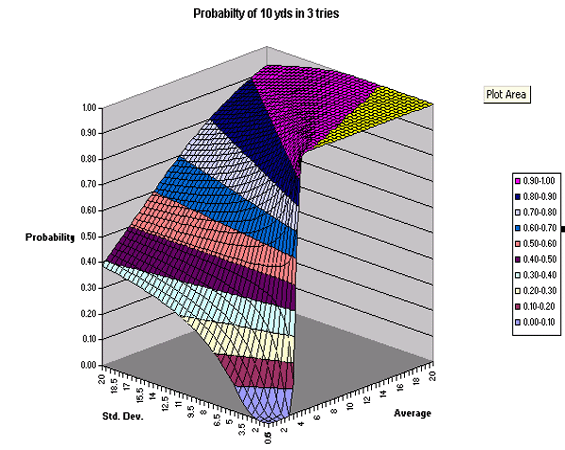
I know this diagram is a bit complicated, but the very steep slope on the right side means that average gain far dominates lower risk when it comes to getting first downs.
The basic gist of this is that in a world without turnovers you would simply try to maximize your average gain per play, and if you could always average more per play by rushing or passing, you would do that (though both rushing and passing have diminishing returns, and at some point you're going to be better off throwing a pass or running even if you hardly ever do it).
In the next section I'll talk about passing's risk per play over rushing, but this is an important conclusion. It implies that if you didn't have to worry about interceptions or turnover risk, then you would not care about run/pass balance at all and you really would just try to maximize your average gain per play whether by running or passing.
(Again, before anyone points out that the rules are different for third downs: I'm well aware, this kind of thinking is mostly for first down and 2nd and 5 and such, which make up the lion's share of all downs actually played. There are only a few third and shorts during a whole season. As I explain in my third Sharpe ratio article, you look at third and fourth downs as success/failure not as gains per play.)
Thus, with the insight that the goal on 1st and (most) 2nd downs should be maximizing average gain per play whether it is from running or passing, I'll turn to the passing premium and turnover risk, or trying to understand how much riskier a pass actually is and how this affects run/pass balance.
The Passing Premium and Turnover Risk
The conclusion that your run/pass mix should be whatever maximizes your average gain per play assumes that runs and passes are equally risky, which of course is not true, as the old adage quoted tells us. But how much riskier are passes, exactly? And what does this say for run/pass balance?
Three things can happen when you pass, and two are bad.
My original run/pass article argued that a football game is a series of Nash Equilibriums: Every down is a little contest and each side must figure out its best strategy using a mixture of runs and passes or different defenses (a "mixed strategy") and should pick the mixture of runs and passes that maximizes (or minimizes, if on defense) average gain per play, subject to the "passing premium," which requires that passes yield more than runs because of their greater risk.
But what is this risk, and how big should the premium be?
Using rough season-long numbers, we saw that Texas Tech and Florida were at about a yard, Southern Cal was a little less, NFL teams average about 2.5 yards, and Minnesota was around 2.25. I argued that Minnesota should have probably passed more, but that was somewhat speculative. To really know we need to better be able to figure out a value for this passing premium. The other problem is it is going to vary team by team, as some teams throw more interceptions than others, etc. Still, the better we understand the risk components the better shot we have.
Again, look at what Henning said:
To run more than 60% of the time will result in low scoring unless we are definitely superior. To pass more than 40% could mean costly losses as the result of failure in pass protection with loss of ball possession and field position due to interceptions.
Henning, at least implicitly, seems to argue that he'd be a lot more comfortable with throwing every down if he never got sacked and never threw interceptions. I think we can go a bit farther and, once we've isolated some of the factors, maybe go back and gather some numbers. I'll label this risk "turnover risk," though it maybe should be called "passing turnover risk minus running turnover risk" as it is the risk of throwing versus running, since the only riskless play has the QB just fall down, and even on that the snap can go wrong.
1. Interception Risk - Per play basis. This article and reader Brad Eccles note that 50 yards per interception could be a decent approximation; so you'd subtract 50 yards from your passing total every time you threw an interception.
2. Fumble Risk - I don't have great data on this, but QBs tend to fumble more than RBs (think about turnover machine Kurt Warner) and receivers are quite vulnerable as well so, a priori, I think there's a greater risk of fumbling on passing plays. [As a coaching point, I always stressed to my QBs to keep both hands on the ball when in the pocket. This makes a huge difference.]
3. Third Down Risk - I think this is the hardest one. As one reader noted, even poor rushing teams are rarely in third and 10, as failed runs usually net at least one or two yards. However, two failed passes in a row (which happens 10-15% of the time even with good passing teams) results in third and 10, which is hard to convert.
For example, if a team has a 65% completion percentage (assuming it stays the same on each down, which I know is somewhat unrealistic), then there is a 12.25% chance that the team will throw two incompletions in a row. If the team has a 55% completion percentage then there is a 20% chance they will wind up in 3rd and 10. This is a very real problem as it can significantly reduce the probability of converting for a first down, as this graph detailing third down efficiency shows:
[Hat tip: MGOBlog]
To properly calculate the risk of failed third downs from a pass attempt on first or second one would have to use the chance of an incompletion along with the reduction in the chance of converting for a first down, and then convert this to a yardage value. I have some ideas how to compute this but I'll save it for another day.
4. Sack Risk - Sack risk has been shown to be somewhat overblown, and its importance depends on down and distance and where the ball is on the field. Still, a sack on third down can (a) see a direct loss of points if it takes one out of field goal range or reduces the chance of converting a field goal, and (b) hurt overall field position, and using some of the analyses that have been done you can hang a point value on the difference between your opponent starting on his 35 and his own 45.
5. Injury Risk - I'm not sure how to quantify this, but in the NFL it might be the dominant reason why the passing premium seems to run higher than in college. Few NFL QBs make it through entire seasons without missing time, and more passes mean more hits which means more injuries. Even if it is not the hits, it could be the chance for injuries from someone rolling over the QB's leg, etc. I do think this of major concern in the NFL, while not as much in High School of College.
6. Uncertainty - I think this is an important one, at times overvalued and other times under valued. While doing some reading several commentators noted that the number of interceptions even NFL QBs threw varied wildly. Also, several teams with high and and seemingly inefficient passing premiums like Texas and Ohio St had QBs who entered the season with question marks about their passing ability. They ended up being more effective and less risky than originally thought (Vince Young lead the nation in pass efficiency) so this could partially explain the outsized passing premium. Compare Brett Favre, whom no one expected to throw 29 interceptions. Green Bay no doubt underestimated turnover risk per pass last season with a future Hall of Famer at QB.
Conclusion
I think these insights are powerful enough to where we can make most, but not all, playcalling decisions with them in mind. As we learn more we can begin approximating or building a model for turnover risk, to more accurately determine what is a sound passing premium per team. Until then, we do know that the most important factors in winning games are turnovers, third down percentage, and average gain per play (and explosive plays and red zone percentage). Taking that into account, on the majority of downs--first and most second downs--coaches should try to maximize their average output, while requiring a high enough passing premium to reward them for the increased risk from throwing the ball.
This is because the data and analysis show that it is average gain, not low standard deviations (like on run plays) that get first downs. However, turnovers and negative plays directly tie into points for the other team. Balance, then is not a matter of how many runs and how many passes, but how good you are at both and making sure you are rewarded for passing's increased risk as this is the way to more first downs, more points, and more wins.
Run/Pass Balance - Response to Comments I
Lots of very good comments, insightful and thought-provoking. Thanks to all who responded to the blog, by email, or otherwise.
Before directly responding, I'll digress for just a moment. The interesting thing to me about football is its complexity. Baseball can essentially be modeled as a two-man game between pitcher and hitter and each's job never really changes throughout the game, it's simpler to identify the key baseball statistics that increase winning--on-base percentage, walks, and others that increase runs scored and decrease runs given up over time.
Football, on the other hand, is full of "noise." Twenty-two players on every play, different strategies, down and distance, leads, and even injury concerns all muddle the analysis. Further, there are only a handful of games each season, so we don't really get a large enough sample to know what works and what doesn't. All is not hopeless though. While baseball can maybe be thought of as a maximization problem for runs with a few variables, football is more like decision theory--many variables, changing circumstances, and lots of uncertainty.
This trait--that football decision-making is overwhelmingly complicated for what is otherwise a very simple game--leads many to throw their hands up and fall back on "common wisdoms" and truisms ("the only stat that matters are wins"). I argue, however, that the correct response is to try to be as objective as possible and get smarter about how you analyze those decisions, and then to use informed judgment. As Charlie Weis says, at some point, play-calling is more art than science, but the best artists have thought it all through.
Lastly, doing the kind of analysis I did in my last article is really just another way to attack the objective/subjective problem in football. Football games are wildly odd events; every single play in a half can be a statistical anamoly, and information is flies at you faster than you can process. Good teams adjust in-game, but the best adjusting teams have already thought of all the scenarios during the week.
In a previous post, I compared Thomas Schelling's work on decision theory to Bill Walsh and his progeny's gameplanning revolution--the real hallmark of the West Coast Offense. Walsh many times has discussed how important it is to make as many decisions as possible in the cool confines of the coaches office in order to be rational and objective rather than subjective and subject to human passions and biases.
The approach I set forth to rethinking balance and average output per play is just an attempt to do the same thing--pursue objectivity--in a different way. I think this idea is best illustrated with an example from New England Patriots coach Bill Belichick. According to several accounts, Belichick realized several rather simple facts. First, winning teams convert their third downs at a rate higher than the NFL average. Second, some teams are consistently better than others. Turning to league data, his own director of research (the fact that the Patriots have one should be a tip-off to the rest of us) and some academic work, he realized that good teams almost exclusively run in short yardage situations. In other words, on the whole, NFL playcallers--the highest paid most experienced coaches in the world--overvalued passing and undervalued running in short yardage situations. Play-callers simply didn't take into account how frequent incompletions were compared to stuffed run plays.
This result is not a total surprise, even from conservative coaches. On 3rd and 1 a QB rolls right, tosses it to the flat to the fullback . . . who drops it. On 4th and short the QB drops back, he has a guy in his face, but the Tight-end is wide open . . . and the ball sails high. Then, on 4th and 1, with the line stacked, the coach calls a dive . . . stuffed. Which one does he receive the media flak for? Criticism from other coaches? Is hardest on himself?
In the first scenario the fullback is the goat (he should have caught it!), on the second the QB (how hard is it to hit the open guy?) or the line (if the guy hadn't gotten through the QB would have thrown it fine), while on the run, it's unimaginative playcalling.
After doing his homework, however, Belichick had no choice but to conclude that all that was subjective bias: The bottom line is that runs work better in those situations, and he's run the ball to being a league leader in those situations over the last several seasons.
This is a perfect example of rethinking the entire approach to a situation in a way supported by theory and data to achieve greater success. Is it revolutionary? Is it upending all football? No of course not. But it was not a widely held belief and despite all the best and most well paid minds in the game preparing every week, he was one of the first to simply stop and say that running the ball simply works better in short yardage than does the pass. My hope is to start down the road of something like this kind of insight regarding our concept of balance on "bread and butter" downs like 1st and 10, 2nd and 5, and the like.
Before directly responding, I'll digress for just a moment. The interesting thing to me about football is its complexity. Baseball can essentially be modeled as a two-man game between pitcher and hitter and each's job never really changes throughout the game, it's simpler to identify the key baseball statistics that increase winning--on-base percentage, walks, and others that increase runs scored and decrease runs given up over time.
Football, on the other hand, is full of "noise." Twenty-two players on every play, different strategies, down and distance, leads, and even injury concerns all muddle the analysis. Further, there are only a handful of games each season, so we don't really get a large enough sample to know what works and what doesn't. All is not hopeless though. While baseball can maybe be thought of as a maximization problem for runs with a few variables, football is more like decision theory--many variables, changing circumstances, and lots of uncertainty.
This trait--that football decision-making is overwhelmingly complicated for what is otherwise a very simple game--leads many to throw their hands up and fall back on "common wisdoms" and truisms ("the only stat that matters are wins"). I argue, however, that the correct response is to try to be as objective as possible and get smarter about how you analyze those decisions, and then to use informed judgment. As Charlie Weis says, at some point, play-calling is more art than science, but the best artists have thought it all through.
Lastly, doing the kind of analysis I did in my last article is really just another way to attack the objective/subjective problem in football. Football games are wildly odd events; every single play in a half can be a statistical anamoly, and information is flies at you faster than you can process. Good teams adjust in-game, but the best adjusting teams have already thought of all the scenarios during the week.
In a previous post, I compared Thomas Schelling's work on decision theory to Bill Walsh and his progeny's gameplanning revolution--the real hallmark of the West Coast Offense. Walsh many times has discussed how important it is to make as many decisions as possible in the cool confines of the coaches office in order to be rational and objective rather than subjective and subject to human passions and biases.
The approach I set forth to rethinking balance and average output per play is just an attempt to do the same thing--pursue objectivity--in a different way. I think this idea is best illustrated with an example from New England Patriots coach Bill Belichick. According to several accounts, Belichick realized several rather simple facts. First, winning teams convert their third downs at a rate higher than the NFL average. Second, some teams are consistently better than others. Turning to league data, his own director of research (the fact that the Patriots have one should be a tip-off to the rest of us) and some academic work, he realized that good teams almost exclusively run in short yardage situations. In other words, on the whole, NFL playcallers--the highest paid most experienced coaches in the world--overvalued passing and undervalued running in short yardage situations. Play-callers simply didn't take into account how frequent incompletions were compared to stuffed run plays.
This result is not a total surprise, even from conservative coaches. On 3rd and 1 a QB rolls right, tosses it to the flat to the fullback . . . who drops it. On 4th and short the QB drops back, he has a guy in his face, but the Tight-end is wide open . . . and the ball sails high. Then, on 4th and 1, with the line stacked, the coach calls a dive . . . stuffed. Which one does he receive the media flak for? Criticism from other coaches? Is hardest on himself?
In the first scenario the fullback is the goat (he should have caught it!), on the second the QB (how hard is it to hit the open guy?) or the line (if the guy hadn't gotten through the QB would have thrown it fine), while on the run, it's unimaginative playcalling.
After doing his homework, however, Belichick had no choice but to conclude that all that was subjective bias: The bottom line is that runs work better in those situations, and he's run the ball to being a league leader in those situations over the last several seasons.
This is a perfect example of rethinking the entire approach to a situation in a way supported by theory and data to achieve greater success. Is it revolutionary? Is it upending all football? No of course not. But it was not a widely held belief and despite all the best and most well paid minds in the game preparing every week, he was one of the first to simply stop and say that running the ball simply works better in short yardage than does the pass. My hope is to start down the road of something like this kind of insight regarding our concept of balance on "bread and butter" downs like 1st and 10, 2nd and 5, and the like.
Monday, May 29, 2006
Packaging Concepts - Using Route Adjustments
In the previous post I discussed how to deal with uncertainty with what your QB will face by putting different "beaters" to each side--Cover 2 and Cover 3, Man or zone. In this one I will show how some advanced passing teams convert actual patterns on the field to fight uncertainty. The simplest and likely best is the middle read, as shown in the linked article on the three-verticals route. Further, coaches want to pare down the conversions to just a few options rather than tell the QB "it could be anything." Typically, teams either rotate their safeties to run Cover 2 and Cover 3, or stick within the coverage "family"--i.e. keeping 1-safety high and running man or zone, or jumping between 2-zone and 4-zone with two safeties "high." The examples below are focused on the most troublesome version, dealing with teams that jump between Cover 2 and Cover 3.
Curl/Corner Read:

The infamous "curl/corner" read, shown above, has been around a long time. Currently, coaches like Charlie Weis, formerly with the Patriots and now with Notre Dame, Petrino at the University of Louisville, and Steve Spurrier have use this a lot. I already diagrammed some of the route's mechanics regarding Spurrier here.
Deep Choice:
An intriguing combination is the "deep choice" which combines a 3-level Cover 3 beater to one side with a Cover 2 beater by letting the slot or tight-end read MOFO/MOFC and run either a corner route or a post. The QB then adjusts his progression depending on MOFO or MOFC.
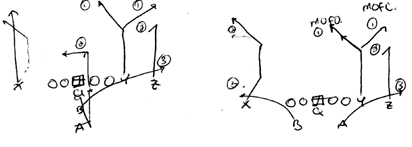
On the right is how Petrino at Louisville uses it, getting a corner/flat read against Cover 2, and on the left is how Weis likes to use it, instead getting a similar effect to the "Texas" concept used by many West Coast offense teams.
Choice Route:
If there is no deep middle safety, the "choice" receiver will plant at 10-12 and drive for the goal post, looking for the ball over his inside shoulder. If there is a deep middle safety, he will stick his inside foot at 10-12 and break for the corner at a depth of 22-25 yards. The outside receiver runs a curl at 12 yards.
Louisville Version:

The Louisville version is the simplest. If the middle of the field is closed (or there is 1-high) the QB will look for the corner first, then the curl, then to the flat to the strongside. The curl will look to slide a bit inside the first flat defender. Basically, if the cornerback retreats with the corner route, then the QB has a simple curl/flat read.
Against MOFO, the QB looks (1) to the deep post route, (2) to the corner route, and (3) to the flat (sometimes it is a hitch route). This is a basic hi/lo read, and he should be able to hit the post or the corner route for a significant gain.
The Weis version:

Against cover 3/MOFC, the route is read exactly the same (1-corner, 2-curl, 3-flat). Against MOFO it becomes like Texas, in that the QB is high/low'ing the Mike or middle linebacker rather than the outside cornerback. The QB looks for the post first: if the Mike squats or does not retreat fast enough, the QB must get it over his head and throw it to the post, splitting the safeties; if Mike drops fast (in the "Tampa 2" defense made popular by Tony Dungy, the Mike linebacker drops back so far and quickly he becomes like a deep middle safety) the QB wants to look for the RB over the middle on either a quick cross or an angle route, as shown above.
If Mike drops deep to cover the post but Sam (strongside outside linebacker) collapses on the RB, then the curl should be open late, as he slides into the QB's vision and the open space.
Conclusion:
While "reading on the fly" appears difficult to do, the routes shown above have only a key or two and have proven to be effective at many levels, including High School. The godfather of all "reading passing games" is of course the run and shoot (see link for details of its routes against different coverages), and while no major college or pro team uses it in its full form, these routes show its lasting impact and that much can be learned from its six or seven basic plays.
Curl/Corner Read:
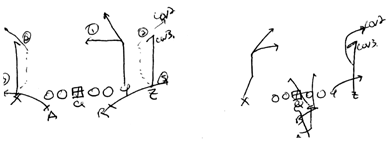
The infamous "curl/corner" read, shown above, has been around a long time. Currently, coaches like Charlie Weis, formerly with the Patriots and now with Notre Dame, Petrino at the University of Louisville, and Steve Spurrier have use this a lot. I already diagrammed some of the route's mechanics regarding Spurrier here.
Deep Choice:
An intriguing combination is the "deep choice" which combines a 3-level Cover 3 beater to one side with a Cover 2 beater by letting the slot or tight-end read MOFO/MOFC and run either a corner route or a post. The QB then adjusts his progression depending on MOFO or MOFC.

On the right is how Petrino at Louisville uses it, getting a corner/flat read against Cover 2, and on the left is how Weis likes to use it, instead getting a similar effect to the "Texas" concept used by many West Coast offense teams.
Choice Route:
If there is no deep middle safety, the "choice" receiver will plant at 10-12 and drive for the goal post, looking for the ball over his inside shoulder. If there is a deep middle safety, he will stick his inside foot at 10-12 and break for the corner at a depth of 22-25 yards. The outside receiver runs a curl at 12 yards.
Louisville Version:
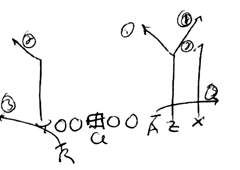
The Louisville version is the simplest. If the middle of the field is closed (or there is 1-high) the QB will look for the corner first, then the curl, then to the flat to the strongside. The curl will look to slide a bit inside the first flat defender. Basically, if the cornerback retreats with the corner route, then the QB has a simple curl/flat read.
Against MOFO, the QB looks (1) to the deep post route, (2) to the corner route, and (3) to the flat (sometimes it is a hitch route). This is a basic hi/lo read, and he should be able to hit the post or the corner route for a significant gain.
The Weis version:
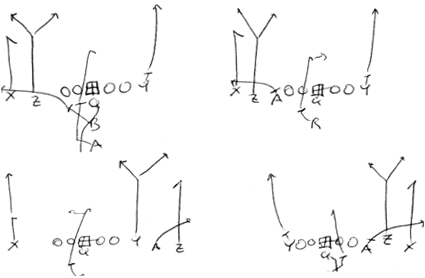
Against cover 3/MOFC, the route is read exactly the same (1-corner, 2-curl, 3-flat). Against MOFO it becomes like Texas, in that the QB is high/low'ing the Mike or middle linebacker rather than the outside cornerback. The QB looks for the post first: if the Mike squats or does not retreat fast enough, the QB must get it over his head and throw it to the post, splitting the safeties; if Mike drops fast (in the "Tampa 2" defense made popular by Tony Dungy, the Mike linebacker drops back so far and quickly he becomes like a deep middle safety) the QB wants to look for the RB over the middle on either a quick cross or an angle route, as shown above.
If Mike drops deep to cover the post but Sam (strongside outside linebacker) collapses on the RB, then the curl should be open late, as he slides into the QB's vision and the open space.
Conclusion:
While "reading on the fly" appears difficult to do, the routes shown above have only a key or two and have proven to be effective at many levels, including High School. The godfather of all "reading passing games" is of course the run and shoot (see link for details of its routes against different coverages), and while no major college or pro team uses it in its full form, these routes show its lasting impact and that much can be learned from its six or seven basic plays.
Packaging Concepts - Putting "Beaters" to Each Side
No, not a reference to those ubiquitous white undershirts, I'm referring to "coverage beaters." Uncertainty is a permanent part of playcalling. Even at the Pros, where they have cameras, computers, and all the best playcallers with natural "feel," no one really knows what is coming next, becauseyou're calling plays against a person, not a computer or a fixed game with certain rules. As Norm Chow has said, a playcaller might look smart in the booth, but he really doesn't know what the other team is going to do, and very often doesn't even know "what the other team just did or is doing." Unfortunately coaches, not only don't you know exactly what is going on, but you have a kid, 16-18 years old, maybe 20-22, whose job it is to figure out what they are doing and make you look smart-- in less than two seconds--while someone tries to remove his jawbone every play.
One of the simplest and best ways to have a good passing attack under uncertainty is to "package" passes to each side of the formation and give the QB a simple "key," which tells him which progression to use. The simplest keys are:
(1) MOFO/MOFC (Middle of the field Open, or closed? I.e. is there a single deep safety down the middle?)
(2) 2-high, 1-high, or none-high (Basically the same as MOFO/MOFC, a simple way to determine coverages); or
(3) the movement/rotation of one defender (usually free safety, strong safety, or middle linebacker).
Then, the QB just goes through his progression of 1, 2, 3 after this. I'll save the mechanics of progression reads for another time, suffice to say that the QB "looks through the window," and basically looks where the receiver is supposed to be, and asks if he has a clear lane to throw him the ball. If not, he moves on to the next receiver.
Basic Concept:
The easiest way to do this is as below, as shown from a balanced 4-wide formation and simple 3-step passing routes like hitches, slants, and speed/outs. For example:
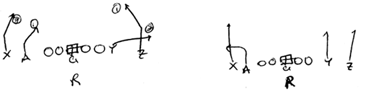
The pattern on the left is a great combination. The double slants is very good versus 2-deep 5-under zones, and the slant/shoot is effective vs. 3-deep 4-under zones. Also, typically 3-deep zones play "off" and 2-deep zones play press, so you can pick and choose what "key" to give your quarterback, but they all end up being the same: you want slant/shoot vs. Cover 3; double-slant vs. Cover 2.
Some teams say "If MOFO, work double-slants, if MOFC, work slant/shoot," while others say "Vs. 2-high, double slants; vs. 1-high work slant/shoot." Finally, some even say: "if press, then..." you get the idea. Any of these "keys" will work. It is probably best to figure out which one is the most versatile for what you're doing and do that the most, so your QB is comfortable for it.
Again, the idea is on the blackboard we want one versus "Cover 2" and another vs. "Cover 3" but first, this is a simple way to determine those coverages, since you can't see all eleven defenders, and second, these keys often simplify "cosmetic" changes, i.e. ones where guys switch assignments or do things to trick you, as they reduce a coverage to its simplest terms: how many guys are deep?
The diagram on the right combines the fade/out and double-hitch combination. Again we have options vs Cover 2 (fade/out) and Cover 3 (double-hitch) but more importantly we have a good pass vs. soft (hitches) and press man (fade/out). So now we turn to some of the mechanics for these "keys."
Mechanics of Reading Keys:
The QB checks his keys pre- and post-snap.Pre-snap, he scans left to right the defense and coverage. If his key is MOFO/MOFC, he looks down the middle of the field. Is someone standing deep in the middle? Are there two safeties on the hashes? Are the safeties moving? Is no one deeper than 7 yards? (Blitz!)
At the snap, he looks for "post-snap confirmation." Basically, did what looked like MOFO/Cover 2 turn into MOFC? Commonly, a safety deep on each hash will rotate to the same side--one safety runs to the deep middle, while the other comes up to guard the flat, an inside zone, becomes a "robber" (roving pass defender reading the QB's eyes), will cover a slot receiver man while another defender blitzes, or blitz.
One advantage to keeping your quarterback under center versus the shotgun is he can keep his eyes downfield from the snap without having to look at the ball to catch the snap as in shotgun. Thus, he is less likely to miss something. Particularly for 3-step passing. In the shotgun the quarterback must rely on his pre-snap read, as he does not have time "confirm" after getting the snap, and must begin his progression. In major college football, the best 3-step passing team has been USC, who almost exclusively throws from under center. On the other hand, the best 3-step passing team of the last 9-10 years has been Purdue, who throws 3-step from the shotgun quite a bit, so it can be done and done well.
I prefer to use MOFO/MOFC and 1-high/2-high as much as possible as my keys, rather than press/non-press or certain other ones, because of the mechanics: I like having the QB look down the middle of the field after the snap because (a) it does not give away which side the QB is looking for right away, as we always teach him to look down the middle when he begins his drop, and (2) it is easier and more obvious and often more telling--sometimes individual defenders "do their own thing" and aren't much help in determining what the other 10 guys are doing, and the difference between "press" and "soft" or sometimes even "man or zone" is often subtle and difficult to gauge in 1.5 seconds. Conversely, 2-high or MOFO is usually easier to see, and is thus preferable. Nevertheless, each key has strengths weaknesses and some fit better for different situations.
Other examples -- Man and Zone Beaters:
The 3-step game and the spread is the ideal setup for this concept. In fact, I really do not like to run too many "drop-back" passes from spread formations for protection reasons, but you can pick a defense apart if you can throw quicks vs Cover 2 or 3 to the outside and be able to run the ball inside in the spread. Below are a couple simple examples for dropback passing.
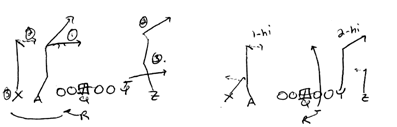
Besides Cover 2 and Cover 3 beaters, the most useful, to me, is packaging man and zone beaters together. Below are my two favorite versions: stick and double slants, and shallow/curl and a zone-beater backside. These are shown below:
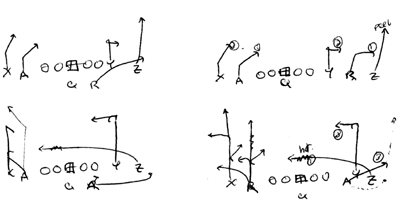
On the top, if the QB sees zone (we can use motion, gameplan, or other keys to determine this) he wants to work the stick, reading flat to stick route. Against man or some kind of weak-blitz, he wants to throw the double slants.
For the patterns below, if he reads man he reads 1-shallow, 2-curl, 3-swing route. Vs. a zone he works the zone beater, such as curl/flat, smash, post/curl, or a 3-step combation. Most of the best passing teams can do this quite a bit and are very good at reading keys and going through the simple progressions. Notice how quick these passes get out--they are designed with the blitz in mind.
One of the simplest and best ways to have a good passing attack under uncertainty is to "package" passes to each side of the formation and give the QB a simple "key," which tells him which progression to use. The simplest keys are:
(1) MOFO/MOFC (Middle of the field Open, or closed? I.e. is there a single deep safety down the middle?)
(2) 2-high, 1-high, or none-high (Basically the same as MOFO/MOFC, a simple way to determine coverages); or
(3) the movement/rotation of one defender (usually free safety, strong safety, or middle linebacker).
Then, the QB just goes through his progression of 1, 2, 3 after this. I'll save the mechanics of progression reads for another time, suffice to say that the QB "looks through the window," and basically looks where the receiver is supposed to be, and asks if he has a clear lane to throw him the ball. If not, he moves on to the next receiver.
Basic Concept:
The easiest way to do this is as below, as shown from a balanced 4-wide formation and simple 3-step passing routes like hitches, slants, and speed/outs. For example:
The pattern on the left is a great combination. The double slants is very good versus 2-deep 5-under zones, and the slant/shoot is effective vs. 3-deep 4-under zones. Also, typically 3-deep zones play "off" and 2-deep zones play press, so you can pick and choose what "key" to give your quarterback, but they all end up being the same: you want slant/shoot vs. Cover 3; double-slant vs. Cover 2.
Some teams say "If MOFO, work double-slants, if MOFC, work slant/shoot," while others say "Vs. 2-high, double slants; vs. 1-high work slant/shoot." Finally, some even say: "if press, then..." you get the idea. Any of these "keys" will work. It is probably best to figure out which one is the most versatile for what you're doing and do that the most, so your QB is comfortable for it.
Again, the idea is on the blackboard we want one versus "Cover 2" and another vs. "Cover 3" but first, this is a simple way to determine those coverages, since you can't see all eleven defenders, and second, these keys often simplify "cosmetic" changes, i.e. ones where guys switch assignments or do things to trick you, as they reduce a coverage to its simplest terms: how many guys are deep?
The diagram on the right combines the fade/out and double-hitch combination. Again we have options vs Cover 2 (fade/out) and Cover 3 (double-hitch) but more importantly we have a good pass vs. soft (hitches) and press man (fade/out). So now we turn to some of the mechanics for these "keys."
Mechanics of Reading Keys:
The QB checks his keys pre- and post-snap.Pre-snap, he scans left to right the defense and coverage. If his key is MOFO/MOFC, he looks down the middle of the field. Is someone standing deep in the middle? Are there two safeties on the hashes? Are the safeties moving? Is no one deeper than 7 yards? (Blitz!)
At the snap, he looks for "post-snap confirmation." Basically, did what looked like MOFO/Cover 2 turn into MOFC? Commonly, a safety deep on each hash will rotate to the same side--one safety runs to the deep middle, while the other comes up to guard the flat, an inside zone, becomes a "robber" (roving pass defender reading the QB's eyes), will cover a slot receiver man while another defender blitzes, or blitz.
One advantage to keeping your quarterback under center versus the shotgun is he can keep his eyes downfield from the snap without having to look at the ball to catch the snap as in shotgun. Thus, he is less likely to miss something. Particularly for 3-step passing. In the shotgun the quarterback must rely on his pre-snap read, as he does not have time "confirm" after getting the snap, and must begin his progression. In major college football, the best 3-step passing team has been USC, who almost exclusively throws from under center. On the other hand, the best 3-step passing team of the last 9-10 years has been Purdue, who throws 3-step from the shotgun quite a bit, so it can be done and done well.
I prefer to use MOFO/MOFC and 1-high/2-high as much as possible as my keys, rather than press/non-press or certain other ones, because of the mechanics: I like having the QB look down the middle of the field after the snap because (a) it does not give away which side the QB is looking for right away, as we always teach him to look down the middle when he begins his drop, and (2) it is easier and more obvious and often more telling--sometimes individual defenders "do their own thing" and aren't much help in determining what the other 10 guys are doing, and the difference between "press" and "soft" or sometimes even "man or zone" is often subtle and difficult to gauge in 1.5 seconds. Conversely, 2-high or MOFO is usually easier to see, and is thus preferable. Nevertheless, each key has strengths weaknesses and some fit better for different situations.
Other examples -- Man and Zone Beaters:
The 3-step game and the spread is the ideal setup for this concept. In fact, I really do not like to run too many "drop-back" passes from spread formations for protection reasons, but you can pick a defense apart if you can throw quicks vs Cover 2 or 3 to the outside and be able to run the ball inside in the spread. Below are a couple simple examples for dropback passing.
Besides Cover 2 and Cover 3 beaters, the most useful, to me, is packaging man and zone beaters together. Below are my two favorite versions: stick and double slants, and shallow/curl and a zone-beater backside. These are shown below:
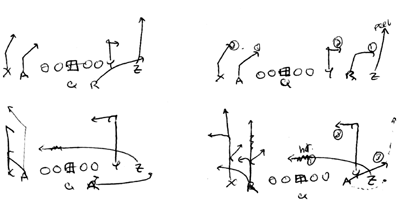
On the top, if the QB sees zone (we can use motion, gameplan, or other keys to determine this) he wants to work the stick, reading flat to stick route. Against man or some kind of weak-blitz, he wants to throw the double slants.
For the patterns below, if he reads man he reads 1-shallow, 2-curl, 3-swing route. Vs. a zone he works the zone beater, such as curl/flat, smash, post/curl, or a 3-step combation. Most of the best passing teams can do this quite a bit and are very good at reading keys and going through the simple progressions. Notice how quick these passes get out--they are designed with the blitz in mind.
Thursday, March 16, 2006
How many concepts do you need in your passing game?
First, I apologize about posting infrequently. I promise to do better; I even have some good material saved up and in the planning phase. Onward.
Inspired by this thread from the Coach Huey X and O Board. Further, if you want to bone up on my specific definitions of concepts, check out this article.
Framing the Question:
"How much offense" and "How much passing" is a common question. I'll let others give their hard and fast answers. I think more interesting is how do you think about this question? Certainly over the course of many seasons one naturally may find out some equilibrium amount of offense, but most of our jobs do not have the security necessary to blindly experiment.
There are several questions you must ask when talking about "more or fewer" passing concepts.
1. How much will you put the ball in the air?
2. How many kinds of passing actions will you use?
3. How many concepts or schemes do you need under each?
How much do you want to put the ball in the air?
The first is the most important question. This is often a function of talent as much as anything else. To simplify, let's assume (I know unrealistically, but just for discussion) that you would always throw more if your talent could handle it. To me, the important question is not how good your receivers are. They are a concern, but more important by far is:
(a) how good are you at protecting your QB? (O-Line talent/technique)your ability to protect your QB (o-line), and
(b) Your QB's ability to read defenses and issues of accuracy, timing, and arm strength.
Thus, Receivers are a secondary question. Typically, if you can protect and have a good QB, receivers will take care of themselves. If you have gamebreakers on the outside but cannot handle much of the 5-step stuff, then you still can work to get the ball to them on screens, quicks, etc.
This is important because you do not want to practice and do not want to waste time installing what you won't run. So before you know "how much 5-step" or "how many concepts" you need to know how much you'll be putting the ball in the air, since the #1 rule of offense organizationis to not practice what you don't use and do practice what you do run, regardless of what you carry in your playbook.
How many kinds of passing actions will you use?
The second question is what kinds of passing actions. Are you a dropback team with draws and screens as your counters (Airraid/Texas Tech/Hal Mumme style), or more action passes, boots and sprint outs (spread teams, some run-oriented team), or maybe just a few pop passes and quicks from your veer sets. This depends on your types of talent and what will be your staple runs, etc. QB factors are key, like height, footspeed, comfortability out of the pocket, etc.
How many concepts or schemes do you need under each?
Finally, you've got some kind of rough breakdown of what will be your strengths. Week to week it will vary based on defense and opponents' weaknesses. (Since pre-season you look at your absolute abilities, but for a given opponent it is all about comparative advantages against your opponents. For example, you might be the worst running team in your district, but your opponent has an even worse rush defense and is geared for your pass, thus you beat them by running the ball. This little sidenote is too broad to explore here.) Anyway, over time this breakdown should correlate with what your strengths are. So let's say you're a 50% passing team, with about 40% of your passes being quick 3-step, 40% play action or sprint outs and bootlegs, and 20% 5-step passes. You can assume somewhere like 50 plays a game.
This means you're only going to throw 5-step passes about FIVE times a game (50% of your plays = 25, 20% of this = 5). You certainly don't need more than five 5-step concepts for a given game since you don't want to practice passes you won't run. More like you only need two or three at most.
This is important to help you frame your offense. The last few seasons I've thrown it around 25 times a game, with between 12-17 per game being 5-step straight dropback concepts (partially because my base play action are my same 5-step concepts). Since this is a big chunk of my offense and constituted an even bigger chunk of my yardage total I run more concepts than many, but these numbers still only justify six or so concepts. This still only leaves passes being run two or at most three times.
What about colleges and other passing teams?
It's helpful to think of the Airraid guys, they purportedly run about seven or eight, but really more like 12-15 concepts (often gloss over the basic concepts that they do run). Looking at Texas Tech with Mike Leach, who throws 55-60 times a game, still has a similar ratio of running each play 3-4 times. So by that math, about 3.5 pass attempts for every one pass concept, if you throw it 25 times you should only have SEVEN total passes, including boots, 3-step, and 5-step.
By that logic I run way too many concepts. So, the short answer if you're extrapolating from Texas Tech, less is probably more. The R&S guys have like five passes. Of course, each R&S package is like 4 or 5 plays; each Tech play is just one.
Conclusion
If you work backwards from your ability to protect and ability to throw, next to the types of throws that will work, then when you have a rough idea of how much you'll throw the ball and how many times you'll run boot and how many times you'll drop back for 5-step, you can then use a ratio of 2-3 attempts for every one pass play as a metric to give some guidance.
Note: The 2-3 times is over a season. For example if you play a Cover 2 team, you'll throw smash, 3-verticals, and double slants maybe 4 times each in a game and Curl/flat and all-hitch almost never. Then versus a Cover 1 and Cover 0 man and blitzing team, you'll run mesh 4-6 times that game, and then versus a zone team you'll only use it a few times. So it's not a hard and fast rule that you'll run each concept 2-3 times each game, just over time.
Further, this too is better suited to its own discussion, but the other concern when answering the question "How many pass concepts do I need?" is you need answers to everything you are likely to face. You typically need a Cover 3 beater, a Cover 2 beater, and a Cover 4 beater, some man beaters (2 and 1) and some anti-blitz (both screens and upfield "take-a-shot" passes).
Lastly, my two favorite pass plays are absolutely integral: draw and screen. Find any way you can to run them.
---------------------
ADDENDUM:
Right after posting I went to the Jerry Campbell football message board and came across this thread. Jerry Easton, Bill Mountjoy and others type out their response to the question "How much do you need in your passing game?" Since I gave the theoretical answer below, I figured I'd paste what Bill Mountjoy says he ACTUALLY does (at the High School level). Visit the thread (and contribute to the comments here or any of the two threads) if you want more.
Inspired by this thread from the Coach Huey X and O Board. Further, if you want to bone up on my specific definitions of concepts, check out this article.
Framing the Question:
"How much offense" and "How much passing" is a common question. I'll let others give their hard and fast answers. I think more interesting is how do you think about this question? Certainly over the course of many seasons one naturally may find out some equilibrium amount of offense, but most of our jobs do not have the security necessary to blindly experiment.
There are several questions you must ask when talking about "more or fewer" passing concepts.
1. How much will you put the ball in the air?
2. How many kinds of passing actions will you use?
3. How many concepts or schemes do you need under each?
How much do you want to put the ball in the air?
The first is the most important question. This is often a function of talent as much as anything else. To simplify, let's assume (I know unrealistically, but just for discussion) that you would always throw more if your talent could handle it. To me, the important question is not how good your receivers are. They are a concern, but more important by far is:
(a) how good are you at protecting your QB? (O-Line talent/technique)your ability to protect your QB (o-line), and
(b) Your QB's ability to read defenses and issues of accuracy, timing, and arm strength.
Thus, Receivers are a secondary question. Typically, if you can protect and have a good QB, receivers will take care of themselves. If you have gamebreakers on the outside but cannot handle much of the 5-step stuff, then you still can work to get the ball to them on screens, quicks, etc.
This is important because you do not want to practice and do not want to waste time installing what you won't run. So before you know "how much 5-step" or "how many concepts" you need to know how much you'll be putting the ball in the air, since the #1 rule of offense organizationis to not practice what you don't use and do practice what you do run, regardless of what you carry in your playbook.
How many kinds of passing actions will you use?
The second question is what kinds of passing actions. Are you a dropback team with draws and screens as your counters (Airraid/Texas Tech/Hal Mumme style), or more action passes, boots and sprint outs (spread teams, some run-oriented team), or maybe just a few pop passes and quicks from your veer sets. This depends on your types of talent and what will be your staple runs, etc. QB factors are key, like height, footspeed, comfortability out of the pocket, etc.
How many concepts or schemes do you need under each?
Finally, you've got some kind of rough breakdown of what will be your strengths. Week to week it will vary based on defense and opponents' weaknesses. (Since pre-season you look at your absolute abilities, but for a given opponent it is all about comparative advantages against your opponents. For example, you might be the worst running team in your district, but your opponent has an even worse rush defense and is geared for your pass, thus you beat them by running the ball. This little sidenote is too broad to explore here.) Anyway, over time this breakdown should correlate with what your strengths are. So let's say you're a 50% passing team, with about 40% of your passes being quick 3-step, 40% play action or sprint outs and bootlegs, and 20% 5-step passes. You can assume somewhere like 50 plays a game.
This means you're only going to throw 5-step passes about FIVE times a game (50% of your plays = 25, 20% of this = 5). You certainly don't need more than five 5-step concepts for a given game since you don't want to practice passes you won't run. More like you only need two or three at most.
This is important to help you frame your offense. The last few seasons I've thrown it around 25 times a game, with between 12-17 per game being 5-step straight dropback concepts (partially because my base play action are my same 5-step concepts). Since this is a big chunk of my offense and constituted an even bigger chunk of my yardage total I run more concepts than many, but these numbers still only justify six or so concepts. This still only leaves passes being run two or at most three times.
What about colleges and other passing teams?
It's helpful to think of the Airraid guys, they purportedly run about seven or eight, but really more like 12-15 concepts (often gloss over the basic concepts that they do run). Looking at Texas Tech with Mike Leach, who throws 55-60 times a game, still has a similar ratio of running each play 3-4 times. So by that math, about 3.5 pass attempts for every one pass concept, if you throw it 25 times you should only have SEVEN total passes, including boots, 3-step, and 5-step.
By that logic I run way too many concepts. So, the short answer if you're extrapolating from Texas Tech, less is probably more. The R&S guys have like five passes. Of course, each R&S package is like 4 or 5 plays; each Tech play is just one.
Conclusion
If you work backwards from your ability to protect and ability to throw, next to the types of throws that will work, then when you have a rough idea of how much you'll throw the ball and how many times you'll run boot and how many times you'll drop back for 5-step, you can then use a ratio of 2-3 attempts for every one pass play as a metric to give some guidance.
Note: The 2-3 times is over a season. For example if you play a Cover 2 team, you'll throw smash, 3-verticals, and double slants maybe 4 times each in a game and Curl/flat and all-hitch almost never. Then versus a Cover 1 and Cover 0 man and blitzing team, you'll run mesh 4-6 times that game, and then versus a zone team you'll only use it a few times. So it's not a hard and fast rule that you'll run each concept 2-3 times each game, just over time.
Further, this too is better suited to its own discussion, but the other concern when answering the question "How many pass concepts do I need?" is you need answers to everything you are likely to face. You typically need a Cover 3 beater, a Cover 2 beater, and a Cover 4 beater, some man beaters (2 and 1) and some anti-blitz (both screens and upfield "take-a-shot" passes).
Lastly, my two favorite pass plays are absolutely integral: draw and screen. Find any way you can to run them.
---------------------
ADDENDUM:
Right after posting I went to the Jerry Campbell football message board and came across this thread. Jerry Easton, Bill Mountjoy and others type out their response to the question "How much do you need in your passing game?" Since I gave the theoretical answer below, I figured I'd paste what Bill Mountjoy says he ACTUALLY does (at the High School level). Visit the thread (and contribute to the comments here or any of the two threads) if you want more.
BASE DROPBACK PASS SYSTEM:
PERSONNEL GROUPINGS = 2 TE/2 WR/1 RB, AND, 1 TE/3 WR/1 RB (both from 2x2 & 3x1 configurations):
1. 2 PASS PROTECTIONS at most (7 man pro = 3 free releases & 2 check releases; AND, 8 man pro = 2 free releases & 3 check releases) = a BASE/BOB type, & a TURNBACK type.
2. 3 THREE STEP dropback passes (I.E.: "HITCH"/"FADE"/"SLANT")
3. 5 FIVE STEP dropback passes (I.E.: "SMASH"/"CURL-FLAT"/"DOUBLE OUTS"/"POST"/"POST/CORNER")
4. "TAGS" off of the above for variety (can vary greatly as needed)
5. At least 1 SCREEN, & 1 DRAW.
6. Be able to handle: BLITZ-MAN/3 DEEP/2 DEEP (I KNOW there is more - but it all boils down to THIS).
7. QUALITY (execution) of the above = more important than MORE quantity!
8. SIMPLE READ CONCEPTS FOR QB (based upon "progressions of reveivers):
----A) INSIDE/OUT HORIZONTAL STRETCH (3 vs 2 or 2 vs 1) WORK 1/2 of field horizontally.
----B) OUTSIDE/IN HORIZIONTAL STRETCH (3 vs 2 or 2 vs 1) WORK 1/2 of field horizontally.
----C) LONG TO SHORT VERTICAL STRETCH (3 vs 2 or 2 vs 1) WORK 1/3 of field vertically.
----D) OBJECT RECEIVER READ (looking for a specific receiver for a specific reason).
9. PHILOSOPHY VS BLITZ IMPORTANT (BELOW):
A) Our philosophy vs the blitz are to call plays in one of two categories that are good vs. either:
1. BLITZ MAN, AND COVER 2 (MOFO), OR
2. BLITZ MAN, AND COVER 3 (MOFC).
B) WE DO NOT AUDIBLE TO DIFFERENT PROTECTIONS BECAUSE:
1. NEVER KNOW WHEN THEY ARE GOING TO COME (CAN BLUFF BLITZ & BACK OUT TO ZONE OR, THEY MAY COME).
2. QB NOT ALWAYS EQUIPPED TO SEE IT THE WAY YOU WANT HIM TO.
3. NOT ENOUGH GAME CLOCK TO AUDIBLE.
4. THEREFORE, WE NEED CALLS THAT ARE GOOD VS EVERYTHING.
5. USE 2 PLAY HUDDLE CALLS, OR “CHECK WITH ME AT THE LINE” – PLAYS THAT DO NOT CHANGE THE PROTECTION CALLED IN THE HUDDLE. THEY FIT INTO ONE OF THE CATEGORIES IN A) ABOVE.
C) AVOID “HOTS” BY USING 7 OR 8 MAN PROTECTION (BE SIMPLE ATTACKING BLITZ SO WE CAN SPEND MORE TIME ON GOOD FUNDAMENTALS – THIS LEADS TO BETTER EXECUTION). REASONS WE DON’T USE “HOT” RECEIVER(S):
1. QB DOESN’T SEE IT – HE GETS HIT!
2. QB SEES IT BUT RECEIVER DOESN’T!
D) MENTAL APPROACH VS BLITZ:
1. NOT “OH, NO – THEY’RE GOING TO BLITZ – I’M GOING TO GET HIT”, BUT:
2. “OH BOY” – IT’S A BLITZ – WE HAVE A CHANCE FOR A BIG PLAY”!!!
SUMMARY: “KISS” (KEEP IT SIMPLE – THE MORE EFFICIENT YOU ARE, THE MORE YOU MOVE THE CHAINS AND SCORE POINTS)!
Subscribe to:
Posts (Atom)

 Posts
Posts


