1. Not a good time to be a Ref
Two rather dramatic referee videos emerging from this weekend. In the first, some kid in a high school game targeted the Ref (watch the left free-safety):
In the second, from the Rams-Seakaws game, the Refs get a little revenge:
2. Why Oh Why Can't We Get a Better [Football] Press Corps?
I stole this line from economist Brad DeLong, and I plan on doing a few more of these sections to point out some of the more egregious errors sportswriters and pseudo-journalists make. This isn't the worst example, but I was watching ESPN's infamous NFL Countdown show with Chris Berman, Tom Jackson, and the revolving array of NFL cast-offs. They did a piece about injuries, which was fine and all: the moral was that NFL players all play fairly banged up throughout the season. Not a surprise. But throughout the 10 minute or so segment, they never bothered to get into the nuances (unsurprising). But one thing they were interested in was comparing some guys who were tough versus others who were not. (Keyshawn Johnson flat out said that Julius Jones spent all his time in the training room.)
In Bill Walsh's amazing book, Finding the Winning Edge, he had some really insightful points about injuries. Namely, that different positions can handle injuries different. Walsh observed that offensive and defensive linemen tend to be able to play through certain injuries with greater ease, than, say, a defensive back.
For instance, imagine if two players have a gimpy or somewhat sprained ankle. The offensive guard, though it is by no means easy, can play through it. But would you really want your press-man cornerback to play with a sprained ankle? One bad step or slow recovery and it's a touchdown. The injury is far more debilitating. Walsh made the same point regarding receivers: they have difficulty playing through injuries for the same reason that a track sprinter would. Quarterbacks provide a good example, in that they can play through a lot of injuries but certain injuries -- to the shoulder, hand, etc -- are debilitating and can often render a QB inoperable.
Runningbacks are a unique case. It often depends on the type of runner and the type of injury. An injury affecting explosiveness is significant no matter what; other bruises and various other problems might not have as much of an affect. Even hand injuries can depend on the type of running back -- is he a prominent receiver out of the backfield?
But, alas, not a mention of this. Just "this guy is tough" and "that guy spends a lot of time in the tub."
Monday, December 22, 2008


Sunday, December 14, 2008
Smart Notes - December 14, 2008
1. Tom Osborne: Enough Spread, Let's See Some Option
 Tom Osborne recently opined on the state of football offenses. And keep in mind that, not only did the guy win multiple championships at Nebraska, his offenses also scored points. Indeed, while much has deservedly been made of Oklahoma's terrific multiple pro-style up-tempo offense, in 1995 it was Nebraska who averaged over 52 points a game en route to a title. Including OU this year, only five teams have averaged over fifty points a game for a season since 1945. So Osborne has a unique perspective on football offenses, the spread, and what could be next.
A few points. First, Osborne's description of the spread belies some of the ambiguity behind the term -- he likely has not read my most recent piece on it -- and it's obviously a truism that you can no longer get the advantage of being different if you're doing what everyone else is. Second, Osborne is absolutely right that there are huge advantages to be had by running something that your opponents only see once a year. At one time, this was the spread. Now of course, that's no longer the case.
That point can't be overemphasized though. Every offensive scheme must be able to do a few things: must have ways to get the ball to your playmakers; must be able to get the ball to different guys when the defense wants to take your best players away; must have schemes and counters that attack the defenses you will see, both in terms of fronts and coverages; and it must be able to do all those things without overwhelming your players with information. Easier said than done. It's an added, but not necessary perk if your opponents are not used to seeing it.
And Johnson, at Georgia Tech, has a special perk with his flexbone: normally, if you do something your opponents are not used to seeing, then you too are not overly familiar with it. That is how it was with the early spread teams. Johnson, by contrast, has used his offense for decades and knows all the adjustments and changes. When Georgia Tech ran all over Miami and Georgia, a lot of it came in the second half. Often, it seemed like the defense had two guys defending, say, the pitch guy, or the quarterback, and none on the guy who wound up running for a forty-yard run. The reason for that was because Johnson knows how to vary his blocking and assignments to take away the guy responsible for those players. So when announcers like to say that you play "assignment" football to stop the option that is only partially true. If you do, Johnson figures out who is "assigned" to his guys and blocks them, and then lets the reads take care of themselves. So this is where execution and soundness of an offense meet uniqueness.
But my last point is that I'm not sure if Osborne's narrative is exactly right. It's true that, to some extent, football is cyclical. But it's not exactly cyclical. Defenses do not completely forget; with the internet, they absolutely cannot forget: the answers are all out there. The single-wing stuff is back, but it's also different. In the old-old days, the centers who did the shotgun snaps did not really know how to snap the ball with their heads up, so they were ineffective blockers. So now, with the wildcat and other single-wing variants, the center is now an equally effective blocker.
But the meta-narrative here is passing. Again, this point can be overstated, as passing was not invented in the last two decades (Joe Namath had a 4,000 yard season with the Jets), but there's clearly been a synthesis. I think that it will be unlikely that teams will be completely unable to throw -- or run -- with consistent success. Now, that does not mean the type of "balance" usually spewed on TV (equal carries, equal yards, etc) as I have well documented that the better approach to balance is a somewhat game-theoretic one. But both Florida's and OU's offenses are examples of ones where they use advanced and time-tested concepts -- spread, play-action, quicks, multiple-formations, etc -- to put maximum pressure on the defense. As a football pragmatist, I think that these types of offenses will continue to set the standard. Unlike Osborne, I think using what once was, alone, will not work, without the added ability to pass or evolve.
2. Malcolm Gladwell's "Quarterback Problem"
The famous (or infamous) Malcolm Gladwell, author of Blink, The Tipping Point, and now Outliers, has a very interesting new essay in the New Yorker. The point of the article is about how we could be better at selecting teachers, because we now know that being a good teacher is all about making a connection with kids (who are not always easy to read) and these are skills not easily taught, evaluated, or identified. To illustrate the problem of identifying good future teachers he uses the problem of identifying successful NFL quarterbacks, focusing on a scout's attempt to evaluate Mizzou's Chase Daniel.
Now Gladwell's explanation is likely imperfect (he clearly has not read my articles, particularly when he talks about the "spread" that Mizzou runs), though it hits at the general truth: the only way to evaluate how good a quarterback will be in the NFL is to see them play in the NFL. And even then sometimes the light just goes on for certain guys after a period of mediocrity. It's just so hard to say. With baseball, as Moneyball showed, you can model the game to at least tell you a great deal of what you need to know. It's a game largely about hitters and pitchers. We may not know everything, but it gets us far to the end. But football is too complex. Players can't be evaluated solely on statistics. And the traditional scouting method, some kind of gestalt impression where you say "ah he looks good" has been proven unreliable.
We know that Peyton Manning and Ryan Leaf were seen as the undoubted 1-2 picks. Many liked Leaf better. We know Leaf completely failed while Manning has had remarkable success. Do we even know why, exactly though? A fair but unscientific pop psychology hypothesis is that Leaf was too mentally unstable: he had all the physical tools but few of the emotional and mental ones. But isn't it obvious that NFL quarterback is only a partially physical game? I always thought of evaluating quarterbacks as a threshold approach: the guy has to be able to do certain things, to make certain throws, but after that, the physical qualities diminish. Whether a guy throws a deep out with "zip" or as a "laser" is irrelevant if he lacks knowledge, awareness, and a sense of timing.
And do we even know if that hypothesis was right? What about those five guys from 1999? How do you explain Akili Smith and Cade McNown who were apparently dead on arrival? Tim Couch seemed to just fumble through mediocrity into eventual oblivion, but those two guys were right there and had unbelievably short careers. Physical? Mental? Mental in what sense? Couldn't learn the playbook? Couldn't handle the pressure? No timing? No support from teammates? I haven't a clue. I don't know how you glean lessons from those evaluation failures.
Indeed, as we have seen with guys like Brad Johnson or Matt Cassell, apparently playing in college is not even as important as some other, less tangible, factors. As Gladwell points out:
Eventually, I suppose, scouting will finally more approximate a science. But right now, we know, that scouts and NFL teams literally do not know what they are doing when they throw money at guys. Matt Ryan and Joe Flacco look excellent, but they just as likely could have been Ryan Leaf or Cade McNown. This year Green Bay drafted Brian Brohm from Louisville early in the draft and Matt Flynn from LSU in the seventh round. Right now, Matt Flynn is ahead of Brohm on the depth chart: he just beat him out in camp and pre-season. No one could have foreseen that until they all got there. Brohm will be fine, but the Packers both were hurt and helped by their own incompetence at evaluating quarterbacks: they seem to have overvalued Brohm and everyone else undervalued Flynn.
UPDATES: 3. Florida Cut-Ups
Someone passed along some Florida TV cut-ups, broken down by concept. (Again, no blame for music selection.)
4. Pete Carroll - 60 Minutes
Not much to say about this, except that it is inspiring to a nearly unbelievable degree. Do yourself a favor and watch it.
 Tom Osborne recently opined on the state of football offenses. And keep in mind that, not only did the guy win multiple championships at Nebraska, his offenses also scored points. Indeed, while much has deservedly been made of Oklahoma's terrific multiple pro-style up-tempo offense, in 1995 it was Nebraska who averaged over 52 points a game en route to a title. Including OU this year, only five teams have averaged over fifty points a game for a season since 1945. So Osborne has a unique perspective on football offenses, the spread, and what could be next.
“You know, people are really obsessed right now with spread offense,” Osborne said. “And I think there are a lot of real great features about it. But I think you’re going to see a team jump up and do really well at something that’s different. For a long time, Oklahoma had a real advantage because the only time you saw the wishbone was the week you played Oklahoma. It was so different from what you were doing.
“Now, although those spread offenses are giving people trouble, you still see it week after week after week. So, as time goes by, defenses are going to get a little better at playing it. I don’t know that anybody will ever shut it down, but they’ll play it better. And then you’re going to see something like what (former Navy coach) Paul Johnson is doing down there at Georgia Tech.” [Flexbone Triple Option]
“That’s something that’s so much different than what anybody’s seeing,” Osborne said. “He’s going to make some waves. He’s taking what they’ve been doing at the service academies for years. And now he’s got bigger linemen. And more speed. Now he can recruit kids he probably wasn’t getting at Navy.
“I’m not saying it’s going to be that type of offense. But there’s going to be somebody who’s going to start doing some things that people just aren’t seeing all the time. And that’ll maybe start another wave of innovation and some different things happening.”
A few points. First, Osborne's description of the spread belies some of the ambiguity behind the term -- he likely has not read my most recent piece on it -- and it's obviously a truism that you can no longer get the advantage of being different if you're doing what everyone else is. Second, Osborne is absolutely right that there are huge advantages to be had by running something that your opponents only see once a year. At one time, this was the spread. Now of course, that's no longer the case.
That point can't be overemphasized though. Every offensive scheme must be able to do a few things: must have ways to get the ball to your playmakers; must be able to get the ball to different guys when the defense wants to take your best players away; must have schemes and counters that attack the defenses you will see, both in terms of fronts and coverages; and it must be able to do all those things without overwhelming your players with information. Easier said than done. It's an added, but not necessary perk if your opponents are not used to seeing it.
And Johnson, at Georgia Tech, has a special perk with his flexbone: normally, if you do something your opponents are not used to seeing, then you too are not overly familiar with it. That is how it was with the early spread teams. Johnson, by contrast, has used his offense for decades and knows all the adjustments and changes. When Georgia Tech ran all over Miami and Georgia, a lot of it came in the second half. Often, it seemed like the defense had two guys defending, say, the pitch guy, or the quarterback, and none on the guy who wound up running for a forty-yard run. The reason for that was because Johnson knows how to vary his blocking and assignments to take away the guy responsible for those players. So when announcers like to say that you play "assignment" football to stop the option that is only partially true. If you do, Johnson figures out who is "assigned" to his guys and blocks them, and then lets the reads take care of themselves. So this is where execution and soundness of an offense meet uniqueness.
But my last point is that I'm not sure if Osborne's narrative is exactly right. It's true that, to some extent, football is cyclical. But it's not exactly cyclical. Defenses do not completely forget; with the internet, they absolutely cannot forget: the answers are all out there. The single-wing stuff is back, but it's also different. In the old-old days, the centers who did the shotgun snaps did not really know how to snap the ball with their heads up, so they were ineffective blockers. So now, with the wildcat and other single-wing variants, the center is now an equally effective blocker.
But the meta-narrative here is passing. Again, this point can be overstated, as passing was not invented in the last two decades (Joe Namath had a 4,000 yard season with the Jets), but there's clearly been a synthesis. I think that it will be unlikely that teams will be completely unable to throw -- or run -- with consistent success. Now, that does not mean the type of "balance" usually spewed on TV (equal carries, equal yards, etc) as I have well documented that the better approach to balance is a somewhat game-theoretic one. But both Florida's and OU's offenses are examples of ones where they use advanced and time-tested concepts -- spread, play-action, quicks, multiple-formations, etc -- to put maximum pressure on the defense. As a football pragmatist, I think that these types of offenses will continue to set the standard. Unlike Osborne, I think using what once was, alone, will not work, without the added ability to pass or evolve.
2. Malcolm Gladwell's "Quarterback Problem"
The famous (or infamous) Malcolm Gladwell, author of Blink, The Tipping Point, and now Outliers, has a very interesting new essay in the New Yorker. The point of the article is about how we could be better at selecting teachers, because we now know that being a good teacher is all about making a connection with kids (who are not always easy to read) and these are skills not easily taught, evaluated, or identified. To illustrate the problem of identifying good future teachers he uses the problem of identifying successful NFL quarterbacks, focusing on a scout's attempt to evaluate Mizzou's Chase Daniel.
And, if we focus just on football for now, this is an amazing thing. No position is paid more highly in the NFL than quarterback, and no position is more integral to a team's success. And no position receives more scrutiny. And it's a total crapshoot. The studies have been done, and draft position -- the best marker of what the expectations levels are for a quarterback -- has absolutely no bearing on how successful a quarterback winds up. This is scary. It's scary enough for football -- all that money and time spent on what is basically a futile endeavor -- but, as Gladwell points out, it's scary for society that we have lots of jobs where we don't know how to pick how people will be successful.But then Shonka [NFL talent scout] began to talk about when he was on the staff of the Philadelphia Eagles, in 1999. Five quarterbacks were taken in the first round of the college draft that year, and each looked as promising as Chase Daniel did now. But only one of them, Donovan McNabb, ended up fulfilling that promise. Of the rest, one descended into mediocrity after a decent start. Two were complete busts, and the last was so awful that after failing out of the N.F.L. he ended up failing out of the Canadian Football League as well.
The year before, the same thing happened with Ryan Leaf, who was the Chase Daniel of 1998. The San Diego Chargers made him the second player taken over all in the draft, and gave him an eleven-million-dollar signing bonus. Leaf turned out to be terrible. In 2002, it was Joey Harrington’s turn. Harrington was a golden boy out of the University of Oregon, and the third player taken in the draft. Shonka still can’t get over what happened to him.
“I tell you, I saw Joey live,” he said. “This guy threw lasers, he could throw under tight spots, he had the arm strength, he had the size, he had the intelligence.” Shonka got as misty as a two-hundred-and-eighty-pound ex-linebacker in a black tracksuit can get. “He’s a concert pianist, you know? I really—I mean, I really—liked Joey.” And yet Harrington’s career consisted of a failed stint with the Detroit Lions and a slide into obscurity. Shonka looked back at the screen, where the young man he felt might be the best quarterback in the country was marching his team up and down the field. “How will that ability translate to the National Football League?” He shook his head slowly. “Shoot.”
This is the quarterback problem. There are certain jobs where almost nothing you can learn about candidates before they start predicts how they’ll do once they’re hired. So how do we know whom to choose in cases like that? In recent years, a number of fields have begun to wrestle with this problem, but none with such profound social consequences as the profession of teaching.
Now Gladwell's explanation is likely imperfect (he clearly has not read my articles, particularly when he talks about the "spread" that Mizzou runs), though it hits at the general truth: the only way to evaluate how good a quarterback will be in the NFL is to see them play in the NFL. And even then sometimes the light just goes on for certain guys after a period of mediocrity. It's just so hard to say. With baseball, as Moneyball showed, you can model the game to at least tell you a great deal of what you need to know. It's a game largely about hitters and pitchers. We may not know everything, but it gets us far to the end. But football is too complex. Players can't be evaluated solely on statistics. And the traditional scouting method, some kind of gestalt impression where you say "ah he looks good" has been proven unreliable.
We know that Peyton Manning and Ryan Leaf were seen as the undoubted 1-2 picks. Many liked Leaf better. We know Leaf completely failed while Manning has had remarkable success. Do we even know why, exactly though? A fair but unscientific pop psychology hypothesis is that Leaf was too mentally unstable: he had all the physical tools but few of the emotional and mental ones. But isn't it obvious that NFL quarterback is only a partially physical game? I always thought of evaluating quarterbacks as a threshold approach: the guy has to be able to do certain things, to make certain throws, but after that, the physical qualities diminish. Whether a guy throws a deep out with "zip" or as a "laser" is irrelevant if he lacks knowledge, awareness, and a sense of timing.
And do we even know if that hypothesis was right? What about those five guys from 1999? How do you explain Akili Smith and Cade McNown who were apparently dead on arrival? Tim Couch seemed to just fumble through mediocrity into eventual oblivion, but those two guys were right there and had unbelievably short careers. Physical? Mental? Mental in what sense? Couldn't learn the playbook? Couldn't handle the pressure? No timing? No support from teammates? I haven't a clue. I don't know how you glean lessons from those evaluation failures.
A college quarterback joining the N.F.L., by contrast, has to learn to play an entirely new game. Shonka began to talk about Tim Couch, the quarterback taken first in that legendary draft of 1999. Couch set every record imaginable in his years at the University of Kentucky. “They used to put five garbage cans on the field,” Shonka recalled, shaking his head, “and Couch would stand there and throw and just drop the ball into every one.” But Couch was a flop in the pros. It wasn’t that professional quarterbacks didn’t need to be accurate. It was that the kind of accuracy required to do the job well could be measured only in a real N.F.L. game.
Similarly, all quarterbacks drafted into the pros are required to take an I.Q. test—the Wonderlic Personnel Test. The theory behind the test is that the pro game is so much more cognitively demanding than the college game that high intelligence should be a good predictor of success. But when the economists David Berri and Rob Simmons analyzed the scores—which are routinely leaked to the press—they found that Wonderlic scores are all but useless as predictors. Of the five quarterbacks taken in round one of the 1999 draft, Donovan McNabb, the only one of the five with a shot at the Hall of Fame, had the lowest Wonderlic score. And who else had I.Q. scores in the same range as McNabb? Dan Marino and Terry Bradshaw, two of the greatest quarterbacks ever to play the game.
We’re used to dealing with prediction problems by going back and looking for better predictors. We now realize that being a good doctor requires the ability to communicate, listen, and empathize—and so there is increasing pressure on medical schools to pay attention to interpersonal skills as well as to test scores. We can have better physicians if we’re just smarter about how we choose medical-school students. But no one is saying that Dan Shonka is somehow missing some key ingredient in his analysis; that if he were only more perceptive he could predict Chase Daniel’s career trajectory. The problem with picking quarterbacks is that Chase Daniel’s performance can’t be predicted. The job he’s being groomed for is so particular and specialized that there is no way to know who will succeed at it and who won’t. In fact, Berri and Simmons found no connection between where a quarterback was taken in the draft—that is, how highly he was rated on the basis of his college performance—and how well he played in the pros.
Indeed, as we have seen with guys like Brad Johnson or Matt Cassell, apparently playing in college is not even as important as some other, less tangible, factors. As Gladwell points out:
The entire time that Chase Daniel was on the field against Oklahoma State, his backup, Chase Patton, stood on the sidelines, watching. Patton didn’t play a single down. In his four years at Missouri, up to that point, he had thrown a total of twenty-six passes. And yet there were people in Shonka’s world who thought that Patton would end up as a better professional quarterback than Daniel. The week of the Oklahoma State game, the national sports magazine ESPN even put the two players on its cover, with the title “CHASE DANIEL MIGHT WIN THE HEISMAN”—referring to the trophy given to college football’s best player. “HIS BACKUP COULD WIN THE SUPER BOWL.” Why did everyone like Patton so much? It wasn’t clear. Maybe he looked good in practice. Maybe it was because this season in the N.F.L. a quarterback who had also never started in a single college game is playing superbly for the New England Patriots. It sounds absurd to put an athlete on the cover of a magazine for no particular reason. But perhaps that’s just the quarterback problem taken to an extreme. If college performance doesn’t tell us anything, why shouldn’t we value someone who hasn’t had the chance to play as highly as someone who plays as well as anyone in the land?One answer is that ESPN the magazine is a hyperbolic and bizarre magazine, but there were actual scouts quoted in that article. The view seemed to be that while Chase Patton is not good enough to beat out Chase Daniel, he is instead good enough to be drafted ahead of him. In any event, this is a problem that affects all professions, and all stages of life. We know that what makes someone good in one level cannot be evaluated until you get to the next. Chase Daniel is an excellent college quarterback, and all the debate about the NFL around him is really unfair and beside the point so long as he in college, as it is with Tim Tebow. The answer is no one knows how good these kids will be. It's no referendum on them, nor their spread offenses or coaches, but just different circumstances.
Eventually, I suppose, scouting will finally more approximate a science. But right now, we know, that scouts and NFL teams literally do not know what they are doing when they throw money at guys. Matt Ryan and Joe Flacco look excellent, but they just as likely could have been Ryan Leaf or Cade McNown. This year Green Bay drafted Brian Brohm from Louisville early in the draft and Matt Flynn from LSU in the seventh round. Right now, Matt Flynn is ahead of Brohm on the depth chart: he just beat him out in camp and pre-season. No one could have foreseen that until they all got there. Brohm will be fine, but the Packers both were hurt and helped by their own incompetence at evaluating quarterbacks: they seem to have overvalued Brohm and everyone else undervalued Flynn.
Midway through the fourth quarter of the Oklahoma State–Missouri game, the Tigers were in trouble. For the first time all year, they were behind late in the game. They needed to score, or they’d lose any chance of a national championship. Daniel took the snap from his center, and planted his feet to pass. His receivers were covered. He began to run. The Oklahoma State defenders closed in on him. He was under pressure, something that rarely happened to him in the spread. Desperate, he heaved the ball downfield, right into the arms of a Cowboy defender.
Shonka jumped up. “That’s not like him!” he cried out. “He doesn’t throw stuff up like that.”
Next to Shonka, a scout for the Kansas City Chiefs looked crestfallen. “Chase never throws something up for grabs!”
It was tempting to see Daniel’s mistake as definitive. The spread had broken down. He was finally under pressure. This was what it would be like to be an N.F.L. quarterback, wasn’t it? But there is nothing like being an N.F.L. quarterback except being an N.F.L. quarterback. A prediction, in a field where prediction is not possible, is no more than a prejudice. Maybe that interception means that Daniel won’t be a good professional quarterback, or maybe he made a mistake that he’ll learn from. “In a great big piece of pie,” Shonka said, “that was just a little slice.”
UPDATES: 3. Florida Cut-Ups
Someone passed along some Florida TV cut-ups, broken down by concept. (Again, no blame for music selection.)
4. Pete Carroll - 60 Minutes
Not much to say about this, except that it is inspiring to a nearly unbelievable degree. Do yourself a favor and watch it.
Tuesday, November 25, 2008
Smart Notes - Nov. 25, 2008
1. Woody and Bo: War as They Knew It
The New York Times this weekend had a review of a new book about Woody Hayes and Bo Schembechler. The review and I gather the book place the two men in the socio-political climate that they operated in, with the book's main thesis being the interesting dynamic of having these authoritarian, almost statist football coaches and programs located on campuses that had begun bustling with counter-culture and anti-war movements. There are a couple good anecdotes from the review:
The line between coaching, and culture, between developing football players and developing men, has always been there. This site is dedicated to a lot of strategy and Xs and Os, but anyone who has ever played, well, anything, knows that coaches do not solely teach the sport that they coach, they teach themselves. Without diving into any of the tensions of that time, it is obviously true that coaching takes on odd and difficult dynamics when the kids they coach grow up in climates markedly different than their own, or for college coaches, the campus's climate.
For Hayes, it eventually caught up with him, in one of coaching's oldest storylines (though rarely played out so dramatically):
As a final note, the thing that most surprised me about the review was that it begins with the reviewer, Jonathan Chait, mentioning that he took a college course called "Theory, Strategy and Practice of Football," taught by Michigan's coaching staff. I have to say, unfortunately for me, they didn't offer that course where I went to school.
2. Oklahoma's clobbering of Texas Tech
So Oklahoma destroyed Texas Tech, 65-21. Not a total surprise that OU won, or even that they won decisively, but I can't say too many predicted that it would just be a beatdown for the ages. Lots of theories spun about why it was such a blowout. I've boiled down the possible explanations to five.
To Airraid aficionados (i.e. the coaches who put their stock behind the offense but not the team), the favorite answer seems to be #1: this way when Tech beat Texas and Okie St it was because of their great schemes, but when they lost to OU it was because they had inferior talent. I don't think it is so easy. Texas Tech has more playmakers and good skill guys than people give them credit for; recruiting rankings alone can't be the difference. That said, clearly Oklahoma, particularly on the offensive and defensive lines, had a decided advantage.
To traditionalists tired of hearing about Leach's offense and the high-flying Airraid with Crabtree, Harrell, et. al, #2 is appealing. To them, it was an example of a turning back of the clock with respect to all this offense-shotgun-nonsense, and instead OU got behind the center and handed the ball off in front of a nation enamored with the shotgun-spread. Further, the storyline is that Stoops, Venables, and others basically have Leach's number, they've figured the offense out, and don't expect all that stuff to work against them. Stoops even reinforced this storyline after the game, by noting that most games between Tech and OU haven't been close. But this too is overblown. The game wasn't a referendum on the offense, it was a battle between two teams. OU clearly has a talent advantage of some kind, and although the offense didn't do nearly enough to even approach winning, it was only a few bad drives before the game was 21-0 and was basically out of reach.
That said, there's a kernal of truth to Stoops' theory about knowing that offense. As I've pointed out before, Leach ran his offense at OU exactly how he wanted. If OU does "get" Leach's offense, he doesn't get it in a way that another team could just pop in the tape and pick up. The Airraid, as much as it is certain schemes -- and no doubt OU's defense sat in zone a lot of the night working on their ability to pattern read the traditional Airraid concepts -- but the Airraid is an approach to football as much as it is an offense. If the OU guys have this heightened familiarity, it's not just schemes, it's knowing how Leach runs a practice, how they practice screens, indeed, how he approaches the game. Again, I don't think OU has the offense or Leach figured out once and for all (I mean, Tech did beat OU the year before and scored over thirty on them), but I can't completely discount this.
Regarding #5, I can't really say. I think Tech came out flat and got overwhelmed. I think OU used its time well, but it's hard to say that Tech just didn't prepare correctly.
#3 and #4 are interesting. This was a team loss by Tech; it can neither be laid at the feet totally of the defense or offense. Guys who love the offense try to blame the defense; guys who hate the offense (or at least hate the hype) try to lay it on the O. The defense was essentially not there, but the offense also turned it over leading directly to scores. I honestly think #4 is onto something, but not necessarily anything that revolutionary.
I haven't been able to break the tape down exactly for this game, but it did seem like there were open receivers and the protection was not horrible. Harrell, Tech's quarterback, was certainly not awful, but I don't think he was all that great. And the fact is that in this offense, against superior talent, the quarterback must be flawless. To score a touchdown on any drive Harrell was required to identify and squeeze in seven yard pass after seven yard pass. It's not easy to do that flawless over and over again. On the other hand, Bradford for OU was required to manage the game, hand it off, and run some play action and take some downfield shots. He missed a little bit, but hit more than enough. His receivers were often wide open, usually because the defense could not contain both the run and the pass.
But is this to say that the old-school, traditional offenses are better? Not necessarily. OU had more talent, good schemes, and good weapons. Tech's defenders couldn't stop anything, so every time they overcompensated OU made them pay. As I said, Tech's QB had to play flawlessly; he did not; the game got out of hand quickly. Yet look at the NFL: almost every game is very competitive between teams with largely even talent, and it seems like every game is decided either by quarterback play or the lines.
So again, nothing revolutionary. If you're going to run a spread, you must have a great quarterback. This is true if you are a running spread or passing spread. If Tim Tebow was knocked out for the season, how different would things be in the National Title picture? When Tech beat OU last year, Sam Bradford was knocked out. Similarly, though less black and white, quarterback play, in modern offenses, must be excellent-to-perfect to consistently win games. Tech has had that most of the year from Harrell, certainly so in the biggest games. They did not have it against OU. This is not to say that he put in a poor showing, but if your offense requires perfection, you can bank on not getting it every single week, though as I said, this is a problem not unique to the Airraid offense Leach runs.
The New York Times this weekend had a review of a new book about Woody Hayes and Bo Schembechler. The review and I gather the book place the two men in the socio-political climate that they operated in, with the book's main thesis being the interesting dynamic of having these authoritarian, almost statist football coaches and programs located on campuses that had begun bustling with counter-culture and anti-war movements. There are a couple good anecdotes from the review:

The defensive lineman Pete Newell skipped the momentous 1969 antiwar rally in Washington to make a road game in Iowa. Afterward, Schembechler praised him before the players for being “out there in Iowa City with the rest of the team, and not in Washington with the damn hippies where he really wanted to be.”And
An amusing running joke in the book centers on his assistant coaches’ struggle to find the team Friday night pregame movies that didn’t subvert traditional values. (The years 1969-78 did not constitute a Hayes-friendly era in American film.) One assistant was relieved of this duty after picking “Easy Rider,” which he thought was about a motorcycle race. The mention of lesbianism in “Slap Shot” prompted Hayes to shout, “This is TRASH!,” berate the theater manager and storm back to the hotel.
The line between coaching, and culture, between developing football players and developing men, has always been there. This site is dedicated to a lot of strategy and Xs and Os, but anyone who has ever played, well, anything, knows that coaches do not solely teach the sport that they coach, they teach themselves. Without diving into any of the tensions of that time, it is obviously true that coaching takes on odd and difficult dynamics when the kids they coach grow up in climates markedly different than their own, or for college coaches, the campus's climate.
For Hayes, it eventually caught up with him, in one of coaching's oldest storylines (though rarely played out so dramatically):
In Rosenberg’s most evocative passage, players from Hayes’s 1968 national championship squad return to campus for a 10th-anniversary reunion, and are shocked at the lack of respect the current team shows the man they once feared. The decline of authority had finally brought down Woody Hayes, along with so many other institutions of the time. In this sense, he was ultimately prescient.
As a final note, the thing that most surprised me about the review was that it begins with the reviewer, Jonathan Chait, mentioning that he took a college course called "Theory, Strategy and Practice of Football," taught by Michigan's coaching staff. I have to say, unfortunately for me, they didn't offer that course where I went to school.
2. Oklahoma's clobbering of Texas Tech
So Oklahoma destroyed Texas Tech, 65-21. Not a total surprise that OU won, or even that they won decisively, but I can't say too many predicted that it would just be a beatdown for the ages. Lots of theories spun about why it was such a blowout. I've boiled down the possible explanations to five.
- #1. Oklahoma simply has far superior talent, and any other result would have been a surprise.
- #2. Oklahoma has figured out the Airraid offense for good, and they simply had Tech's number. The offense will not work against Texas Tech; return your Airraid DVDs to the store.
- #3. Texas Tech's defense was overmatched, and no offense could have kept up the pace with how OU ran over, through, and between Tech's hapless defenders.
- #4. Texas Tech's defense was overmatched, and to have kept pace with how OU ran over, through, and between Tech's hapless defenders, Tech's Airraid offense would have required an absolutely perfect game from Harrell, and he was not perfect, though not terrible.
- #5. Oklahoma simply prepared better than Texas Tech in the two weeks leading up to the game.
To Airraid aficionados (i.e. the coaches who put their stock behind the offense but not the team), the favorite answer seems to be #1: this way when Tech beat Texas and Okie St it was because of their great schemes, but when they lost to OU it was because they had inferior talent. I don't think it is so easy. Texas Tech has more playmakers and good skill guys than people give them credit for; recruiting rankings alone can't be the difference. That said, clearly Oklahoma, particularly on the offensive and defensive lines, had a decided advantage.
To traditionalists tired of hearing about Leach's offense and the high-flying Airraid with Crabtree, Harrell, et. al, #2 is appealing. To them, it was an example of a turning back of the clock with respect to all this offense-shotgun-nonsense, and instead OU got behind the center and handed the ball off in front of a nation enamored with the shotgun-spread. Further, the storyline is that Stoops, Venables, and others basically have Leach's number, they've figured the offense out, and don't expect all that stuff to work against them. Stoops even reinforced this storyline after the game, by noting that most games between Tech and OU haven't been close. But this too is overblown. The game wasn't a referendum on the offense, it was a battle between two teams. OU clearly has a talent advantage of some kind, and although the offense didn't do nearly enough to even approach winning, it was only a few bad drives before the game was 21-0 and was basically out of reach.
That said, there's a kernal of truth to Stoops' theory about knowing that offense. As I've pointed out before, Leach ran his offense at OU exactly how he wanted. If OU does "get" Leach's offense, he doesn't get it in a way that another team could just pop in the tape and pick up. The Airraid, as much as it is certain schemes -- and no doubt OU's defense sat in zone a lot of the night working on their ability to pattern read the traditional Airraid concepts -- but the Airraid is an approach to football as much as it is an offense. If the OU guys have this heightened familiarity, it's not just schemes, it's knowing how Leach runs a practice, how they practice screens, indeed, how he approaches the game. Again, I don't think OU has the offense or Leach figured out once and for all (I mean, Tech did beat OU the year before and scored over thirty on them), but I can't completely discount this.
Regarding #5, I can't really say. I think Tech came out flat and got overwhelmed. I think OU used its time well, but it's hard to say that Tech just didn't prepare correctly.
#3 and #4 are interesting. This was a team loss by Tech; it can neither be laid at the feet totally of the defense or offense. Guys who love the offense try to blame the defense; guys who hate the offense (or at least hate the hype) try to lay it on the O. The defense was essentially not there, but the offense also turned it over leading directly to scores. I honestly think #4 is onto something, but not necessarily anything that revolutionary.
I haven't been able to break the tape down exactly for this game, but it did seem like there were open receivers and the protection was not horrible. Harrell, Tech's quarterback, was certainly not awful, but I don't think he was all that great. And the fact is that in this offense, against superior talent, the quarterback must be flawless. To score a touchdown on any drive Harrell was required to identify and squeeze in seven yard pass after seven yard pass. It's not easy to do that flawless over and over again. On the other hand, Bradford for OU was required to manage the game, hand it off, and run some play action and take some downfield shots. He missed a little bit, but hit more than enough. His receivers were often wide open, usually because the defense could not contain both the run and the pass.
But is this to say that the old-school, traditional offenses are better? Not necessarily. OU had more talent, good schemes, and good weapons. Tech's defenders couldn't stop anything, so every time they overcompensated OU made them pay. As I said, Tech's QB had to play flawlessly; he did not; the game got out of hand quickly. Yet look at the NFL: almost every game is very competitive between teams with largely even talent, and it seems like every game is decided either by quarterback play or the lines.
So again, nothing revolutionary. If you're going to run a spread, you must have a great quarterback. This is true if you are a running spread or passing spread. If Tim Tebow was knocked out for the season, how different would things be in the National Title picture? When Tech beat OU last year, Sam Bradford was knocked out. Similarly, though less black and white, quarterback play, in modern offenses, must be excellent-to-perfect to consistently win games. Tech has had that most of the year from Harrell, certainly so in the biggest games. They did not have it against OU. This is not to say that he put in a poor showing, but if your offense requires perfection, you can bank on not getting it every single week, though as I said, this is a problem not unique to the Airraid offense Leach runs.
Saturday, November 15, 2008
Myron Rolle: Smart Guy
Considering the name of this site, I like to recognize good examples of "Smart Football" when I see them. Well, Myron Rolle pretty much is the walking personification of "Smart Football." Rolle is a finalist to be named a Rhodes Scholar.

The standards for the Rhodes Scholarship are:
By all accounts, Rolle seems to qualify. Top student, and the guy is one of the top, top, top players in the country; this isn't some punter who happened to be bright. This guy is fast, strong, and can lay the wood when he hits you. I also want to give Bobby Bowden and FSU some credit -- though with some of the other stories out of there they may not have had much choice -- for letting Rolle off for a rather important game against Maryland. Sometimes, football comes second.
In any event, along with other famous Rhodes Scholars, like Bill Clinton, one of my favorites (for the nickname if nothing else) is Byron "Whizzer" White. The Whizzer earned the nickname as a running back at the University of Colorado.
Try this for a timeline: He is awarded the Rhodes Scholarship, but defers it to play football for the Pittsburgh Pirates (now Steelers, obviously). He leads the NFL in rushing as a rookie. As an encore, he goes off to Oxford to study for a year. Then he returns to the NFL, this time with the Detroit Lions, and leads the NFL in rushing again. His career is then cut short when he entered the Navy during World War II.
Then, after the war, he finds a pretty good second career after football: White graduated from Yale Law School, and, of course, became one of the longest sitting Supreme Court Justices, having been nominated by John F. Kennedy


The standards for the Rhodes Scholarship are:
- literary and scholastic attainments;
- energy to use one's talents to the full, as exemplified by fondness for and success in sports;
- truth, courage, devotion to duty, sympathy for and protection of the weak, kindliness, unselfishness and fellowship;
- moral force of character and instincts to lead, and to take an interest in one's fellow beings.
By all accounts, Rolle seems to qualify. Top student, and the guy is one of the top, top, top players in the country; this isn't some punter who happened to be bright. This guy is fast, strong, and can lay the wood when he hits you. I also want to give Bobby Bowden and FSU some credit -- though with some of the other stories out of there they may not have had much choice -- for letting Rolle off for a rather important game against Maryland. Sometimes, football comes second.
In any event, along with other famous Rhodes Scholars, like Bill Clinton, one of my favorites (for the nickname if nothing else) is Byron "Whizzer" White. The Whizzer earned the nickname as a running back at the University of Colorado.
Try this for a timeline: He is awarded the Rhodes Scholarship, but defers it to play football for the Pittsburgh Pirates (now Steelers, obviously). He leads the NFL in rushing as a rookie. As an encore, he goes off to Oxford to study for a year. Then he returns to the NFL, this time with the Detroit Lions, and leads the NFL in rushing again. His career is then cut short when he entered the Navy during World War II.
Then, after the war, he finds a pretty good second career after football: White graduated from Yale Law School, and, of course, became one of the longest sitting Supreme Court Justices, having been nominated by John F. Kennedy

Wednesday, November 12, 2008
Football, Luck, and Noise
I received a surprising amount of pushback via email regarding my last post about Texas Tech and the Hot Hand Theory. At first I was confused, but then I realized that many readers do not share a rather fundamental assumption I hold about football: an incredible amount of the game is determined by "luck." Now, when I say luck, I do not mean fluke events, or the ol' bounce a da ball, or things like that. What I mean is that almost any and every outcome in football is not set in stone, but rather, there is some probability that the outcome will be X, another probability that the outcome will be Y, and maybe even a chance that it will be Z.
 Theological questions aside, I really think this is a rule of life and not just football. But the point is that at no point in a football game, be it success of a play or even a determination of what the other side is actually doing, do you have fixed answers. Instead, you have probabilities, and even then your probabilities are merely estimates of the actual probabilities. So when I talk about "coolly flipping coins," I mean that everything is probabalistic. Just like when Michael Jordan went to the free-throw line, no matter what any sports writer tells you, he is never destined to make the shot, or destined to make the game-winner. Tiger Woods is never destined to hit the putt, and Tom Brady or Peyton Manning were neither destined to win the Super Bowl or hit any particular pass.
Instead, it was merely "highly likely" that each was going to do those things, because each is very good at what they do. But at no point is anything determinate.
Indeed, one of the criticisms of my post was that the probabilities dramatically increase regarding offensive success because you gain more information as time goes on. But that argument doesn't hold water. If Michael Jordan can only max-out his free-throw percentage to a point, then there is no way to max out offensive production in football when at all turns you have a human (or group of them) making choices on the other side in ways that shift your probabilities. That is a far too nebulous cloud to assume certitude.
And any playcaller will tell you the same thing. As Norm Chow says, you are never quite sure what coverage they are in, but instead you take pieces of the field or pieces of the defensive front and attack those, and therein lies success. Mike Leach does not even require his guys to memorize coverages in the sense of "Hey they are in Cover 4!" Instead, they group them into things they can recognize and they probe areas. But at every stage, things are probabalistic. I've even discussed the notion that a purely random approach to offensive and defensive calls might even be optimal.
When I made the point about the hot hand theory, part of it was about how you cannot always extrapolate how good an offense is versus a defense just because they scored on a drive, or even if they scored a lot in a half or game, because the standard deviation is too high. Some people argued that things would even out over the course of a game; I think that is sort-of true, but I still think the variance is higher than they account for. But that's an empirical question we can solve later.
But another (amazing) site, Advanced NFL Stats, made the point about the difficulty of extrapolating skill levels from even successful outcomes:
And adding support for my argument about the high degree of variance, Advanced NFL Stats went on to try to nail down exactly how much in the way of outcomes can be attributed to skill versus luck in the NFL. You can read the details of the explanation there, and NFL teams obviously are closer in relative skill levels than most college teams, but the results are nevertheless striking:
 Theological questions aside, I really think this is a rule of life and not just football. But the point is that at no point in a football game, be it success of a play or even a determination of what the other side is actually doing, do you have fixed answers. Instead, you have probabilities, and even then your probabilities are merely estimates of the actual probabilities. So when I talk about "coolly flipping coins," I mean that everything is probabalistic. Just like when Michael Jordan went to the free-throw line, no matter what any sports writer tells you, he is never destined to make the shot, or destined to make the game-winner. Tiger Woods is never destined to hit the putt, and Tom Brady or Peyton Manning were neither destined to win the Super Bowl or hit any particular pass.
Instead, it was merely "highly likely" that each was going to do those things, because each is very good at what they do. But at no point is anything determinate.
Indeed, one of the criticisms of my post was that the probabilities dramatically increase regarding offensive success because you gain more information as time goes on. But that argument doesn't hold water. If Michael Jordan can only max-out his free-throw percentage to a point, then there is no way to max out offensive production in football when at all turns you have a human (or group of them) making choices on the other side in ways that shift your probabilities. That is a far too nebulous cloud to assume certitude.
And any playcaller will tell you the same thing. As Norm Chow says, you are never quite sure what coverage they are in, but instead you take pieces of the field or pieces of the defensive front and attack those, and therein lies success. Mike Leach does not even require his guys to memorize coverages in the sense of "Hey they are in Cover 4!" Instead, they group them into things they can recognize and they probe areas. But at every stage, things are probabalistic. I've even discussed the notion that a purely random approach to offensive and defensive calls might even be optimal.
When I made the point about the hot hand theory, part of it was about how you cannot always extrapolate how good an offense is versus a defense just because they scored on a drive, or even if they scored a lot in a half or game, because the standard deviation is too high. Some people argued that things would even out over the course of a game; I think that is sort-of true, but I still think the variance is higher than they account for. But that's an empirical question we can solve later.
But another (amazing) site, Advanced NFL Stats, made the point about the difficulty of extrapolating skill levels from even successful outcomes:
Consider a very simple example game. Assume both [Pittsburgh] and [Cleveland] each get 12 1st downs in a game against each other. PIT's 1st downs come as 6 separate bunches of 2 consecutive 1st downs followed by a punt. CLE's 1st downs come as 2 bunches of 6 consecutive 1st downs resulting in 2 TDs. CLE's remaining drives are all 3-and-outs followed by a solid punt. Each team performed equally well, but the random "bunching" of successful events gave CLE a 14-0 shutout.
The bunching effect doesn't have to be that extreme to make the difference in a game, but it illustrates my point. Natural and normal phenomena can conspire to overcome the difference between skill, talent, ability, strategy, and everything else that makes one team "better" than another.
And adding support for my argument about the high degree of variance, Advanced NFL Stats went on to try to nail down exactly how much in the way of outcomes can be attributed to skill versus luck in the NFL. You can read the details of the explanation there, and NFL teams obviously are closer in relative skill levels than most college teams, but the results are nevertheless striking:
...By comparing the two distributions, we can calculate that of the 160 season outcomes, only 78 of them differ from what we'd expect from a pure luck distribution. That's only 48%, which would suggest that in 52% of NFL games, luck is the deciding factor!
There might yet be more to it than these calculations, but the point is that variance is high in outcomes in football games. This is not to say that skill is unimportant, but the lesson is instead that you cannot merely look to actual statistics and actual outcomes to determine who is the best. Football games are tests of ranges of probabilities put up against one another:
Will all eleven players execute their assignments; will the quarterback make the right reads; will the coaches accurately assess the opponent's schemes; will the sun shine in the receiver's eye; will the ball become sweaty where the ballcarrier holds it; will there be an injury on the play; and if these factors randomly cut 50/50, will they work in our favor enough times in a row to get us in field goal or touchdown range.
In other words, lots of football fans, players, and even coaches suffer from a Fooled by Randomness problem when they analyze the game. Football is more quantum mechanics than it is Newtonian physics (though with a splash of game theory). Yet the belief in absolute determinism is natural: we intuitively want results to be indicative of objective truths, and it is much less complex to analyze easy to observe statistics and outcomes than it is to try to estimate the underlying probabilities. But football doesn't always give us large enough sample sizes to believe that results are as instructive as we'd like. So, if we want real answers, we have to admit that there's lots of luck around.
(And if you're a fan of the Michigan Wolverines, this gives you an (incredibly weak) excuse: "It's all the result of bad luck!")
Sunday, November 09, 2008
Texas Tech's Offense and the Hot Hand Theory
After Texas Tech's drubbing of Oklahoma St, and the much-quoted fact that they scored a touchdown on seven straight possessions, I heard yet another commentator say that their offense was "streaky." And you hear this about other offenses too, and you hear it constantly in other sports, particularly about shooters in basketball and hitters in baseball. As I've written about previously, I think the idea of "hot streaks" are overblown.

Try flipping a coin fifty times. If you chart out the results, I would wager that it does not look as even as you might expect. Just because it's an equal chance of heads or tails doesn't mean you neatly get heads-heads followed by tails-tails. Instead you get seemingly bizarre - seemingly streaky - patterns of, say, fourteen heads followed by a few back and forth then sixteen tails. The probabilities aren't all that different.
So it is with most offenses. There's an imaginary equilibrium of how much we'd expect a particular offense to score against a particular defense. This is the average score if, say, Alabama played LSU a thousand times. But there's variance; each game is different. And once you look at it like that, you see how silly it can be to get too wrapped up into comparing a couple of drives back to back.
The answer with a team like Texas Tech is that they have a hell of an offense, and we can just expect them to score a lot. How they get those points, in what order, all in the first half, all in the second, is largely a function of variance, or in other words, luck.
I am reminded of all this because the game that seemed a shining example of this was Texas Tech's 31 point comeback in their bowl game against Minnesota a couple of years back. Tech was down 31 in the second half, and, after a barrage of passes from then-sophomore quarterback Graham Harrell, Tech won, and Glen Mason lost his job. As I stated:
I did note an exception to this, though. Not all football teams or quarterbacks act like coins; sometimes they can get rattled, and the probabilities can change on the basis of perceived adversity. The "human coin" would be someone like Michael Jordan. He's shot millions of free-throws, and he was not going to be rattled. If he missed five free-throws in a row, it wasn't because he was rattled, it was because that's how the coin flip turned out (though it was a stacked coin, with 90% heads and 10% tails).
But with young players, they might let it get to them. I noted this with Harrell in that game: he was but a sophomore then, but he had a full-season under his belt. Had he not, I do not think he would have had the confidence to keep the probabilities the same. Flash forward to now. Last second drives against Texas, falling behind early against Oklahoma State. Not an issue. Harrell's just out there coolly flipping his coins. I will end with what I said about the end of that comeback game, which has renewed relevance now.
* As a final note, sorry for all being all Texas Tech all-the-time recently, but (a) I've been acutely familiar with Leach (once had a long conversation with him about applying the pythagorean theorem to calculate how long a QB's throw was) and that offense for over a decade, so it's nice for me to see their success, and (b) their past two prime-time games have really been the only football I've been able to see recently. In any event, there might be a bit of a delay before my next post, because I'm working on some more detailed substantive posts - or as Orson Swindle likes to call them, my "coach porn" articles - about Florida's offense along with a couple of passing concepts in vogue right now. So stay tuned for those.

Try flipping a coin fifty times. If you chart out the results, I would wager that it does not look as even as you might expect. Just because it's an equal chance of heads or tails doesn't mean you neatly get heads-heads followed by tails-tails. Instead you get seemingly bizarre - seemingly streaky - patterns of, say, fourteen heads followed by a few back and forth then sixteen tails. The probabilities aren't all that different.
So it is with most offenses. There's an imaginary equilibrium of how much we'd expect a particular offense to score against a particular defense. This is the average score if, say, Alabama played LSU a thousand times. But there's variance; each game is different. And once you look at it like that, you see how silly it can be to get too wrapped up into comparing a couple of drives back to back.
The answer with a team like Texas Tech is that they have a hell of an offense, and we can just expect them to score a lot. How they get those points, in what order, all in the first half, all in the second, is largely a function of variance, or in other words, luck.
I am reminded of all this because the game that seemed a shining example of this was Texas Tech's 31 point comeback in their bowl game against Minnesota a couple of years back. Tech was down 31 in the second half, and, after a barrage of passes from then-sophomore quarterback Graham Harrell, Tech won, and Glen Mason lost his job. As I stated:
As most of you know, Texas Tech came back from 31 down with 7 minutes to go in the third quarter to beat Minnesota. What was amazing to me, as I watched the game, was that despite the short time frame, the entire thing happened almost sleepily. The "comeback" appeared like some odd mixture of luck and manifest destiny. Minnesota did not really lose the game like most teams who give up huge comebacks do. Indeed, Minnesota should be a team designed to control second half leads: they have an impressive running game and a methodical passing game to complement it. Minnesota did not turn the ball over in the second half, and got a number of first downs. Tech did not get particularly good field position, either. The most frantic moment of the entire game was Tech's 90+ yard drive to kick a 52-year field goal, and even that still seemed surprisingly serene. . . .
There actually is an entire field of study dedicated to this idea regarding sports, investing, and other facets of life and it is called the "hot hand fallacy." (See also here, and here.) Surely we've all experienced and witnessed the "hot streak" or the "cold streak" in basketball where a shooter has a poor half and then literally can't miss in the second. We see the swing in momentum, the crowd cheering or silenced, the shooter's swagger, his confidence, his teammates feeding him the ball, and his confidence to shoot it from anywhere on the court with a hand in his face.
Except that is an illusion. At least according to researchers Gillovich, Vallone, and Tversky: If you're a 40% field goal shooter for the season, you're pretty much a 40% shooter all the time, even if in one game you shot 20-22 and another 1-15. It evens out over time. The difference is just chance.
This same logic applies to football, and to no offense in football more than Texas Tech's. Clearly, over the last several years Tech's offense has been one of the most productive in football. It's been well documented that Leach's offense often sputters for a quarter or two before exploding to score points at an almost ridiculous pace. So maybe the comeback wasn't such an aberration. 44 points is not so abnormal for them--what's the difference if they had scored those touchdowns on every other drive over the course of the entire game, rather than scoring them all in the second half?
I did note an exception to this, though. Not all football teams or quarterbacks act like coins; sometimes they can get rattled, and the probabilities can change on the basis of perceived adversity. The "human coin" would be someone like Michael Jordan. He's shot millions of free-throws, and he was not going to be rattled. If he missed five free-throws in a row, it wasn't because he was rattled, it was because that's how the coin flip turned out (though it was a stacked coin, with 90% heads and 10% tails).
But with young players, they might let it get to them. I noted this with Harrell in that game: he was but a sophomore then, but he had a full-season under his belt. Had he not, I do not think he would have had the confidence to keep the probabilities the same. Flash forward to now. Last second drives against Texas, falling behind early against Oklahoma State. Not an issue. Harrell's just out there coolly flipping his coins. I will end with what I said about the end of that comeback game, which has renewed relevance now.
The upshot of all this is simply that, particularly from an offensive standpoint, you practice to remove emotion and to remove the hot hand effect. You want to be Michael Jordan looking at the game winning free throw like it is just the 156th free throw after a routine practice. I think what made Leach come to tears after the game is that everyone on the team - coaches, player, fans - went about their business as usual. Tech didn't come back by launching hail marys, running trick plays, grabbing turnovers, or even really getting lucky breaks. Everyone bought into the system and the program, did their job, played smart football, and performed.
I think what brought Leach to tears was the realization that, for young kids in a hyperbolic football world, sometimes it's brave and valiant simply to do your job.
* As a final note, sorry for all being all Texas Tech all-the-time recently, but (a) I've been acutely familiar with Leach (once had a long conversation with him about applying the pythagorean theorem to calculate how long a QB's throw was) and that offense for over a decade, so it's nice for me to see their success, and (b) their past two prime-time games have really been the only football I've been able to see recently. In any event, there might be a bit of a delay before my next post, because I'm working on some more detailed substantive posts - or as Orson Swindle likes to call them, my "coach porn" articles - about Florida's offense along with a couple of passing concepts in vogue right now. So stay tuned for those.
Sunday, November 02, 2008
Guns Up
Texas Tech 39 - Texas 33
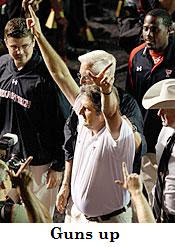 From purely a fan's perspective, that was maybe the best football game I've seen in a long while. Wild, erratic, well-played, well-coached, hard fought, with everything on the line between two unbeatens. The game was of course won on a magnificent pass from Graham Harrell to Michael Crabtree, who -- twisting, turning, ripping -- not only caught the ball but scored a touchdown. Below are a few more specific observations regarding the game.
Clock Management
First, clock management. Immediately after the game, a reporter asked Texas Tech quarterback Graham Harrell, when he saw that he was down with only a minute twenty-nine remaining, what he was thinking:
The successful offense Tech runs was of course the predicate for having any success on a drive like that (gotta throw and catch), but you have to give yourself a chance. Tech did it exactly right: They did not stupidly try to spike the ball, instead calling all the plays at the line (and without an excessive amount of communication); they did not overdo it with downfield passes nor all dump-offs to the running back (you generally just need to throw most passes past the first down marker); and although they didn't end up needing it, they preserved their time out.
It was a great drive, and it was well-orchestrated. I saw a commentator say something along the lines of "they had failed to use all their time outs" and further that "had Crabtree been tackled on the final play, they would have lost." Not only were both statements wrong (or at least carried the wrong sentiment) they also didn't flow together.
Tech intelligently kept their final timeout; had it been anyone else besides Michael Crabtree (assuming he caught it) he would have been tackled, and the time out would have allowed them to get their field goal unit on the field. And the rest -- the no spikes, the efficient communication -- was an application of the trappings of good clock management teams that I have previously described.
Texas's 91 yard stop-and-go
Second, I may draw this up in more detail later, but Texas's ninety-one yard TD was well designed and it was a good call. Throughout the game, the Longhorns had run the traditional curl/flat combination: the outside receiver would run a twelve-yard curl back to the quarterback, while a slot or running back would run to the flat. The play is designed to pull the flat defender to the sideline and to be completed in front of retreating defensive backs.
The base play had seen only marginal success: McCoy had completed a few of these, but this was also the combination that he had tried to throw on the pass intercepted and returned for a touchdown (the flat defender had drifted to the flat but had stayed in position to come back under the throw to the curl).
The touchdown was not only a stop-and-go, it was curl/flat and go. The slot ran the flat route and the outside receiver ran downfield and put his foot in the ground at about ten to twelve yards. This is a big reason why the cornerback bit so hard: he was not only reacting to a receiver but he was also reacting to what he thought was a route combination. It was a good call.
Mike Leach
Leach, for all his oddities, is a heck of a coach. Tech outplayed Texas the entire game, and it's a cliche, but there's only a handful of guys on Tech's roster who could have made Texas's. Also, Tech's defense played well, and much has been made about Tech's ability to run the ball better.

But this game's ending was fitting: A frantic last minute drive, all passes, and a touchdown pass on the sideline. And even further, the play itself was typical Leach: a basic play that Tech runs all the time (four verticals), but it was a play they had practiced so often that it was going to work.
Which gets back to the macro story about what Leach does. Leach and his offense are sui generis. As a result, a lot of coaches do not like Leach. Not on a personal level, but they are dismissive because he's so different. His success undermines their traditional approaches to the game. Too many football coaches are walking stereotypes right out of central casting; whereas sometimes the fact that Leach is head football coach for a major program seems like a Seinfeld plotline.
And that offense. As Michael Lewis described in his great New York Times Magazine piece on Leach (of somewhat renewed interest now), it's not an "offense" in the traditional sense: Leach's offense is "in effect, an argument for changing the geometry of the game."
It's funny that even fans who only casually watch the game immediately realize that Texas Tech is not the same "spread" that is so in vogue across football (in fact, it is Texas's offense that resembles that "spread"). It's his brainchild. It's a pass-first offense that is actually almost amazingly staid (Leach runs the same plays that he ran when he got there; the same plays he ran at OU; the same he ran at Kentucky; which all are mostly the same ones they got from BYU in the 1980s), but with lots of slight variants. New tags to move a guy here and there, to flip the play, and others. But always the freedom and variance with the offense has come by allowing the quarterback to find the right play and the receivers to get open.
In Leach's offense, the receivers do not really run "read-routes," but he does give them plenty of freedom to beat their men and settle in zone holes.
In the end, I'm not sure if you can really emulate Leach's offense per se. The current BYU staff has lots of ties to Leach and they are having great success and Sonny Dykes is the offensive coordinator at Arizona with mixed results. There are others. But Leach is just plain a "different" guy, so he could care less whether his offense looks like other offenses -- and in fact I'm sure he wants it to be different -- and this allows him to always push football's boundaries in ways other coaches cannot.
So the season is long, success in football is always ephemeral, but for now, in Leach's ongoing case against the football traditionalists (Leach has a law degree), his argument against the "geometry of the game" looks pretty persuasive.
 From purely a fan's perspective, that was maybe the best football game I've seen in a long while. Wild, erratic, well-played, well-coached, hard fought, with everything on the line between two unbeatens. The game was of course won on a magnificent pass from Graham Harrell to Michael Crabtree, who -- twisting, turning, ripping -- not only caught the ball but scored a touchdown. Below are a few more specific observations regarding the game.
Clock Management
First, clock management. Immediately after the game, a reporter asked Texas Tech quarterback Graham Harrell, when he saw that he was down with only a minute twenty-nine remaining, what he was thinking:
HARRELL: We're gonna win the game. . . . They left us too much time.
The successful offense Tech runs was of course the predicate for having any success on a drive like that (gotta throw and catch), but you have to give yourself a chance. Tech did it exactly right: They did not stupidly try to spike the ball, instead calling all the plays at the line (and without an excessive amount of communication); they did not overdo it with downfield passes nor all dump-offs to the running back (you generally just need to throw most passes past the first down marker); and although they didn't end up needing it, they preserved their time out.
It was a great drive, and it was well-orchestrated. I saw a commentator say something along the lines of "they had failed to use all their time outs" and further that "had Crabtree been tackled on the final play, they would have lost." Not only were both statements wrong (or at least carried the wrong sentiment) they also didn't flow together.
Tech intelligently kept their final timeout; had it been anyone else besides Michael Crabtree (assuming he caught it) he would have been tackled, and the time out would have allowed them to get their field goal unit on the field. And the rest -- the no spikes, the efficient communication -- was an application of the trappings of good clock management teams that I have previously described.
Texas's 91 yard stop-and-go
Second, I may draw this up in more detail later, but Texas's ninety-one yard TD was well designed and it was a good call. Throughout the game, the Longhorns had run the traditional curl/flat combination: the outside receiver would run a twelve-yard curl back to the quarterback, while a slot or running back would run to the flat. The play is designed to pull the flat defender to the sideline and to be completed in front of retreating defensive backs.
The base play had seen only marginal success: McCoy had completed a few of these, but this was also the combination that he had tried to throw on the pass intercepted and returned for a touchdown (the flat defender had drifted to the flat but had stayed in position to come back under the throw to the curl).
The touchdown was not only a stop-and-go, it was curl/flat and go. The slot ran the flat route and the outside receiver ran downfield and put his foot in the ground at about ten to twelve yards. This is a big reason why the cornerback bit so hard: he was not only reacting to a receiver but he was also reacting to what he thought was a route combination. It was a good call.
Mike Leach
Leach, for all his oddities, is a heck of a coach. Tech outplayed Texas the entire game, and it's a cliche, but there's only a handful of guys on Tech's roster who could have made Texas's. Also, Tech's defense played well, and much has been made about Tech's ability to run the ball better.

But this game's ending was fitting: A frantic last minute drive, all passes, and a touchdown pass on the sideline. And even further, the play itself was typical Leach: a basic play that Tech runs all the time (four verticals), but it was a play they had practiced so often that it was going to work.
Which gets back to the macro story about what Leach does. Leach and his offense are sui generis. As a result, a lot of coaches do not like Leach. Not on a personal level, but they are dismissive because he's so different. His success undermines their traditional approaches to the game. Too many football coaches are walking stereotypes right out of central casting; whereas sometimes the fact that Leach is head football coach for a major program seems like a Seinfeld plotline.
And that offense. As Michael Lewis described in his great New York Times Magazine piece on Leach (of somewhat renewed interest now), it's not an "offense" in the traditional sense: Leach's offense is "in effect, an argument for changing the geometry of the game."
It's funny that even fans who only casually watch the game immediately realize that Texas Tech is not the same "spread" that is so in vogue across football (in fact, it is Texas's offense that resembles that "spread"). It's his brainchild. It's a pass-first offense that is actually almost amazingly staid (Leach runs the same plays that he ran when he got there; the same plays he ran at OU; the same he ran at Kentucky; which all are mostly the same ones they got from BYU in the 1980s), but with lots of slight variants. New tags to move a guy here and there, to flip the play, and others. But always the freedom and variance with the offense has come by allowing the quarterback to find the right play and the receivers to get open.
In Leach's offense, the receivers do not really run "read-routes," but he does give them plenty of freedom to beat their men and settle in zone holes.
In the end, I'm not sure if you can really emulate Leach's offense per se. The current BYU staff has lots of ties to Leach and they are having great success and Sonny Dykes is the offensive coordinator at Arizona with mixed results. There are others. But Leach is just plain a "different" guy, so he could care less whether his offense looks like other offenses -- and in fact I'm sure he wants it to be different -- and this allows him to always push football's boundaries in ways other coaches cannot.
So the season is long, success in football is always ephemeral, but for now, in Leach's ongoing case against the football traditionalists (Leach has a law degree), his argument against the "geometry of the game" looks pretty persuasive.
Friday, October 24, 2008
Smart Notes - Oct. 24, 2008
1. "How To Make Friends and Influence People" - By Tony Franklin
So Auburn is still awful. And Tony Franklin's post-mortem interview the otherday revealed little about the situation, though it reaffirms a basic coaching truth: it's always going to be about more than Xs and Os. Yes there's the old Jimmies and Joes, but it's also whether or not your colleagues actively dislike you. That never helps.

2. Spread Worth Watching
Let's unpack this a bit. The main point is a simple one: good schemes ebb and flow, and knowledge bases change so, as he says, defensive coordinators who have done nothing but face spread teams may not have good and ready answers when a spread team comes around. There's not much new in football (contrary to the beliefs of some fanatics unlearned in football's history). Further, Saban is a great coach, but he knows what it is like to be unprepared. The worst I ever personally saw a Saban defense perform was back when he was at Michigan St. when they played Purdue, which was quarterbacked by Drew Brees at the time.
Purdue 52, Michigan State 28
Drew Brees had over 500 yards passing and five touchdowns. And oh-by-the-way, it was Michigan State's homecoming. Whoops. Saban's defense was simply unprepared for the precise, pass-first spread offense Purdue was using.
But the point about football knowledge is one illustrated by Saban himself. The next year Purdue was arguably better (they went on to the Rose Bowl and had beaten both Michigan and Ohio State), and Michigan State crushed them 30-10. So the point is that, while I agree with Saban that what goes around comes around in full force, I disagree that, in the future, coaches will have to start from scratch.
Defenses do not forget. Football might be cyclical, but its history is recorded. What worked once might work again, but the answers are also right there on the game film to be retrieved; there's no guesswork necessary. Saban might be right that the wishbone might come back -- it's an exceptionally well designed offense, and with the right talent, any offense can work -- but no one will succeed simply by resurrecting football's dinosaurs. Someone will have to put a new twist, or a new spin on it. So a restatement of the rule might be that football is cyclical, but it evolves at every step.
So Auburn is still awful. And Tony Franklin's post-mortem interview the otherday revealed little about the situation, though it reaffirms a basic coaching truth: it's always going to be about more than Xs and Os. Yes there's the old Jimmies and Joes, but it's also whether or not your colleagues actively dislike you. That never helps.

2. Spread Worth Watching
Texas Tech and Kansas play this upcoming weekend. For all the talk about the rise of awful spread teams, these two squads still get it right. Interestingly both Mike Leach and Mark Mangino worked together at Oklahoma, and after Leach left to take the TTech job Mangino basically ran Leach's offense the year OU won the title. But now, don't get them confused. While Leach still runs his Airraid offense, Mangino's has evolved into something of a more traditional -- but still unique -- spread offense. (They run the absolute heck out of the smash package, and they run it better than just about anyone else.)
And although Rich Rod's Michigan tenure, along with failed spread experiments at Auburn, Virginia, and others may have sufficiently freaked out any head coaches, athletic directors, and boosters at major programs from making a switch, both Leach and Mangino should get serious consideration for top jobs at major programs.
3. Nick Saban, Football Historian
Nick Saban is a good coach, alright? And he's been around for longer than people realize. So it warms my heart in a special way to hear him making a point that I've made on many occasions: Football is a game of repeating cycles, with what went out one year coming back the next. In a recent interview, Saban got all fired up on the topic (prompted by a discussion of the Wildcat offense):
...Now the Crimson Tide coach really starts waxing poetically about the past. You mention a running attack... He went deep into the memory bank for this reference. Back to being a defensive assistant on a West Virginia team that lost 52-10 to Oklahoma in 1978.
"I've been coaching for a long time, aight?" Saban said. "Played Oklahoma when you couldn't even see the other sideline because the crown of the field was so heavy, when they tried running downhill, and they were moving. They had (David) Overstreet, (Billy) Sims, and guys that could run fast anyway, they didn't need any help. And so, I've been through that. And them horses that pull that wagon around every Oklahoma scored, [darn]-near died, because they had to do it so much the day we played them."
His final point was a good one: "All this stuff comes around," he said.
"One of these days," he warned, "when old the guys like me don't coach anymore, and the young bucks who grew up defending four-wides and everything, somebody's going to run the wishbone, and they may not know a thing about how to stop it."
Let's unpack this a bit. The main point is a simple one: good schemes ebb and flow, and knowledge bases change so, as he says, defensive coordinators who have done nothing but face spread teams may not have good and ready answers when a spread team comes around. There's not much new in football (contrary to the beliefs of some fanatics unlearned in football's history). Further, Saban is a great coach, but he knows what it is like to be unprepared. The worst I ever personally saw a Saban defense perform was back when he was at Michigan St. when they played Purdue, which was quarterbacked by Drew Brees at the time.
Purdue 52, Michigan State 28
Drew Brees had over 500 yards passing and five touchdowns. And oh-by-the-way, it was Michigan State's homecoming. Whoops. Saban's defense was simply unprepared for the precise, pass-first spread offense Purdue was using.
But the point about football knowledge is one illustrated by Saban himself. The next year Purdue was arguably better (they went on to the Rose Bowl and had beaten both Michigan and Ohio State), and Michigan State crushed them 30-10. So the point is that, while I agree with Saban that what goes around comes around in full force, I disagree that, in the future, coaches will have to start from scratch.
Defenses do not forget. Football might be cyclical, but its history is recorded. What worked once might work again, but the answers are also right there on the game film to be retrieved; there's no guesswork necessary. Saban might be right that the wishbone might come back -- it's an exceptionally well designed offense, and with the right talent, any offense can work -- but no one will succeed simply by resurrecting football's dinosaurs. Someone will have to put a new twist, or a new spin on it. So a restatement of the rule might be that football is cyclical, but it evolves at every step.
Wednesday, October 15, 2008
Linemen Splits
This doesn't always come up, but one of the most interesting games within the game in football are the splits between the offensive linemen. Some teams use a lot of wide splits, with as much as three to even six feet between linemen, while others keep it closer to roughly a foot, or even toe-to-toe. But like everything else in football, what kind of splits you take is informed both by what the defense does and what your philosophy is.
Conclusion
So in sum, the choice of what splits a team uses will vary by play. Some will rely on teamwork and overwhelming force to overpower the defense, others will play games with varying them to set up the play they have called, and others, like Texas Tech, build it into their philosophy. As a final thought, many of you might think: Hey, if you always go tight splits for outside runs and wide for inside runs, won't the defense catch on? The response is the same one Bill Walsh would give when he heard this concern: If you have built a tendency (like running inside whenever you go wide splits), you simply self-scout, figure that out, and then confuse the defense by breaking your own tendency. Some of his biggest plays came when he broke his own tendencies.

To understand why splits matter, you need to understand how defensive fronts align. Typically, most defenses are taught to align on the basis of where the offensive guys align, which makes sense because those defenders are trying to get through or around the blockers to get to the running back or quarterback. So defensive linemen and linebackers were told from the earliest days of football to align "on the inside eye of the guard," "heads up the center," or "on the outside eye of the tackle." The linebackers had similar instructions, though they aligned behind the offensive line. Over time, defenses got better at mixing up these alignments, even before the snap. We've all seen linemen shift from the outside eye of the guard to the gap between the guard and center, or simply align late. All this is designed to confuse blocking schemes.
So as offenses became more complex, it became necessary to give linemen rules that would allow the run play to be blocked no matter what games the defense played, and to do that you needed a nomenclature that could be communicated via playbook as well as on the sideline (or at the line) in the heat of a game. This system became known as the assignment of defensive "techniques" to each defensive player. The credit for it is typically given to Alabama's legendary coach Bear Bryant, though he gives much of the credit to Bum Phillips. Below is an example of the numbering system.
Note that this is not the same as "hole numbering," because it is about where the defender aligns not where the run is designed to go. Although it looks a bit confusing, this system is used at literally every level of football, from pee wee football to the NFL. Below is another diagram with slightly different nomenclature, though it also specifies the "gaps." (Hat tip to the USC Trojan Football Analysis site for the image.) So now that we know that defenses align based on where the offense aligns, and we know that offenses identify defenses based on the alignment, we can discuss splits. It's a bit of an oversimplification, but the choice is basically between tight or wide splits. I begin with tight splits.
Tight Splits
Tight splits are the most common. In fact, most people probably don't think of them as tight, but merely notice when they see "wide splits." Below is an example of a typical alignment.

The advantage of tight splits are easy to see: Linemen are close to each other so you can get good teamwork between them; there are few or at least narrow gaps between them; and the line is constricted to keep defenders away from outside runs and quick outside throws.
The teamwork part cannot be underemphasized. One reason that tight splits are so common is because zone running and slide protection is so popular today. Zone running requires linemen to step in a direction, double-team guys in their area, and then one of them works up to block the linebacker. If the linemen are too far apart, you cannot get a good double-team, and the play won't go. For slide protection, linemen slide into a gap, and work together to create a fence for the QB. Any unblocked rushers must come from the outside, as the priority is to prevent a blitzer or linemen up the middle.
The point about gaps is similar. But the point about constricting the line for outside plays is underemphasized. Most teams, when they want to run an outside option play or a sweep of some kind, will have their line condense in by cutting their splits. That way a fast runner can get outside quickly.
Wide Splits
Wide splits are more interesting. Traditionally, the teams with the widest splits were option running teams. That might sound surprising, but the reason was is that they used a lot of man blocking rules (i.e. block your man, rather than zone an area). More importantly though, by splitting out, because the defense aligned on the basis of where the offensive linemen were, the guy the QB was reading was split out. So if on the triple option you wanted your QB to first read the defensive tackle ("T") and then the defensive end ("E"), you'd split your linemen out to give him more time to make each successive read. (Hat tip: Hugh Wyatt)
You also simply created wide running lanes inside by having your linemen split out so wide. If you watched the old Nebraska teams, while they didn't take enormous splits, they did have wide ones for both their inside option plays and inside man blocking runs.
But there's a new trend for wide splits, and that's with air-it-out passing teams like Texas Tech. Traditionally passing teams took very narrow splits to stop inside penetration, Texas Tech takes exceptionally large splits. Their rationale is a few-fold: (a) make the pass rushers come from farther away and enlarge the pocket, (b) open up throwing lanes for the quarterback, and (c) because they throw so much, all they need is a block or two to have an effective draw play -- the defensive ends aren't even really a factor. They can do this because they are almost exclusively a "man" pass protection team, just as the old Lavell Edwards BYU offenses were. (Indeed, Mike Leach's offense is a direct descendent from BYU's offense, he spent time there as an assistant, and many of his other coaches had experience at BYU as players or coaches when Edwards and Norm Chow were there.)
The obvious concerns are that if one guy gets beat in pass protection then there is no help, and also that there are wide gaps for linebackers to shoot through. For the latter, Tech feels like they can hurt that in other ways, through quick passes, screens, outside run plays, and traps. And they also feel that they can simply teach their linemen to be smart and reactive, and still stop that kind of penetration.
For the former problem though, the answer is simply that they have to have good blockers. They freely admit that they put their linemen one on one a great deal of the time, but their philosophy is that if someone gets to the quarterback, everyone knows who got beat. More and more teams have been adopting this strategy.
As a side note, I observe that Leach went to this trend after he got away from having a two-back formation as his primary one for passing downs. With a two-back offense you can stop a lot of overload passing threats to either side, but with a one-back formation -- Leach's current primary version -- the wide splits were necessary to take those extra rushers out of the play. For more on all this, see my old article here. And you can get a flavor for what Texas Tech does in the video below:
Conclusion
So in sum, the choice of what splits a team uses will vary by play. Some will rely on teamwork and overwhelming force to overpower the defense, others will play games with varying them to set up the play they have called, and others, like Texas Tech, build it into their philosophy. As a final thought, many of you might think: Hey, if you always go tight splits for outside runs and wide for inside runs, won't the defense catch on? The response is the same one Bill Walsh would give when he heard this concern: If you have built a tendency (like running inside whenever you go wide splits), you simply self-scout, figure that out, and then confuse the defense by breaking your own tendency. Some of his biggest plays came when he broke his own tendencies.
Friday, October 03, 2008
Auburn's offense might be bad, but don't call it the spread, the Airraid, or the Tony Franklin System
I recently wrote piece about the "Rise of the Terrible Spread Team," and while I didn't have this season's Auburn Tigers in mind, that's the connection a lot of folks made. And with some good reason: Auburn brought in Tony Franklin, a "spread guru," with the hype that the spread had come back to the SEC and that Auburn would light people up. And, it uh, hasn't happened that way. Hundred yard passing games seem like the norm, and the games Auburn has won have been on the strength of their defense. Most Auburn fans are fearful as the SEC season heats up, as everyone knows you need to be able to score to win games in that conference.
So public enemy #1 is now Tony Franklin. I might have bought into this, and agree that his offense has failed. Except they aren't even running his offense.
What do you mean, you might (reasonably) ask? They look "spread" to me (several wide outs on the field), they are in the shotgun, and they also suck. Yes, yes, and an emphatic yes.
But the system (or the "The System" with a trademark symbol) that Franklin was (supposedly) hired to run was the Airraid offense he learned from Hal Mumme and Mike Leach when all three coached together at Kentucky. (At the bottom of this post is an addendum explaining a bit more about the Airraid.) Franklin of course had a famous falling out with Mumme, as Franklin thought he had been thrown under the bus, that Mumme was either willfully blind to the cheating done at UK by one Claude Bassett, and as a result of it all - the bad pub, the book, etc - Franklin was blacklisted from coaching. So he reinvented himself as a spread offense consultant and he marketed Mumme's system to high school programs across the country. (His most prominent client was Hoover High School, which, with Franklin's system, went from mediocrity to the highest level of football success: a reality show on MTV.) Franklin later surfaced at Troy University, where his offense succeeded, and he was hired by Auburn, presumably to run what he'd been coaching and selling for over a decade.
Despite outward appearances, that assumption is wrong. Every coach I speak to says the same thing: I don't know what they are doing at Auburn, but it ain't the Airraid. So what's going on? I'm not an insider, but my best sense is that the other coaches on the staff (including Tuberville) never bought into the system - maybe because Franklin did a poor job selling it internally, or maybe he thought he didn't have to - and now their offense is simpl a muddle, a grab-bag of pseudo-spread garbage. This seems to be general sentiment among the smart money in football. For example, as one high school coach, who is also a client of the Tony Franklin system, said:
I'm not ready to blame Tommy Tuberville; he's an extremely smart guy and coach. But I do wonder: why in the world would you bring a guy in who knows one system extremely well but one system only, and then not run what he knows? And even if the pressure was on from the AD or the boosters to go spread, why not pick a twig off the Rich Rodriguez or "running-spread" tree? Instead, they picked a guy whose background was in a pass-first spread, and then they shelve the passing concepts. It really boggles my mind.
Now, this is raw speculation, but here's my best guess: Franklin comes in, and does not bring in any other staff. The rest of the staff does not buy into this system. They didn't think it would work, and Franklin has not convinced them. They are convinced they don't have the players (more on that in a bit) and that either they can't go too spread too quickly, or they have to keep some other elements, or the play-calling is off, or something. Plus, since he didn't bring the rest of his staff in, Franklin had to coach the coaches in his offense, and at that he apparently did a poor job.
Once you start going in multiple directions on offense, you lose focus, and all the paranoia becomes a self-fulfilling prophecy. In college there is simply not enough time to try to do everything. It's the converse of Bobby Bowden's old quote about defense: If you try to stop everything, you stop nothing. Here we could say if you try to be everybody's spread, you're nobody's spread. And Franklin knows this. From an interview he gave over the summer:
Yet they have clearly lost focus. Again I'm not blaming anyone. You could still plausibly argue that if Franklin came in to run a system and he can't convince the coaches and players, then he's failed at an important part of his job. That said, if someone hires me to run an offense at Auburn University of all places, I don't expect to have to spend most of my time convincing my colleagues of what I'm doing. But that's how it goes. Yet make no mistake, the rest of the coaching staff has not bought in. As Tuberville is now saying:
Well, it's not like they ever tried. Setting aside whatever merit this statement has as a matter of diplomacy, it's bogus as a factual matter. Or at least bizarre. If you hire a guy to run a system, why can you then say, oh, after the fact, we don't have the talent. (But did in our bowl game?) Remember: the reason this guy was hired was because at Kentucky, the offense rolled up yardage and points in the SEC, and Franklin, while he was at Troy, rolled up yardage on big name schools (read: Georgia). Auburn has the horses, and when you're going to switch, you just switch.
But, what about QB? They don't have a QB, the critics say. Or they say that their guy Todd is noodle-armed, and you need the other kid, Burns in there. Now I really don't want to wade into a fan battle about who is the better QB (though I observe the rule of thumb that the backup QB for a struggling offense is always the most popular guy in town), but I will say that all you need for this offense is a game manager. Todd appears to be that, though, again, the offense itself just isn't being run correctly.
To highlight the absurdity of this situation, let's think of the last time a big name school hired an offensive coordinator to run the Hal Mumme offense: Bob Stoops, when he went to Oklahoma from the U of Florida, hired Mike Leach as his offensive coordinator. Why? Well as defensive coordinator with Florida, Stoops said that they only team that had an incommensurate level of success against them was Kentucky. Stoops noted that UF's talent level was far superior, yet stopping Kentucky was maddening for Stoops. So Stoops said: I want that.
Compare this to what is happening with Tuberville and Franklin. Back in 1999, Stoops hired Leach and gave him free rein to install his offense. (In fact, I have a coaching clinic talk where Stoops said that he ordered Leach not to change anything that first year, because he wanted exactly what he saw with Kentucky.) And who was Leach's QB at OU? A noodle-armed guy named Josh Heupel. And their receivers were a bunch of converted running backs and defensive backs. Yet I didn't hear the same cry that "Oh, we'll spread it out when we get the athletes." (News flash: if that's your approach, it'll never happen.) Now, I also observe that Stoops too wasn't entirely comfortable being a spread it all the time guy, and Leach happily went on to Texas Tech where he could be as much of a mad scientist as he liked. Yet OU stuck with the exact same system the next year with Mark Mangino as OC, and won a National Title. But Stoops knew what he was getting when he hired Leach, and most importantly he let him do it.
Which of course, again, draws us into questions about what the hiring process was like. What was Franklin told (or what did he ask?), and who wanted him to come to Auburn? Tuberville, or various boosters or administrators? I have no clue. Maybe in the end, this is beside the point: they aren't good at offense right now, so they need to do something the coaches buy into. If it's not the Tony Franklin system then it should just be whatever they can find that will help them score a touchdown every once in awhile.
Airraid Addendum:
As an addendum here I wanted to expound briefly on what I mean when I say that Auburn isn't running the Airraid system. The Airraid is basically two things:
First, it is a small collection of a handful of pass plays, largely derived from the Norm Chow/Lavell Edwards BYU offense of the 80s and early 90s. The most prominent of these are the mesh (see here under "62" for the read), the shallow (see also here), the stick, and then mostly screens.
Second, it is an approach. Specifically, it is a patient, analytic, probing approach to attacking the defense. You have a few formations, you have your base plays (which you have repped continuously), and each has a structure and individual routes but receivers are given enough freedom within each to get open, and QB's are allowed to check plays at the line. Since there aren't many plays, they are practiced over and over again; you might see Texas Tech run the same plays with only slight variations ten times in a given game, often back-to-back-to-back, and a different receiver might get the ball on each one. I can't stress the analytic, probing part enough. Often you don't know what the defense is doing or will do, but you take a piece of the field, you attack it with some route concept, and you take your completions where you can get them. In Hank Stram's phrase, you matriculate the ball down the field.
And what is Auburn doing? I don't really have a clue. They basically line in just a couple of formations, run the outside zone over and over again. They don't run the mesh, the shallow, or the stick concepts. They have some very basic pass plays, mostly based on the four-verticals concept or sometimes a smash pattern. But that's really about it. It's just a bizarre approach that hints at dissent among the staff. The irony is that the whole point of the Airraid was to take the Vince Lombardi approach - run a few plays exceptionally well - and apply that to a pass-first offense.
As a counterpoint, only some video can do justice to how different the approaches are. Compare Auburn this season:
With a cut-up of Kentucky against LSU (talent gap, anyone?) while Mumme, Franklin, and Leach were all there (and take note of how easy so many of these completions are - just short dump offs to the running backs, screens, and quick passes):
UPDATE: Franklin has been fired, and the spread experiment at Auburn ends. Just to clarify as I expect some further scrutiny of this post, I really don't mean to entirely absolve Franklin of blame. One possible hypothesis is that Franklin himself had done too much adapting of his offense - either at Troy before he got to Auburn or while he was there - that undermined its core. But I'm not sure if that's the most plausible solution. Seems me to like it was a tough situation for everybody, with quite possibly everybody getting into it not with their eyes wide open - head coach, offensive coordinator, and position coaches. Hopefully, for Auburn's sake, they can move on from here. As I predicted previously, the offense will probably improve some just by having less conflict amongst the staff. But it won't improve by too much, at least not this season.

So public enemy #1 is now Tony Franklin. I might have bought into this, and agree that his offense has failed. Except they aren't even running his offense.
What do you mean, you might (reasonably) ask? They look "spread" to me (several wide outs on the field), they are in the shotgun, and they also suck. Yes, yes, and an emphatic yes.
But the system (or the "The System" with a trademark symbol) that Franklin was (supposedly) hired to run was the Airraid offense he learned from Hal Mumme and Mike Leach when all three coached together at Kentucky. (At the bottom of this post is an addendum explaining a bit more about the Airraid.) Franklin of course had a famous falling out with Mumme, as Franklin thought he had been thrown under the bus, that Mumme was either willfully blind to the cheating done at UK by one Claude Bassett, and as a result of it all - the bad pub, the book, etc - Franklin was blacklisted from coaching. So he reinvented himself as a spread offense consultant and he marketed Mumme's system to high school programs across the country. (His most prominent client was Hoover High School, which, with Franklin's system, went from mediocrity to the highest level of football success: a reality show on MTV.) Franklin later surfaced at Troy University, where his offense succeeded, and he was hired by Auburn, presumably to run what he'd been coaching and selling for over a decade.
Despite outward appearances, that assumption is wrong. Every coach I speak to says the same thing: I don't know what they are doing at Auburn, but it ain't the Airraid. So what's going on? I'm not an insider, but my best sense is that the other coaches on the staff (including Tuberville) never bought into the system - maybe because Franklin did a poor job selling it internally, or maybe he thought he didn't have to - and now their offense is simpl a muddle, a grab-bag of pseudo-spread garbage. This seems to be general sentiment among the smart money in football. For example, as one high school coach, who is also a client of the Tony Franklin system, said:
I live in Alabama and I attended the game between [Auburn] and Tennessee. I also am an offensive coordinator for a high school football team that runs the [Tony Franklin System]. From what I have seen this year from AU, this is not the system.
It seems to me that Franklin is getting told what to run on offense. Tubs wants to run the ball to set iup the pass and Franklin likes to set up the run with the pass. I never saw any hurry up offense from AU at this weeks game . . . . Franklin has said that to be sucessful in this offense you must be good at the screens, and get a lot of snaps (maybe like 80) on offense. I dont think I have seen but maybe four screens all year and I don't think they are close to getting 80 snaps.
I'm not ready to blame Tommy Tuberville; he's an extremely smart guy and coach. But I do wonder: why in the world would you bring a guy in who knows one system extremely well but one system only, and then not run what he knows? And even if the pressure was on from the AD or the boosters to go spread, why not pick a twig off the Rich Rodriguez or "running-spread" tree? Instead, they picked a guy whose background was in a pass-first spread, and then they shelve the passing concepts. It really boggles my mind.
Now, this is raw speculation, but here's my best guess: Franklin comes in, and does not bring in any other staff. The rest of the staff does not buy into this system. They didn't think it would work, and Franklin has not convinced them. They are convinced they don't have the players (more on that in a bit) and that either they can't go too spread too quickly, or they have to keep some other elements, or the play-calling is off, or something. Plus, since he didn't bring the rest of his staff in, Franklin had to coach the coaches in his offense, and at that he apparently did a poor job.
Once you start going in multiple directions on offense, you lose focus, and all the paranoia becomes a self-fulfilling prophecy. In college there is simply not enough time to try to do everything. It's the converse of Bobby Bowden's old quote about defense: If you try to stop everything, you stop nothing. Here we could say if you try to be everybody's spread, you're nobody's spread. And Franklin knows this. From an interview he gave over the summer:
The spread is a formation, not an offense: Some people spread the field to run it, like West Virginia. Others spread the field to pass it, like Texas Tech. It’s what you do after you spread the field that defines your offense. We spread it to figure out what is going to work in any particular game and then we just do that. At Troy we basically ran it half the time and threw it half the time. We just always took what the defense was giving us. [Note: Troy rolled up 488 yards in a 44-34 loss to Georgia last November.] Our plan at Auburn is to throw first and run second but if we find a running play that works, we’re going to do that. I’m not hung up on who gets the ball and how we do it. I just want to score points.
Yet they have clearly lost focus. Again I'm not blaming anyone. You could still plausibly argue that if Franklin came in to run a system and he can't convince the coaches and players, then he's failed at an important part of his job. That said, if someone hires me to run an offense at Auburn University of all places, I don't expect to have to spend most of my time convincing my colleagues of what I'm doing. But that's how it goes. Yet make no mistake, the rest of the coaching staff has not bought in. As Tuberville is now saying:
"We don’t run Tony Franklin’s spread offense,” Tuberville said. “This is Auburn’s offense. It’s like our defense. We’re going to run what works and what
we’re going to match up better with the other team. Everybody has to do that. You can’t put a square peg in a round hole. Why would you do that?"
Well, it's not like they ever tried. Setting aside whatever merit this statement has as a matter of diplomacy, it's bogus as a factual matter. Or at least bizarre. If you hire a guy to run a system, why can you then say, oh, after the fact, we don't have the talent. (But did in our bowl game?) Remember: the reason this guy was hired was because at Kentucky, the offense rolled up yardage and points in the SEC, and Franklin, while he was at Troy, rolled up yardage on big name schools (read: Georgia). Auburn has the horses, and when you're going to switch, you just switch.
But, what about QB? They don't have a QB, the critics say. Or they say that their guy Todd is noodle-armed, and you need the other kid, Burns in there. Now I really don't want to wade into a fan battle about who is the better QB (though I observe the rule of thumb that the backup QB for a struggling offense is always the most popular guy in town), but I will say that all you need for this offense is a game manager. Todd appears to be that, though, again, the offense itself just isn't being run correctly.
To highlight the absurdity of this situation, let's think of the last time a big name school hired an offensive coordinator to run the Hal Mumme offense: Bob Stoops, when he went to Oklahoma from the U of Florida, hired Mike Leach as his offensive coordinator. Why? Well as defensive coordinator with Florida, Stoops said that they only team that had an incommensurate level of success against them was Kentucky. Stoops noted that UF's talent level was far superior, yet stopping Kentucky was maddening for Stoops. So Stoops said: I want that.
Compare this to what is happening with Tuberville and Franklin. Back in 1999, Stoops hired Leach and gave him free rein to install his offense. (In fact, I have a coaching clinic talk where Stoops said that he ordered Leach not to change anything that first year, because he wanted exactly what he saw with Kentucky.) And who was Leach's QB at OU? A noodle-armed guy named Josh Heupel. And their receivers were a bunch of converted running backs and defensive backs. Yet I didn't hear the same cry that "Oh, we'll spread it out when we get the athletes." (News flash: if that's your approach, it'll never happen.) Now, I also observe that Stoops too wasn't entirely comfortable being a spread it all the time guy, and Leach happily went on to Texas Tech where he could be as much of a mad scientist as he liked. Yet OU stuck with the exact same system the next year with Mark Mangino as OC, and won a National Title. But Stoops knew what he was getting when he hired Leach, and most importantly he let him do it.
Which of course, again, draws us into questions about what the hiring process was like. What was Franklin told (or what did he ask?), and who wanted him to come to Auburn? Tuberville, or various boosters or administrators? I have no clue. Maybe in the end, this is beside the point: they aren't good at offense right now, so they need to do something the coaches buy into. If it's not the Tony Franklin system then it should just be whatever they can find that will help them score a touchdown every once in awhile.
Airraid Addendum:
As an addendum here I wanted to expound briefly on what I mean when I say that Auburn isn't running the Airraid system. The Airraid is basically two things:
First, it is a small collection of a handful of pass plays, largely derived from the Norm Chow/Lavell Edwards BYU offense of the 80s and early 90s. The most prominent of these are the mesh (see here under "62" for the read), the shallow (see also here), the stick, and then mostly screens.
Second, it is an approach. Specifically, it is a patient, analytic, probing approach to attacking the defense. You have a few formations, you have your base plays (which you have repped continuously), and each has a structure and individual routes but receivers are given enough freedom within each to get open, and QB's are allowed to check plays at the line. Since there aren't many plays, they are practiced over and over again; you might see Texas Tech run the same plays with only slight variations ten times in a given game, often back-to-back-to-back, and a different receiver might get the ball on each one. I can't stress the analytic, probing part enough. Often you don't know what the defense is doing or will do, but you take a piece of the field, you attack it with some route concept, and you take your completions where you can get them. In Hank Stram's phrase, you matriculate the ball down the field.
And what is Auburn doing? I don't really have a clue. They basically line in just a couple of formations, run the outside zone over and over again. They don't run the mesh, the shallow, or the stick concepts. They have some very basic pass plays, mostly based on the four-verticals concept or sometimes a smash pattern. But that's really about it. It's just a bizarre approach that hints at dissent among the staff. The irony is that the whole point of the Airraid was to take the Vince Lombardi approach - run a few plays exceptionally well - and apply that to a pass-first offense.
As a counterpoint, only some video can do justice to how different the approaches are. Compare Auburn this season:
With a cut-up of Kentucky against LSU (talent gap, anyone?) while Mumme, Franklin, and Leach were all there (and take note of how easy so many of these completions are - just short dump offs to the running backs, screens, and quick passes):
UPDATE: Franklin has been fired, and the spread experiment at Auburn ends. Just to clarify as I expect some further scrutiny of this post, I really don't mean to entirely absolve Franklin of blame. One possible hypothesis is that Franklin himself had done too much adapting of his offense - either at Troy before he got to Auburn or while he was there - that undermined its core. But I'm not sure if that's the most plausible solution. Seems me to like it was a tough situation for everybody, with quite possibly everybody getting into it not with their eyes wide open - head coach, offensive coordinator, and position coaches. Hopefully, for Auburn's sake, they can move on from here. As I predicted previously, the offense will probably improve some just by having less conflict amongst the staff. But it won't improve by too much, at least not this season.
Subscribe to:
Posts (Atom)

 Posts


