At the NFL level, where nearly every player has already won the DNA lottery, there are plenty of candidates to be effective tight-ends who can both run block like guards and get downfield like receivers -- or at least there are enough to be a force in the league and make every other team salivate (I'm looking at you Antonio Gates). At the lower levels though, finding one of these perfect specimens isn't so easy. And, with the rise of the spread, it is no surprise that tight-ends don't take the field quite as often as they used to. But reports of the demise of the position are overstated.
As an example, one coach recently asked, "Realistically, how much of a problem does a TE as a pass blocker pose in modern football?" He went on to say, "I say this because now that everyone's trying to go to some type of spread and put as many small, quick guys on the field as possible, TEs are becoming an almost endangered species on teams who want to throw." There were other observations about the ongoing usefulness of the tight-end position. Although I agree that just holding up a freak like Antonio Gates doesn't get you far (good luck finding those), I do not think the position is so useless or impractical as some have implied. (Beware, this post is kind of wonky and technical.)
Homer Smith discussed the role of the TE/H-back as a triple threat: he can block, release vertical (in a way that a back cannot), and can block for a few counts and release on a delayed pass, and therefore make two guys cover him. Here is what Homer Smith explained:
It takes a sixth frontal player (not counting the QB) to pull an identifiable pass defender into the front and to give the blockers something to work with to keep the center off the island. It takes the sixth, just as it takes him to deal with a blitz.
Which is a better sixth [blocker, a tight-end or a runningback]? A TE is more of a threat with the delayed pass that makes the pass defender on him stay at bay while the TE blocks the rusher. I think a TE is the better.
Anyway, this is not so black and white, RB versus TE. It's all shades: imagine lining up with a FB in the I. Now the FB cheats over; he lines up in a two-point stance, behind the guard at 4 yards. Now behind the tackle at 3 yards. Now he splits the tackle with his inside leg, at about 2 yards. What is he? A FB or an H-back? He can BOB the linebacker, no? He can still kick out for power, release into the flat, maybe even take a handoff if he comes inside enough. Now he steps over maybe another foot, etc. Now suddenly he's a tight-end/h-back all the way? And all those advantages are lost?
Also don't confuse personnel with position. You can put anyone you want there. I don't see why your RB is some invaluable pass blocker, despite the fact that he has to work on carrying the ball, catching the ball, and blocking in the run game, while the TE is just helpless?
Nothing wrong in HS in having a division of labor for these positions. On most teams I've been around, the TEs spend more time practicing with the OL than they do the receivers. If you want a glorified slot guy, then sub a receiver in and go from there. Or use a FB type (if you're got one).
Bottom line: it's an exceptionally useful thing, and don't be straitjacketed by black and white conceptions. The advantage of the four wide spread was a division of labor thing -- you could put four wides out there and get mismatches against the other team's base personnel, and often get them out of their base looks. You might not have a good TE or fb, so you didn't put one out there; you looked for advantages elsewhere. Nowadays with everyone being spread, is that really the case that just going four wide gives you all these mismatches? I'm not so sure; using a TE -- or alternating between TEs, FBs, and slot receivers -- seems to me the better move.
I consider my base offense to be 3 WR, 1 QB, 1 RB, and then a hybrid H-back position. That H-back position can be a true slot receiver (routes and jet sweeps), a FB, a true TE/H-back (either as a blocker or hybrid guy, though those are quite rare), or even just a 2nd RB. Depends on the guys you have, what you're trying to accomplish, and also your depth (can do a lot of great things if you have a couple of kids who fit the above descriptions and then just sub them in and out to give different looks).
But unquestionably, TE is maybe my favorite position. True, it's not always easy to find a good one, but it helps a lot. (And the two best formations in football might be trips closed and a TE/wing set, with a TE and a wing player to one side, and either a split end and flanker or a twins look).
Finally, one of the concerns was that a tight-end is in poor position to pass protect:
To me, a RB who starts out deeper in the backfield is in much better position to pick up blitzers, chip DEs, or even take a DE 1-on-1. . . . Now, compare that to a TE, who is always on the end of the line and is really only in position to pick up somebody coming off the edge. He also has far less time and room for error in diagnosing a blitz or stunt and getting his body where he needs to be.
I disagree; it is best not to overthink this. One, if you're having that many problems you can always back the TE up to be an H-back so he can see more. Second, you can make a very simple call ("solid") if the DE lines up on or outside the TE and the LB lines up inside. If both the DE and LB come (and don't twist) the tackle takes the LB and the TE takes the DE; if the LB doesn't rush then the TE passes the DE off to the tackle before releasing. You do get into the matchup issues, but it's not so ridiculous like he can't get there or will just whiff. It's just a simple area principle.
Tomahawk Nation responds to my earlier post on David & Goliath Strategies. See parts one and two of TN's responses. (See also my post on conservative and risky strategies and kurtosis.) Both pieces are well worth the read (I am a supporter of anything that combines football and six sigma). But a couple basic thoughts:
First, I completely agree with the idea of reducing variation, particularly negative variation. That really is the genius of Bill Walsh's passing game: what he brought to the game was a reduction of risk related to passing. Passing had been the quintessential "underdog" or David strategy; he reduced risk so much it arguably stopped being a David strategy and became a dominant one.
But I'm not sure if I agree with this:
Think of UF. To me, the Urban Meyer offense at Utah is a prime example of a David strategy. As he moved to Florida, he helped a Goliath school with Goliath resources begin to think like a David. People said that his offense would never work in the SEC, the QB would get killed, defenses were too fast, etc. But Meyer knew that his approach took advantage of a weakness in defenses, and if executed properly wouldn't be nearly as risky as people thought. Think back to the Ole Miss game from 2 years ago (the game that might have won Tim Tebow the Heisman). When the basic structures of the Meyer offense failed to work against the Ole Miss defense (Goliath being unable to hit David with his sling), and Ole Miss still allowed UF to stay in the game (Goliath managing to fight to a draw with David in a slingshot battle), UF was able to run Tim Tebow left/Tim Tebow right to win the game (Goliath is able to fall back on his superior size and strength combination to win the battle). . . .
...Gladwell highlighted the press in basketball as an example of a David strategy. Why is this a David strategy? Because Goliath doesn't focus on beating the press as much as David focuses on executing it. Because it takes Goliath out of his comfort zone. And honestly, because frequently the top point guards in the country have a certain level of confidence/cockiness in themselves that makes them want to beat the press by themselves and not rely on their teammates. The goal of the press is also to force the ball into someone's hands who is not used to handling the ball-- an inefficiency in Goliath's approach. This is how a team can use the David strategy to capitalize on an advantage. It's a risk, but if executed correctly it's not just a risk for the sake of being risky.
But is that really a David, or underdog strategy? Or is it a dominant strategy? I.e. better no matter who you are? One of the reasons I wrote my post was that I thought Gladwell confuses this point too, and I also concede at the end of the post that one conceptual difficulty is that some strategies are better for favorites (Goliaths conservative, low variance strategies), some solely for underdogs (risky David strategies), but some strategies are simply better no matter who you are (dominant), or inferior (punting on first down).
The things Tomahawk Nation is focusing on are, to me at least, dominant: better matchups, an unusual strategy the favorite is not ready for, etc. Admittedly, Gladwell confuses these two concepts -- or at least doesn't tease them out -- but I do think it's important.
To better illustrate what I mean, Advanced NFL stats showed that David strategies are often beneficial for underdogs even when they are basically inferior overall. In other words, even if a strategy would result in fewer expected points, it still would benefit the underdog because it still could get lucky. As ANFL explains:
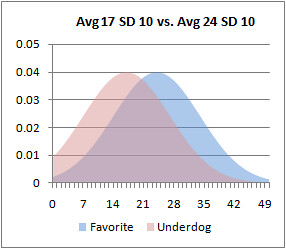
Here’s why underdogs should play aggressive and risky gameplans. Take an example where one team is a 7-point favorite over its underdog opponent. Say the favorite would average 24 points and the underdog would average 17 points. With a SD of 10 points for each team, the underdog upsets the favorite 31.5% of the time. The favorite’s scoring distribution is blue and the underdog’s is red.
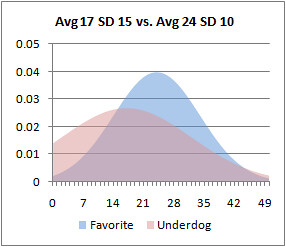
But if the underdog plays a more aggressive high-variance strategy, increasing its SD to 15 points, it would upset the favorite 35.3% of the time.
Note that I haven’t increased the underdog’s average score in any way, just its variance. The increase in its chance of winning results due to more of its probability mass moving to the right of the favorite’s mean score of 24. In fact, the higher the variance, the wider the probability mass will be spread. Consequently, more mass will be to right side of the favorite’s average score. But more mass will also be to the left, meaning there is a higher risk of an embarrassing blowout.
Even if employing a high-variance strategy is non-optimum, it can still help an underdog. In other words, even if an aggressive gameplan results in an overall reduction in average points scored, it often still results in a better chance of winning.
Yet would there be any reason for a Goliath to use this strategy? No, not at all. All it would be doing is inviting variance that would result in a few more upsets, and in fact might make the team worse (though could give the illusion of success because, again, of its high variance, resulting in a few high-scoring output games).
Goliath University believes in the old Big Ten philosophy, 3 yards and a cloud of dust. Let's say they've even perfected their approach to the point that they can get exactly 3.3333 yards every time without ever turning the ball over. There is no risk involved and they know exactly what they are going to get with every play. Per play, they expect to get around .23 points. In true Goliath fashion, however, they run a quick, no-huddle offense in order to maximize the number of trials on the field. Over the course of the game this translates (assuming about 100 plays per game) to about 23 points and let's say a little over 30 minutes T.O.P. They'd win most of their games, but they'd lose any game where their defense gave up 24 or more due to random variation in the amount of time their opponent held the ball.
Goliath State University instead takes a more wide open approach, similar to Tulsa's offense. They throw the ball a lot more often, and go downfield more frequently as well. There is a lot more uncertainty associated with this approach, as there are many possible outcomes to their plays. However, through the strength of their preparation, they have a 50% chance of completing any given pass. Each of their 5 options (4 receivers and a QB run) has a 10% chance of success.
* If the QB runs, there is a 70% chance he will gain 4 yards, a 25% chance he will gain 14, and a 5% chance he scores * Receiver A is running our deep fly, and there is a 50% chance he gets a 40 yard completion and a 50% chance he scores * Receiver B is running the post, and there is a 80% chance he will get a 14 yard completion and a 20% chance he scores * Receiver C is running the out, there is a 95% chance he gets 7 yards and a 5% chance he scores * Receiver D is running the drag, there is a 95% chance he gets 4 yards and a 5% chance he scores
The expected point value of this play is:
.5*.1*((.7*.23+.25*1+.05*7)+(.5*3+.5*7)+(.8*1+.2*7)+(.95*.5+.05*7)+(.95*.23+.05*7)) = .468 expected points per play
Again, this is simply a better strategy, which is different than being a David strategy. Risk does not automatically equal David, and very conservative does not equal Goliath. Sometimes there is still better or worse.
To be fair, there is some indication in the TN pieces that this comes through. It repeatedly discusses the need to reduce the riskiness of these strategies "through film study, personnel decisions, and practice." Again though, I would argue that (a) these extra resources are themselves often a Goliath strategy (this becomes evident at high school for sure, but also in college with big differentials in resources, film equipment, practice materials, etc), and (b) practice and preparation is the quintessential dominant strategy -- it neither favors the underdog nor favorite, it's just a good idea!
The upshot is that these are two very good pieces, and well worth the read. I just want to emphasize my earlier point that I am using David and Goliath strategies in a very specific way, and one that differs slightly from Gladwell (it may not even be correct, it's just how I am using it). A true "David strategy" is one that, by definition, would not be good for a Goliath, because it is riskier. I used the example of extra fake punts, onside kicks, going for it on fourth, trick plays, etc. Relatedly, some Goliath strategies are low variance but that doesn't mean they have to be literally three-yards and a cloud of dust.
But the important point that TN clearly does get is that, Goliaths may nevertheless act suboptimally, and it is the underdogs and Davids that might discover the better, dominant strategies. The dominant ones will be adopted by those Goliaths (think of the spread of the spread, with its ability to push boundaries while keeping risk low), and others, though derided mightily as "gimmicks," simply might be appropriate for an underdog. It's not always easy to tell the difference, but this is an idea definitely worth continued exploration.
To work on how to stop the spread. Sounds almost like Kiffin has been reading this site -- and it certainly sounds like David Climer, for the Tennessean has. The Climer for the Tennessean reports:
Monte Kiffin schemes to slow down Florida offense
Word has it that defensive guru Monte Kiffin is spending a few days in Tampa where he has visited with old friends and compared notes with members of the Bucs coaching staff. . . .
In particular, Kiffin continues to explore ways to counter some of the unique offenses Tennessee's Vols will face this season. Foremost among them is Florida's lethal spread, with Tim Tebow pulling the trigger.
Those who know Kiffin say he has spent considerable time analyzing ways to deal with the divide-and-conquer formation as well as the Gators' across-the-board speed. At UT, it's Job 1.
For all he has accomplished over the past 26 years in the NFL, this is a new test for Kiffin. Just because he developed the Tampa-2 scheme that is all the rage in pro football, that doesn't mean he has an answer for all the questions Florida's offense poses.
Consider this, then, the education of Monte Kiffin. By following his son, Lane, to Tennessee, he has gone to college to get his doctorate in defense.
And he appears to enjoy the challenge. There's something to be said for old coaching dogs and new tricks.
The NFL is a one-size-fits-all league. Everybody uses the same basic offensive scheme, albeit with a few variations here and there. Occasionally, somebody will come up with something new under the sun — Miami's Wildcat formation was all the rage last season — but it doesn't take long for the rest of the league to catch on.
College football is different. Florida runs the spread. Georgia uses a pro set. Vanderbilt runs some option. As a defensive coordinator, Kiffin must adjust from one week to the next. [Editor's note: Exactly!]
Like he says: "I don't think you can blink or show weakness."
The toughest thing for the 69-year-old Kiffin is to adjust his teaching style to a different classroom. In the NFL, he had unlimited access to players. He could keep them in meetings as long as he wanted. Practices were as long or as short as necessary. It's a full-time job for player and coach alike.
The college game is different. Hands-on time with players is limited. You have a 20-hour work week. And believe it or not, players actually go to class.
"You don't have as much time to work with the kids," Kiffin said.
Too, there is a disparity of talent. The NFL salary cap can level the field. In college ball, the rich get richer via superior recruiting. . . .
Thus, all the coaching expertise in the world can carry you only so far. Just because Kiffin can scheme up a way to get an outside linebacker a free shot at Tebow, that doesn't mean Tebow is going down.
In short, if your X's aren't as big and athletic as the other team's O's, you're in for a long afternoon.
This is also why, for all of Lane's insanity, Monte Kiffin remains a coaches' coach, a favorite among the cognoscenti. He was already a defensive god -- Pete Carroll said he visited him every year and that Kiffin taught him all he knew, and even high school coaches said much the same thing. He just exuded a love for football and an incredible knowledge of it.
Yet here has taken a complete switch by going to the college game, and has had to give himself a crash course in what other teams do. (I would recommend that he compare notes with people other than just the Bucs, but he'll figure it out.) Will his defense work in the SEC? Well there's lots of questions, talent foremost among them. But the point is he's eating it up. He loves the challenge. And that is fun to see.
I vote the latter. Yet, the story to this day, as reflected in some of the (very thoughtful) comments to my recent NFL Offense piece, is that Spurrier's offense failed in the NFL and that this is a significant data point in the storyline that "college offenses don't work there." But I find very little to support the broad form of this statement, and certainly I don't find it very generalizable to what people usually think of when they talk about "college offenses."
First, a modest defense of the efficacy of Spurrier's offense in the pros. He did not set any records in his two years in the NFL. His teams went 7-9 in 2002 and 5-11 in 2003, at which point he quit. His vaunted offense consistently finished in the bottom third of the league in every major category, usually ranked between 20th and 25th in categories like points, total yards per game, passing efficiency and yards per attempt, rushing yards per attempt, and so on. (Source: Pro-Football Reference.) Yet does that make his offense a complete failure? Or just merely weak? And what of the players he used?
Consider two teams whose offenses finished in this same territory in this past 2008 season, with offenses ranked in the bottom third of the league: the Pittsburgh Steelers and, lo', Washington Redskins. The Steelers were 20th in points, 22nd in total yards, and 24th in yards per play; the Redskins finished 28th in points, 19th in yards, and 23rd in yards per play. Now neither offense is considered elite, but neither offensive coordinator has been filed with the epitaph that "their system does not and will never work in this league." They just need to get better, no? (The Steelers' offensive weakness was obviously offset by a great defense, and some of it too was caused by an unexpected in the running game.)
Moreover, the NFL puts a premium on players, who did Spurrier have running his schemes in the Pros? Try these names:
Quarterback: 2002 - Shane Matthews, Danny Wuerffel, and Patrick Ramsey (rookie); 2003 - Patrick Ramsey and Tim Hasselbeck (yeah, the other Hasselbeck).
Runningback: 2002 - Stephen Davis (who missed four games) and Kenny Watson; 2003 - Trung Canidate and Rock Cartwright.
Receiver: 2002 - Rod Gardner, Derrius Thompson, Darnerian McCants, and Chris Doering; 2003 - Laveranues Coles, Rod Gardner, Darnerian McCants.
Seeing this list, wouldn't the bigger surprise be that the offense did in fact finish higher than bottom third of the league? Indeed, NFL films, in its typical chicken-salad-out-of-chicken-scraps season review tried to turn Gardner and Thompson into some kind of modern day Lynn Swann and John Stallworth, as the video below shows:
But a more realistic appraisal -- and a bit of history (Thompson was out of the league by 2004, and the other leading receiver besides Coles, Darnerian McCants, was out of it by 2005 -- reveals something altogether different. See the below "highlight" video of some of Gardner's best dropped passes:
Of course both Stephen Davis and Coles were legitimate players and did not help much (and Davis apparently felt unwanted or incorrectly used), but without a quarterback the rest is moot, and you're not going to win many games with a combinations of Matthews, Wuerffel, Ramsey, and Hasselbeck at the helm. Indeed, no one else has won with them. The problem was that Spurrier tried to.
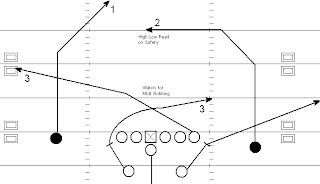
The second point is that, even if you call Spurrier's time in the NFL a total bust, offense and all, it's just not a great example to use in the general argument about "college offenses" not working in the pros. When people have that discussion they are usually talking about why an option-based or a spread offense won't or can't work there. But what is Spurrier's offense if not pro-style? He relies exclusively on a dropback passer, he frequently uses a fullback, and the routes he uses came from the NFL. Insofar as his offense had some kind of unique element (at least for its time), it was that he let his receivers read coverages on the fly and adjust their routes accordingly -- a technique more complicated and thus more appropriate to the advanced NFL. See the below diagram of Spurrier's variation on "smash," whereby the receiver can run a curl underneath the cornerback against cover three, or will break for the corner if the cornerback stays close to the line.
Moreover, his offense was largely based on a very pro-style dichotomy: his base run play was the lead-draw, which allowed his linemen to largely pass set and his QB to get a look at the defense. The basic diagram of the play is below.
And if the defense came up on him he went to play-action off of a lead-draw look. This was ingenious, because he could both show a run play yet his linemen could pass-set and his quarterback could get a look at the defense downfield. See one of his most common plays below, where combined with the lead-draw were routes where the receivers also adjusted their patterns on the fly based on the coverage.
Focusing so heavily on the lead-draw and fake lead-draw also gave him the advantage of setting up his normal dropback plays as well. Check out the highlight video from the 1996 SEC Championship for some good examples.
And compare all this with what Urban Meyer does at Florida now. That is what people mean when they say "college offense." And if they don't mean that they mean the option of a Nebraska or what Paul Johnson does at Georgia Tech. Regardless whether you buy those arguments, the success or failure of Spurrier's drop-back and play-action pass-based offense seems wholly irrelevant to the discussion.
Then why did he fail? As I indicated at the beginning, to me, it was not the offense, it was the man as head coach. Being an NFL head coach is about many things, but calling the plays is a very small part of it, and it is a part that can be (and maybe should be) delegated to someone competent. As stated above, the talent situation was a huge mess and was in total flux, with a bunch of Florida cast-offs (I loved Chris Doering and Wuerffel in college but come on), several high-priced busts (Chad Morton?), and no quarterback to speak of. These are faults that reflect on the man, but not necessarily on the schemes. And really, the narrative is that the schemes probably got too much hype all along, as is common. (And keep in mind that Joe Gibbs won only six games in 2004 and only five in 2006.)
They were ingenious but that is different from him being a genius, and of course he had the talent at Florida to make it go. He also, it must be said, arrived at the right time in history when the spread and pro-style offenses had really just begun to supplant an older, earlier way of thinking, especially in the SEC. But in addition to the lack of institutional advantages for Spurrier in the Pros as opposed to his time at Florida, he also lacked the preparation to make it go. I don't know about discipline and all that, but there were enough stories of the franchise's disorganization to affirm that he did not have a handle on the bundle of intense personalities that makes up any NFL team, and certainly did and continues to make up the Washington Redskins in particular.
Yet there was one scheme criticism that got much play that was in fact true: his inability to gameplan pass protection. Spurrier won his first NFL game against the Arizona Cardinals where his offense scored 31 points, but in his second, against the Philadelphia Eagles and blitz-happy defensive coordinator Jim Johnson, he was fundamentally outcoached on the way to a 37-7 blowout. And that was the beginning of the end.
But he was not outcoached in some fundamental "college offense won't work in pros so there" way, but instead he fell victim to the 80/20 principle I talked about: Spurrier ran a pro-style system, and if you're going to do that in the pros you better be ready for the meat grinder that is their film study. Johnson, a wily guy who has been around the block a few times, devised one blitz after another that got to the core of Spurrier's protections and never let him out. (Incidentally, this gets to one of the common criticisms of my NFL bit, which was that I couldn't be serious saying that the NFL wasn't complex. But I never said that; I said it was bland yet, within that blandness was incredible complexity on the micro scale. A lot of college guys have said if you introduced more macro variation you could reduce the micro complexity -- i.e. a million blitzes you have to gameplan for -- but that's something for later.)
So what's the verdict? Spurrier failed, but it was not his "college offense" that let him down, it was the man, his overall lack of control of players, his roster management, and his own coaches, and in no small part the inadequate planning that went into his "pro-style attack."
I am frequently asked why I don't more often discuss NFL offenses. Haven't many of these college gurus been chewed up by the NFL? Didn't the NFL "prove" that the run & shoot can't work? Isn't the NFL football's highest level, and doesn't it therefore have the most money and resources, the best people, and shouldn't the result then be that NFL football is the most strategically interesting?
Yes and no. There's several reasons why I devote less space here to what NFL teams do than for college teams. Far and away the most significant reason though, is that, somewhat counterintuitively, NFL offenses are surprisingly bland and homogenized. Not entirely, but as a rule of thumb, 80% of what NFL teams do on offense (or defense, really too) is extremely straightforward to the point where every team runs the same stuff. And the list is not that long. In an appendix at the bottom, I have cataloged basically the entire set. Most notably, the whole NFL's entire run game amounts to about four or five plays: the inside zone (also known as the "tight zone"), the outside zone (also known as the "stretch play" or the "wide zone"), power, counter, and some kind of draw, particularly the lead draw. No matter what cosmetic deceptions you see when you watch an NFL game (and remember, these cosmetics are supposed to be good enough to fool the opposing coaches who have studied film all week), you're seeing the same plays over, and over, and over again. There is some admitted monotony to this. Indeed, after today, having sketched out a great deal of this 80% of the NFL's offense, there won't be much need for me to come back to what a specific NFL teams do.
But what of all those stories of Jon Gruden or Andy Reid getting only 45 minutes of sleep a night (and of course sleeping in their offices), and all the film study, 500 page NFL playbooks, and lengthy gameplans buttressed by exhaustive statistical analyses. This is the other 20%, which often is interesting. But it is interesting in a very specific way -- within the framework of the basic, repetitive concepts that compose the other 80%. NFL coaches are understandably obsessed with "matchups," a word favored by every football talking head. The coaches spend an incredible amount of time focused on how to get this receiver to go against that safety, this blitzing linebacker against that tight-end, or this pulling tackle against that defensive end. It's an evolving, repetitive, circular, intensive battle.
Yet is of limited ongoing or generalizable significance. Let's say an NFL coach wants to run the counter trey, which is a run play where one lineman pulls and traps (i.e. blocks from the inside out), and another blocker (either lineman or tight-end) leads (i.e. goes up into the crease and looks to hit a linebacker). He might alter the assignments, or use a particular motion or shift or formation, because he wants the kick-out block to go against a certain guy and the lead against another. And, if successful, you, as spectator, probably won't notice what he did: the coach wasn't looking for a pancake block, just "success," which might be as simple as the blocker's getting in the way enough that the runner could get four yards. This "matchup" isn't always as dramatic as you might think. This does not demean its importance, but, from my perspective, does not always lend itself to lengthy, repeated examples.
Moreover, getting into this minutiae requires a great deal of digging and backstory. What have these teams done in the past? Who is injured this week? What is the history between the opposing coaches? I have discussed some of this type of thing before, for example, here. But again, this great complexity ironically flows from a rather bland and homogenous set. The NFL appears populated by eternal, diligent tinkerers rather than broad thinkers.
Television's role
There's a final reason, however, that I don't routinely get into detail with NFL offenses: I'm not convinced the NFL wants anyone to. Whether a marketing decision or one to placate paranoid franchises --word is guys like Mangini are exceptionally controlling of the flow of info, including requiring people to burn and destroy film or handouts -- NFL films does not actually make this footage available, and most of what it shows are such extreme close-ups that it is impenetrable from a strategy perspective. Part of the theory is undoubtedly the desire to overcome the fact that it is marketing a sport where all the players wear masks, something the NBA and golf and most other sports don't have to deal with.
Unfortunately, the result is that it's impossible to get a sense of what is going on during a play: the quarterback releases the ball, the ball floats magically in the air, and the receiver appears like an apparition out of nowhere to catch it. And the practical questions remain. What coverage were they in? What route did the receiver run? What complementary routes did the other receiver run? Who rushed the quarterback? Who picked up those rushers? It's impossible to tell. Take the clip below of the 49ers's dramatic, waning minutes victory over the Bengals in Super Bowl XXIII.
There's a couple of times where you can get a sense of a route or two, but there's not one play where I could (a) diagram the play in its entirety, i.e. all the receivers, or (b) more importantly, tell you what exactly the defense was doing, particularly the secondary. On the big pass to Jerry Rice over the middle, it's clear he ran a dig route, but it's not clear why he was so open. And then the voice-over goes so far as to tell you the actual name of the game winning touchdown play, yet could you tell me what any of the receivers besides John Taylor did on the play? Wouldn't the coverage on Jerry Rice, who would up MVP of the game, have been relevant as to why Taylor was so open? (Both Bill Walsh and Joe Montana later diagrammed the play in their books; there was actually a problem with the playcall as meshing with the formation.)
Fine, that's NFL Films. But what about watching the game on television? Yes, you get some replays, but generally it is not much better. You're lucky if you see the linebackers. Homer Smith once gave advice to people who watch football on television: Don't watch the ball, watch the defense -- you'll never miss where the ball winds up going. Yet he admits that with modern angles this advice is often impracticable. Ironically, too, the NFL, with more money (and likely its intent to market personalities) affixes its camera angles tighter than do college broadcasts My sense is that many college games can only afford a couple of cameras, so they pick a couple that can get a flavor for more of the field. The NFL instead overdoes it.
Why so simple?
That 80% of every NFL teams' offense consists of the same bunch of plays run over and over, combined with the inadequate broadcast techniques that robs the viewer of the ability to decipher the minute game-within-a-game adjustments that are going on, helps explain why it is not always worth it for me to discuss with great specificity what each NFL team does. But that still doesn't answer why NFL offenses are like this. (Defenses have the same issue of 80/20 blandness, though they will sometimes give incredibly exotic looks solely due to the freakish nature of some of the players. NFL cornerbacks can constantly play "press-bail" -- meaning they can show bump and run and yet be able to "bail" and play deep if necessary -- because they are so athletic, and I've seen guys like Ravens safety Ed Reed do miraculous things like line up directly on the line of scrimmage over a tight-end and then at the snap retreat and play deep half-field safety on the opposite side of the field. Other than the kind of stuff that you can only do if you've won the DNA lottery, NFL defenses all tend to be the same as well.)
Theories abound to explain the phenomena. Ones often trotted out: NFL coaches are closed minded; they don't understand the option/spread/wishbone/etc; the speed of the game is much greater than it is college; it's all some sort of conspiracy; and, finally, we have it all backwards, and this NFL-homogenity is actually somehow better, we're just missing it.
These can be dealt with in short order. The NFL has the most money and pressure at stake, and coaches have little job security. There is no reason for them to be so closed minded. And they certainly do understand the option. Many have coached at other levels before, and, though they might not be experts, it doesn't take long to explain how the option and the spread work and why they have been effective. The conspiracy stuff is bunk, and I think it can't be argued that the NFL is not homogeneous or monotonous, and, in theory at least, more diversity would be better, no? Most of the NFL offense defenders argue that the players make it worthwhile to do this, or the passing game is what makes it all necessary, or there is some hidden meaning we're all missing. (This argument is more common than might be initially guessed, and usually takes the following form: "The NFL is better because all that stuff is just a bunch of gimmicks," with "gimmick" being the derogative catch-all term for anything that breaks out of the 80% mold delineated in full below. As described below, one unfortunate plank of this argument is the reliance on the idea of "ideal" football.)
The speed argument is more difficult to discard, though I think for now we can ignore it. On the one hand, the idea that the defense is faster suddenly dooms all these schemes common to college seems bizarre considering that the offensive guys are (or should be?) faster too. Thus, relatively, there is no speed advantage. On the other hand, if NFL players are all both bigger and faster, then in practical terms the field itself has shrunk, even if the players are relatively the same. Yet on the other, other, hand, with more straight ahead speed and better quarterbacking, teams can better stretch the field vertically. On the whole, unless someone wants to do some real studies, I find this rather inconclusive.
There are three arguments that I think do help explain the NFL 80/20 blandness. Note however that not included in this list is the meme popular among the NFL itself (and those announcers!) that what they do is simply "better." The problem with this idea is that "better" begs too many questions: Better than what? Better how? Better as a professional offense with professional players, or better for high school players too? What is better considering that there is time to integrate any concept you want into your playbook? Isn't the "better" thing then just the more time and resources you have? So I leave this aside.
The three are:
Coaching incest. The NFL fraternity is too incestuous, and thus they don't get out of their comfort zone enough and don't seriously engage with what is going on elsewhere.
Lack of incentive to experiment.Related to above, but the idea is that, post free-agency, there is little reason for NFL coaches to "think outside the box," and when they do and fail, they will be ridiculed and fired. For example, Marv Levy famously went to the Wing-T offense with the Kansas City Chiefs in the late 70s and early 80s, and was promptly fired.)
The quarterback obsession. The money and necessity involved with NFL quarterbacks has so come to dominate the thinking and strategy behind the sport that it hampers both experimentation but literally what they have time to do. If you ask an NFL coach what he spends his time on, or why they don't use more run plays, and he will likely tell you that they spend all their time on pass protection and protection schemes, and this cuts down on what else they can do.
I think all three of those ideas have some merit. The incest idea sounds a little odd, but then you remember that the vaunted "Wildcat" offense was brought to the NFL by David Lee, former quarterbacks coach at Arkansas.
The second I think is underrated but important. Lost in the debate about who is more innovative, the NFL or college or high schools, is their institutional capacities. It doesn't surprise me that the most sophisticated zone blocking techniques or pass protection schemes -- or even five or seven-step drop pass patterns -- are usually developed in the NFL. The margins are quite thin there because the personnel is so good and every team has a salary cap. This stuff is their bread and butter, and they will constantly tinker with it.
But what incentive does an NFL team have to just say "screw it, I'm going to do something weird." Very little. Even the moribund Detroit Lions don't really have this need; the Miami Dolphins went from worst-to-playoffs, though with a little help by being different. Different helps but we're not talking about extremes.
In college or high school, however, you have teams that are completely downtrodden, as in winless in years downtrodden. There is no reason in these scenarios not to experiment. Of course, everyone knows that Rich Rodriguez's "zone read" offense was born at Glenville State where he said his entire goal was "just to get a first down." There are a lot of really bad Division I programs, but even more bad or obscure small colleges, and thousands more high schools. Indeed, for all the talk of the "Wildcat" as a "college thing," it really was a high school thing. Gus Malzahn ran some similar stuff while a high school coach, and insofar as Houston Nutt and others had their input the shotgun jet-sweep offense which the Wildcat is but one strand of is something that has exploded at high school level but hasn't really made its way to major college football. NFL coaches would do well to keep their eye on the lower levels to see what broad, new, general ideas spring forth. (A final X factor is the issue of practice time: Major D-1 colleges have just about the least practice time at any level, and high schools of course have to spend so much time teaching fundamentals that strategy is secondary. As a result there is what I call variation by hedgehog, meaning that you get variety by having a bunch of teams focus on one or two things they do really well, compared with the NFL where teams try to do a bit of everything.)
Finally, this third issue cannot be discounted. Bruce Arians, now offensive coordinator for the Pittsburgh Steelers and former quarterback coach for the Indianapolis Colts, once did a bit on defeating the zone-blitz. His basic thought was about protecting the passer: the importance of planning for the zone-blitz and protecting the quarterback at all costs. Then, at the end he wrote: "P.S. If your quarterback doesn't make $48 million then don't forget the lead option."
Coming from an NFL guy, that's damn near heresy. Of course the quarterback he was referring to was Peyton Manning (though I haven't seen Roethlisberger run any option either), but here's the thought, expanded out. Yes, quarterbacks are incredibly important, and must be protected. You have to spend a lot of time focusing on this protection, getting it right, and calibrating your matchups on top of it all when you have freaks of nature as pass rushers. (I wrote a lengthy article about pass protection here.) That's fine, do what you have to do to protect those guys.
But what Arians hinted at is something a lot of coaches believe: instead of focusing all your energy on trying to scheme your way out of all that crazy, myriad blitzing from everywhere that causes you to drop everything week to week and focus solely on that to the detriment of the run game, then why not focus on what might deter that kind of blitzing in the first place? Like option, or certain spread sets, or other things that college teams do a pretty solid job of right now. Sometimes, rather than bang your head against the wall, there's a better way.
Now this gets into the question about letting some team hit your quarterback, and involves other questions beyond the scope of this article. No one thinks running the option with Manning or Brady is a good idea, and their passing skills are so good that it probably wouldn't be worth it anyway. But is great passing ability exclusive of great running ability? And if it is not, then does running the option significantly increase the risk of injury? How much worse can it be than David Carr being sacked countless times in a season, mostly by being hit from the blindside mid-throwing motion? I'd probably rather be hit while running the ball than like that.
The wildcat and beyond
This is where the wildcat stuff becomes intriguing. The theme for this offseason seems to be that every team is studying the wildcat or looking to install it. There's strategic reasons for this and there's practical ones.
The strategic reason is that the arithmetic doesn't lie: When you run the ball and your quarterback stands there just watching the play, his defensive counterpart can assault the runner. And even if his counterpart holds back, the runner's counterpart remains unblocked; you win games by getting the defense to commit two players to one of yours and thus gain an advantage. The wildcat -- as with the triple option or shotgun spread offense where the quarterback is a run threat -- does this. That's why I predicted back in September 2008 that the wildcat would not be "gone within a week" as several commentators so confidently explained. Indeed, it appears to be gaining momentum.
The second reason is practical. The colleges the NFL drafts from are producing these kinds of multi-skilled players, and NFL teams ought to be able to employ some of them in these schemes without having to risk their $48 million quarterbacks as the bait. E.g., Pat White. That's why this concept has potential for growth, and NFL coaches seem to embrace it now. (How bizarre though that they seem to be embracing this one rather specific branch off what is a much wider and older tree of single-wing/spread/option football. Maybe its apparent newness allows them plausible deniability about having ignored what has been put to good use for decades.)
I will have a future post delineating how I think the wildcat will be used and expanded upon this fall. Unfortunately, I don't see the storyline being quite so rosy as the NFL finally breaking down and going all out with Eric Crouch types at quarterback. I can safely predict that some of the teams that are discussing their wildcat will be completely inept with it: they will do things like going five-wide with their quarterback split out, their runningback or wideout alone in the backfield, call for no motion or faking, and then expect him to plunge into the line for some kind of great effect. That team, its coaches and its fans, will declare the Wildcat a bust. Some other team, maybe the Dolphins again, will expand the package and see success with it. But then what? The worst case -- though possibly the most likely -- will be this:
The offense will fade from prominence, and will be relegated to NFL Films productions about the "WACKY WILDCAT" days of yore, where they will show somebody running free downfield while they speed up the footage and play Benny Hill music. Then they will show a clip of someone stuffing a particular play, and the voice-over will announce that the Wildcat, like all other gimmicks, was figured out and defeated. The NFL types will nevertheless congratulate themselves for having discovered it in the first place. Someone will be called on air to talk about how it was a travesty of the game, in some bizarre platonic ideal sense.
But there is a slight counter narrative. One is that the wildcat, as some kind of hype-machine and maybe even explicit look will die down, but the concepts will infiltrate the NFL and it will finally, and slowly, co-opt ideas that have been successful in every level of football elsewhere. Some will still deride the flashes as gimmicky, but seeing as that most didn't understand it to begin with, most probably won't even notice. Take a look at the clip below: the Ravens, using Ohio State quarterback Troy Smith ran the zone-read, and the highlight guys began a small war on what to call it. (Smith also takes a rather bizarre inside angle with his run.)
Conclusion
Time will tell where all this goes. For now, however, I expect the NFL Offense to remain as indicated, with just a flew flashes of the wildcat and other similar elements. But maybe with more, and cheaper, players who can execute these schemes the NFL will be forced to adapt them to its own ends. And maybe that will even help protect its quarterbacks.
APPENDIX - The NFL Offense
Formations may differ, as will motions and a few little quirks, but basically this is what every single NFL team does. They might have a wrinkle or two per week; they might adjust the formations so they get their Pro-Bowl receiver running the route they want; they might run each play from everything from a three tight-end set to a spread formation; but it is all there. It is a partial sketch below. There are some I have diagrams, and with others I have links to old articles either instead of or to supplement the diagrams.
(1) Run game
- Inside Zone, a.k.a. "tight zone"
- Outside zone, a.k.a. "wide zone" or "stretch" (either regular blocking (shown below, diagram courtesy of Trojan Football Analysis) or "pin and pull")
- Shallow series (for more on the drag and drive series, see here, and for a comprehensive look at the shallow stuff Mike Martz ran with the Rams, see here)
- Seam and square-in/other downfield passes like double-post
(4) Movement passes
- Bootleg. Everybody runs the same bootleg passes, one with the fullback faking the counter and running to the opposite flat, and the other the basic one with one guy to the flat after a count as a blocker and another dragging behind him.
(5) Screens
- Slow screen to RB and TE. Also will use double-screens or read-screens with the slow screen combined with either a sail or drag type route
The Navy blog "The Birddog" has a great post breaking down elements of Paul Johnson's flexbone offense. The videos he culls exhibit something I've tried to explain about defending Johnson's offense: you can't just play "assignment football." That term gets thrown around by announcers a lot, with the implication being that all you have to do is "assign" one guy to the dive back, one to the quarterback, and one to the pitch back. The problem is that Johnson will figure out your assignments and change his blocking schemes accordingly. For example, compare the two videos below, again, both courtesy of The Birddog.
Okay, so the safety ends up making the tackle on the pitch back, while the cornerback forced the pitch by taking on the quarterback. Johnson saw that, and on the very next play, called the same play to the other side, but with one important difference: the near slotback blocked the safety -- i.e. the guy responsible for the pitch back. So who now has the pitch back? Let's find out:
Answer: No one. That Paul Johnson, he's crafty. This is basically what happened when those Georgia Tech teams put it together last season and whupped up on teams. Indeed, his offense had a rather high degree of variance, considering that in some games against weak opponents it did little but in others, including against Miami and Georgia, the second half was defensive armageddon. I think the Miami game in particular was an example of a defense that had a plan for the flexbone going into the game, a decent one, but Johnson figured it out about halfway through and Miami lacked the ever important counter-to-his-counter. And once Johnson started messing with UM's defensive assignments, the defense got stretched out, and then plays like these happened:
(Ht Dr Saturday.) I will have more to say about Johnson's flexbone before the season begins, including some thoughts on defending it.(Preview question: how do you deal with the flexbone's triple scheme -- which can easily outflank the defense to one side of the field -- with the flexbone's immediate pre-snap threat of four-verticals? Keep in mind that adding another defender to the box tends to force you into a single-safety defense, which is precisely what four verticals is designed for. More on this later.)
But for now, savor last season's mutlifarious brilliance of option football writ BCS. The flexbone-triple:
End note: As a final bonus, it appears the good people at EA Sports have added more passing to the flexbone. In the video below, the old run and shoot "choice" route is shown. (Ht EDSBS.)
I'd like to think they got this from me, but all of us like to tout our self-importance, no?
Singletary is sometimes inspiring and always entertaining. But, over at the NY Times's Fifth Down blog, KC Joyner discusses whether Singletary's motivational tactics are effective. What motivational tactics? Well, one involves mooning your own team, and the other, well, here:
Joyner quotes Vince Lombardi -- to paraphrase, that the key to being a good motivator is to know which players need a kick in the tail and which need a pat on the back and then giving them what they need -- and then reasons that Singletary might be good with the former but not so much the latter. His evidence is that Vernon Davis, the tight-end who drew Singletary's public ire, saw his blocking efficiency numbers go up slightly after Singletary took over, while the efficiency of the offensive line went down, a result especially salient since Singletary fired the offensive line coach after taking over for not being "physical enough."
A couple thoughts. First, I respect Singletary, but I am not convinced that you can win NFL football games by simply increasing the "physicality" factor of the your O-Line. The incentives, the structure, the lifting coaches, the salaries, job security, and all the rest already point to the idea that for the most part the line is doing about as well as it can with the players it has and the schemes being employed. I'm not saying you can't increase it at all, but I am doubtful as to whether it can be increased enough to have an effect on winning and losing football games. In high school, where the player variance is so high, sure, that's a big deal. But in the NFL?
But, even assuming, arguendo (and dubitante), that it is possible to increase the physicality and all that, I am not sure that Joyner's critique is the right one. Now, I will admit that I don't have all the methodology for how Joyner computes his "point of attack" efficiency. (I do know that, broadly at least, he watches the film, decides whether a play is being run in that lineman's area, and determines whether he deems that block a success or not. Maybe my lack of further knowledge dooms my response but it is hard to critique without watching all those plays myself.)
Joyner's argument seems to be that the line just plain got worse; they responded poorly to Singletary's high-energy style. But does that make sense? A line's ability to block well often hinges on what kind of front they are going against and how likely the other team is to expect the run. In college, Texas Tech routinely averages over six yards a carry because running for them is at times about the equivalent of a trick play. After Singletary took over, he made no secret of his desire to run the ball more and he did in fact do so. A rational defensive response to this would be for opponents to focus more on run defense, thus making the line's job harder.
And there is evidence for this in the stats. While the 49ers actually averaged fewer rushing yards per game after Singletary took over, the team averaged more total yards. The differences are small, and can therefore be attributed to several things, but one viable answer is that the defense began focusing more on the run allowing the 49ers to actually pass their way to more victories. A surprising result.
Surprising, but more plausible than the fact that the offensive line just started quitting on Singletary, which is apparently Joyner's conclusion. It is unremarkable to observe that lineman will more consistently make their blocks -- and thus have higher efficiency numbers -- if the front they are going against is easier to run against. Indeed, Joyner himself observed those statistics, even if he didn't quite see the result, when he discussed the fact that the Arizona Cardinals' offensive line was surprisingly efficient.
The upshot is that point of attack efficiency numbers aren't all that helpful in the context of constantly evolving fronts with a splash of game theory in that the defense adjusts to not only actual strengths by the offense, but perceived ones, like a new coach's commitment to running the ball. Again, maybe I'm being unfair to Joyner, but it is hard to evaluate his stats without seeing all those individual plays. (I am not sure what he defines "point of attack loss" or "defeated blocks" as. Does that take into account extra defenders? Where a successful double-team did not turn into a combo block to a linebacker? Line play is not always about one-on-one battles.
I'm not saying I agree with Singletary either, but I'm not sure it's a failure of motivation or the wrong kind of motivation being applied, but instead that aspect being dwarfed by other factors, particularly the defense's extra scrutiny of the run game. "Getting physical" is sometimes a euphemism for stubborn playcalling, and a runningback who averages five yards per carry for 120 yards a game plays in a better offense than one who averages 130 on 32 carries. Singletary may recognize this, but time will tell. Even for lineman, the game is about putting your players in positions where they can have success. It's not productive to put them in a difficult position and then say they aren't motivated enough, or conversely that the wrong kinds of motivational tactics are being used. This is the NFL we're talking about.
The previews are coming in and they are grim. The Quad ranks the Boilermakers a preseason 94th, while Dr Saturday ponders the likelihood of a return to pre-Tiller ineptitude. As my previous forays evidence, Purdue, or at least its offense, is a special subject for me, as I learned a lot about the passing game, the one-back, and offense in general from the spread-show that Tiller brought to West Lafayette. The spread’s whole history is in many ways perfectly captured by Joe Tiller’s Big 10 tenure: from its blockbuster beginnings as the perfect underdog offense, which allowed the little guy to compete with the big dog, to me-too offense that everyone had to run, to finally complete saturation, where the spread – or at least the pure, pass-first version as was first developed – might actually help seal the fate of the little guy who tries to isolate inferior receivers against superior defensive backs (and hence also inferior linemen versus superior defensive linemen and linebackers). That worry would seem particularly acute for Purdue, considering it lost its quarterback, runningback, and top two receivers, which is especially acute considering Purdue had already lost its top two receivers from the year before that as well, in Dorien Bryant and Dustin Keller, now tight-end with the New York Jets. So the cupboard looks bare. Yet I speculated on what Purdue’s new “mystery offense” might look like under new offensive coordinator, calling it “NFL-esque” and even going so far as to say that Purdue’s spread offense days were “likely over.”
I may have spoken too soon, though the signals are mixed. Blogs for the Orlando Sun Sentinel, in reporting on Nord’s leaving the Florida Atlantic staff where he had worked for Howard Schnellenberger (and had worked for Schnellenberger for decades, going back to their time together at Louisville), assured its readers that Nord’s departure did not mean that FAU would become a spread team: “Note: The offense will remain the same. Howard is not about to join the charge to the spread. And as was shown Saturday night, his offense can roll through defenses and put up points just like the spread can.” This implies that he did not run a spread offense at FAU.
Similarly, the reports are that Nord is pleased with the development of his tight-ends, and looks to feature them at Purdue. Now, tight-ends and the spread are not mutually exclusive, but such a heavy focus is usually a bit different than the philosophy as it is for most spread teams. As the Indianapolis Journal and Courier has reported:
Gary Nord made no secret about one of his goals for Purdue's offense.
"We're going to throw the ball to the tight end," the first-year offensive coordinator said.
Nord's history would indicate that he won't stray far from that statement. In his 24 seasons as an offensive coordinator, tight ends have led in receptions 22 times.
"We're seeing that," junior tight end Kyle Adams said. "Coach Nord gets the ball a lot to the tight ends. It's great being in this offense."
Okay. But then ESPN throws out further mixed signals:
Florida Atlantic used more two-back sets with double tight ends, but kept the spread structure in place.
What is a “spread structure” with two-back sets? At some point all that is just semantics. What I predicted, based on what I had seen from Nord and Schenellenberger, was a pro-style offense in that they would use one-back, four wide, five wide sets, but also two-back, I-formation ones with play-action. Whether that is “spread structure” or not, I am unsure, but the basic idea was to predicate your offense on either a one-two punch of power-runs with play-action passes or spread sets with quick and five-step passes countered by draws and screens. Purdue, with Painter and in recent years, focused almost entirely on the latter, whereas I expected Nord to bring in a mix.
Below are clips of the kinds of sets I expected Nord to mix in with his system.
Note the mix of spread sets and play-action from traditional sets. Yet here is video of Purdue’s spring game. (Ht: The Rivalry, Esq.
Looks an awful like the old stuff, no? That’s not necessarily bad, but it’s a concern. FAU had some decent success as an upstart program running a system that suddenly was sort of out of vogue – the pro-style stuff. Yet why focus solely on what hadn’t gotten you over the hump against the good teams? Maybe those concepts are on the way; maybe Purdue didn’t want to show too much for spring ball; maybe they know something I don’t. I’m sure familiarity with the old system was important for the players because so much of the spring was about newness: new players, new coaches, new schemes. So no need to unleash the whole package. But I’m just not convinced Purdue will win a lot of games without doing something more interesting next year, and that more interesting might be something a bit old school. Going back to the Brees days of five-wide three-step quick game from gun will not be enough; being different takes all kinds of forms.
Best case scenario: the offense evolves from what is in that spring highlight clip to something like what Mike Gundy and Gunter Brewer do at Oklahoma State – lots of three-wide, one-back and one tight-end sets, play-action from gun as well as quick passes, and the occasional under center look as well. (The more I study the Okie State offense the more I like it, at least regarding schemes.) Worst case scenario? A replay of 2008, but with inferior players.
The Ryan Leaf saga has taken its most tragic -- and possibly final -- turn:
CANYON, Texas (AP) -- Former NFL quarterback Ryan Leaf has been indicted by a Randall County grand jury on drug and burglary charges.
The indictment handed up Wednesday in Canyon charged the 33-year-old former San Diego Chargers quarterback and former West Texas A&M quarterbacks coach with one count of burglary to a habitation, seven counts of obtaining a controlled substance by fraud and one count of delivery of a simulated controlled substance.
The indictment said Leaf presented an incomplete medical history to several physicians between January 2008 and September 2008 to get or try to obtain the painkiller Hydrocodone. . . .
Canyon police Lt. Dale Davis said Leaf is suspected of breaking into a Canyon apartment on Oct. 30 and stealing Hydrocodone, which had been prescribed to an injured football player. . . .
"We have not found any evidence implicating anyone other than Mr. Leaf in this case ... but believe there's additional evidence implicating him in other events," [Randall County district attorney James] Farren said. He would not elaborate.
(H/t Dr Saturday.) Leaf of course was a world-class bust in the NFL, as much for personality reasons as for physical ones. But in college, he was a beast: He led Washington State to a 10-2 record and a Rose Bowl appearance, he threw for 3637 yards (over 330 a game), and 33 touchdowns. (Team stats here.)
And, particularly in historical perspective, that Washington State offense was dynamic. Mike Price designed it based on, in part, by what he had learned from Dennis Erickson's one-back attack at Washing State and elsewhere. Indeed, this one-back offense was one of the predecessors for the modern spread attack, both in terms for passing and running. Mike Leach and Hal Mumme visited Price to learn his offense before they went on to break every SEC passing record in 1998, and Price shared his offense's precepts with coaches like Purdue's Joe Tiller, who had also worked with both Price and Erickson.
Price, of course, experienced his own rise and fall. He was hired to coach at Alabama and, after some kind of stripper-scandal (aren't all the best scandals stripper-related?), was fired before his first season could even commence.
But, for a time, especially in 1997, the two, Leaf and Price, coach and quarterback, combined to put on a show worthy of the sliver of immortality reserved for all such successful seasons. In this post I will give a brief overview of the theory behind the Washington State offense that year. Mike Price liked to joke that he could explain it in five minutes on the back of a napkin. An exaggeration, but not much of one.
The Washington State one-back
Price employed a lot of formations that year, but they used the "double slot" the most: two receivers to either side of the quarterback along with one running back. Many now will recognize this as the basic spread formation (though Leaf was usually under center rather than in the shotgun), but back then it was somewhat of a novelty still. Price used it because of its then relative rarity, but also for practical reasons: Washington State's fourth wide receiver was better than its tight-end.
The basic theory behind the offense is the one that has been adopted by almost all spread teams: count the safeties, identify how many defenders are in the "box" to decide whether to run or pass, and call your bread and butter stuff until defenders get of of position, then when they do hit them with the constraint plays like bubble screens or play-action. As my article on Urban Meyer's offense explains, Meyer's offense follows the same basic pattern.
To begin with, assume the defense has just one safety back. That means that, if they cover all the receivers, the defense has only six guys in the "box" -- i.e. the interior defenders. The offense has only five blockers, and Leaf was not much of a threat to run. They did however have good matchups on the outside. So the first thing WSU looked for was the leverage of the cornerbacks: were they playing soft or tight? If they played soft, Price (or Leaf via audible) would call a quick, five-yard hitch to the outside receivers. Leaf needed only to pick the best matchup and fire the ball out there. Let the receiver catch a quick one, make a defender miss, and make a big play.
If the defense played "tight," however, Price and co. dialed up one of their "option routes." The outside receivers were to run deep and try to get open deep (which happened with some regularity, as the highlight against UCLA above showed). The inside receivers were to burst upfield to eight to twelve yards depending on the call. Against man-to-man, they cut inside or outside depending on the defender's leverage; against zone they found a hole between defenders and settled in it.
What if the defense put two safeties back, to guard the deep pass and play the receivers tight? Well, then it only had five in the box, so it was time to run the ball. In 1997, Washington State had a good running back, Michael Black, who ran for over 1100 yards in 11 games.
And that pretty much covers the bases. Where it gets trickier is when defenders try to "cheat" -- and that's when you get into the constraint plays. First, the defense might line up with two safeties back but the outside linebackers over the slot receivers will cheat in to stop the run. In that case, the offense can throw the bubble screen.
Alternatively, the inside linebackers or the outside linebackers might cheat in or be watching the run, so that's when the bootleg is often effective. The quarterback looks to hit either the man in the flat or the slot on the deep crossing route.
Finally, if the safeties want to cheat up, well then it is home run time. The quarterback will fake it to the runningback and run the four-verticals concept or another deep attacking play.
That's really about it. an incredible amount of their offense was spent just cycling between that sequence. And Leaf, at least that year, showed a great propensity to read defenses and make the right read on passing plays. But obviously he was helped by having a smart, simple framework to work from.
Other applications
Of course there are other concepts worth mentioning briefly. One was Price's version (or one of his versions) of the shallow cross. Price combines the shallow with the deep cross. The quarterback reads the play by first looking at his deep routes as his "peek" or "alerts" -- i.e. if the home-run is there, take it. If the go and the post aren't open, the shallow cross is "hot," against a blitz, otherwise he can read the deep-cross as his "high" read and the runningback as his "low" read. See the diagram below.
And you can see Leaf hit the deep-cross or "hunt" player against Michigan in the Rose Bowl, with heavy pressure in his face.
And another nice route is what Spurrier called the "Mills" play. It is designed to either be a simple curl-flat read, but with a post route over the top of it. In a lot of coverages -- especially four-deep across -- the safeties play very aggressive, and will jump routes in front of them. This gives the play its big-play potential: if the safety jumps the curl, the post route is wide open behind the defense . . .
. . . and that is exactly what happened in 2002 when Washington State played Pete Carrol's Southern Cal team. (Washington State upset USC, led by Carson Palmer, and probably cost them a shot at the national title game. WSU's quarterback was Jason Gesser, though Price was still the coach.) See the video below.
Conclusion
Exceedingly simple, but those were the spread's gestative years. Maybe history would be different had Price managed to stick around at Alabama, and brought his unique one-back to the SEC before Meyer had set foot in Gainesville. (Though Price's subsequent years at UTEP haven't been spectacular.)
But the larger point is that football, especially in modern times, offers some degree of immortality for those who succeed. Leaf's more recent infamy as NFL bust and low-level criminal will now never leave him, but his full record will always include 1997, when there was no better triggerman in the Pac-10 -- maybe the country. He didn't have an all-star cast around him, just some shifty, tough guys, a well-designed playbook, and the confidence, maybe arrogance, to be great, even if only for a time.
Smart Football analyzes football's strategies, Xs and Os, and tactics, along with the theory and history supporting them. Chris Brown writes Smart Football, and he has been writing about football, in one form or another, since 2002. @SmartFootball (Twitter)






 Posts
Posts


