Singletary is sometimes inspiring and always entertaining. But, over at the NY Times's Fifth Down blog, KC Joyner discusses whether Singletary's motivational tactics are effective. What motivational tactics? Well, one involves mooning your own team, and the other, well, here:
Joyner quotes Vince Lombardi -- to paraphrase, that the key to being a good motivator is to know which players need a kick in the tail and which need a pat on the back and then giving them what they need -- and then reasons that Singletary might be good with the former but not so much the latter. His evidence is that Vernon Davis, the tight-end who drew Singletary's public ire, saw his blocking efficiency numbers go up slightly after Singletary took over, while the efficiency of the offensive line went down, a result especially salient since Singletary fired the offensive line coach after taking over for not being "physical enough."
A couple thoughts. First, I respect Singletary, but I am not convinced that you can win NFL football games by simply increasing the "physicality" factor of the your O-Line. The incentives, the structure, the lifting coaches, the salaries, job security, and all the rest already point to the idea that for the most part the line is doing about as well as it can with the players it has and the schemes being employed. I'm not saying you can't increase it at all, but I am doubtful as to whether it can be increased enough to have an effect on winning and losing football games. In high school, where the player variance is so high, sure, that's a big deal. But in the NFL?
But, even assuming, arguendo (and dubitante), that it is possible to increase the physicality and all that, I am not sure that Joyner's critique is the right one. Now, I will admit that I don't have all the methodology for how Joyner computes his "point of attack" efficiency. (I do know that, broadly at least, he watches the film, decides whether a play is being run in that lineman's area, and determines whether he deems that block a success or not. Maybe my lack of further knowledge dooms my response but it is hard to critique without watching all those plays myself.)
Joyner's argument seems to be that the line just plain got worse; they responded poorly to Singletary's high-energy style. But does that make sense? A line's ability to block well often hinges on what kind of front they are going against and how likely the other team is to expect the run. In college, Texas Tech routinely averages over six yards a carry because running for them is at times about the equivalent of a trick play. After Singletary took over, he made no secret of his desire to run the ball more and he did in fact do so. A rational defensive response to this would be for opponents to focus more on run defense, thus making the line's job harder.
And there is evidence for this in the stats. While the 49ers actually averaged fewer rushing yards per game after Singletary took over, the team averaged more total yards. The differences are small, and can therefore be attributed to several things, but one viable answer is that the defense began focusing more on the run allowing the 49ers to actually pass their way to more victories. A surprising result.
Surprising, but more plausible than the fact that the offensive line just started quitting on Singletary, which is apparently Joyner's conclusion. It is unremarkable to observe that lineman will more consistently make their blocks -- and thus have higher efficiency numbers -- if the front they are going against is easier to run against. Indeed, Joyner himself observed those statistics, even if he didn't quite see the result, when he discussed the fact that the Arizona Cardinals' offensive line was surprisingly efficient.
The upshot is that point of attack efficiency numbers aren't all that helpful in the context of constantly evolving fronts with a splash of game theory in that the defense adjusts to not only actual strengths by the offense, but perceived ones, like a new coach's commitment to running the ball. Again, maybe I'm being unfair to Joyner, but it is hard to evaluate his stats without seeing all those individual plays. (I am not sure what he defines "point of attack loss" or "defeated blocks" as. Does that take into account extra defenders? Where a successful double-team did not turn into a combo block to a linebacker? Line play is not always about one-on-one battles.
I'm not saying I agree with Singletary either, but I'm not sure it's a failure of motivation or the wrong kind of motivation being applied, but instead that aspect being dwarfed by other factors, particularly the defense's extra scrutiny of the run game. "Getting physical" is sometimes a euphemism for stubborn playcalling, and a runningback who averages five yards per carry for 120 yards a game plays in a better offense than one who averages 130 on 32 carries. Singletary may recognize this, but time will tell. Even for lineman, the game is about putting your players in positions where they can have success. It's not productive to put them in a difficult position and then say they aren't motivated enough, or conversely that the wrong kinds of motivational tactics are being used. This is the NFL we're talking about.
Tuesday, June 09, 2009
Monday, June 08, 2009
"Confabulatory" rankings of college football players
 So I stumbled on "The College Football Performance Awards" site. Its mission statement is "to provide the most scientifically rigorous conferments in college football. Recipients are selected exclusively based upon objective scientific rankings." The basic driver seems to be that the ballot system, whereby some names are picked, some folks vote, and somebody wins, is an inherently flawed way to select football players; indeed, it is, they argue, more like a "popularity contest."
I suppose there's some merit to that proposition. The idea is that there must be some better way to evaluate a player, particularly if a player wins an award because of his strong supporting cast as opposed to what he individually brings to the field. Brad Smith, former Davidson and USC kicker who runs the site, also seems to have the laudable goal of including more mid-major program players into the final award mix. For example, in his rankings Rice quarterback Chase Clement finished higher in the overall rankings than Tim Tebow (Colt McCoy finished #1). So these are generally laudable goals but I still don't quite know what to make of all this.
First, the value of any so-called "objective metric" is in how good the algorithm is. On that score, despite journalists telling us that Mr. Smith's "methodology is all there on the website," I come to find out that it is not.
Smith tells us simply:
The goal of this research is to advance a sophisticated representation of college football; a just, refined, and elegant measurement of performance; a precise, objective, and scientifically reliable selection of deserving recipients; an inherently dispassionate, methodologically sound, and experimentally valid celebration of individual achievement.
But that's really it for explanation, just cool assurances that it is an elegant, sound, and valid "celebration." My favorite of course is his discussion of why rushing yards is inadequate, which I must paste in full:
Q: Is football performance analysis a form of scientific enquiry?
A: The question, "Who are the top performers in college football?" is an inherently empirical question. In other words, any attempt to answer this question trespasses overtly on the domain of science.
PERFORMANCE 101: ANALYZING RUSHING DATA
The college football player with the most rushing yards per game is sometimes referred to as the "rushing leader". This usage is misleading and, in some sense, even confabulatory. In reality, the rushing yards per game statistic is not very helpful in evaluating rushing performance and is a poor predictor of team success. For an example of this, consider running back A with 900 yards on 300 carries, B with 870 yards on 145 carries, C with 840 yards on 120 carries, and D with 800 yards on 80 carries. Further, assume that A, B, C, and D have all played the same number of games, and all other rushing variables are held constant. According to the rushing yards per game statistic, A is the rushing leader, B is second, C is third, and D is fourth. Yet, almost certainly, these rankings are inverted. After all, in this case, the discrepancies in rushing yards per game are fairly small, while there are significant differences in rushing yards per carry. To declare A the rushing leader merely based upon A's standing in rushing yards per game without careful review of other factors and considerations is at best -- a cursory and superficial analysis, and at worst -- a specious and obfuscatory one.
I know what is "obfuscatory," and it is not just the ballot system. (I also enjoy spelling "enquiry" with an "E"; he was a philosophy major so I guess he has to spell it the way David Hume did.)
But all this begs this question. He tell us that subjective views of a runningback, or even a "scientific" review based on total yards doesn't tell us much. This is of course all rather pedestrian, but he he doesn't tell us what the next step is. Is it average yards per carry? Some mixture? He doesn't say. There is no explanation of his methodology.
He does have an "academic review" section, but these fine folk don't really discuss his actual methods, and instead seem to comment only on the general idea that objective, statistics-based criteria for ballots is inherently better than the ad hoc poll/ballot system currently in use. All quite possibly true, but merely stating that is not enough. (He also has a section titled "models," which I clicked on thinking it would tell me about his algorithms or the models he used to rank players. I was wrong, but it is likely worth clicking on anyway.)
The reason this is significant is because, contrary to what he seems to think, he's not the first guy to try to evaluate players based on the statistics. Football Outsiders has been trying to do this for over a decade, and the Pro-Football Reference site is another notable site which has gone into great detail and has laid it out for the world to understand. These enquiries, along with many others, have been going on for some time, and are free from the ballot box problems he identifies.
But the other reason it is significant, in light of his apparent thought that he is the first to finally Rank All That Is Good in Football, is that we've learned a lot about how difficult it is to model and evaluate players because of the hard work and transparency of these other sites and books. It isn't easy. He claims to be able to extract the fact that Colt McCoy is better individually than Sam Bradford, or that Dez Bryant was better than Michael Crabtree; any differences in results were just based on teammates. Maybe so, but how can you be sure? And how do you apply that kind of analysis to teammates, or offensive line play, or even quarterbacks, whose job is to distribute the ball around while relying on other guys to protect, get open, make the right play, etc? It's not that it can't be done, it is silly to act like you're first, or to but acting like you're the first to have thought about these questions, or to convince journalists to write things like:
Smith says on his website: "Who are the top performers in college football?" is an inherently empirical question. In other words, any attempt to answer this question trespasses overtly on the domain of science.
Science.
There's college football's seven-letter word. It suggests computers, which suggests BCS, which will make some of you stop reading right here.
And Let The Light of Discovery Shine Down Upon Thee. The answer is that it's all a bit silly, and this majestic quest to give awards based on elegant and objective science is a commendable goal, but Mount Everest hasn't been climbed yet, and the way has been paved for some time.
But the other reason why this is so bizarre to me, is why is this so focused on post-season awards? The article linked to implies a suggestion: that Mr. Smith's (perfectly acceptable) goal is to sell his ideas to various decisionmakers who hand out the Doak Walker Award, or the Unitas Quarterback Award, Lou Groza, and the like. That's fine, but for all the arguments about how subjective the post-season awards are, it ignores the question of why they shouldn't be somewhat subjective?
What should be wholly objective is a coaching decision to start one player or another, or to recruit a guy or for an NFL team to hire one as a free agent (marketing aside). That is 100% about getting the best players on the field to perform. (Though that analysis ignores the correlations that might exist among different groups of players, an idea studied much more in depth in basketball than football.)
But with awards, why is it so bad if the Big Schools win? What are these awards? No one has ever sufficiently answered for me whether the Heisman trophy is a "most valuable player" award designed to go to the critical member of a great team without whom the team would fail, or whether it is simply the best individual player in the country, or alternatively (and this is not the same thing), the player who has put in the best performance.
The implicit premise of Smith's site is that it should go to the latter, but I'm not certain that others would agree. Why shouldn't Danny Wuerrfel win the Heisman when the Gators were rolling over people rather than Troy Davis, who was individually quite impressive with over 2,000 yards rushing? Would a supposedly "objective" result be any fairer, one that not only would be subject to the vagaries of the model (which we can't review), but also would discount Wuerrfel's leadership, or ability to get up to throw pass after pass after defender and defender slammed into him head first?
I'm not so convinced that all that is flatly irrelevant in the limited context of postseason awards. Is it a crime that we take all those "subjective" impressions into account? I think not, especially with little to no explanation of the supposedly grand "science" behind the endeavor.
Purdue - Big 10 bottom dweller and offensive enigma?
 The previews are coming in and they are grim. The Quad ranks the Boilermakers a preseason 94th, while Dr Saturday ponders the likelihood of a return to pre-Tiller ineptitude. As my previous forays evidence, Purdue, or at least its offense, is a special subject for me, as I learned a lot about the passing game, the one-back, and offense in general from the spread-show that Tiller brought to West Lafayette. The spread’s whole history is in many ways perfectly captured by Joe Tiller’s Big 10 tenure: from its blockbuster beginnings as the perfect underdog offense, which allowed the little guy to compete with the big dog, to me-too offense that everyone had to run, to finally complete saturation, where the spread – or at least the pure, pass-first version as was first developed – might actually help seal the fate of the little guy who tries to isolate inferior receivers against superior defensive backs (and hence also inferior linemen versus superior defensive linemen and linebackers). That worry would seem particularly acute for Purdue, considering it lost its quarterback, runningback, and top two receivers, which is especially acute considering Purdue had already lost its top two receivers from the year before that as well, in Dorien Bryant and Dustin Keller, now tight-end with the New York Jets. So the cupboard looks bare. Yet I speculated on what Purdue’s new “mystery offense” might look like under new offensive coordinator, calling it “NFL-esque” and even going so far as to say that Purdue’s spread offense days were “likely over.”
I may have spoken too soon, though the signals are mixed. Blogs for the Orlando Sun Sentinel, in reporting on Nord’s leaving the Florida Atlantic staff where he had worked for Howard Schnellenberger (and had worked for Schnellenberger for decades, going back to their time together at Louisville), assured its readers that Nord’s departure did not mean that FAU would become a spread team: “Note: The offense will remain the same. Howard is not about to join the charge to the spread. And as was shown Saturday night, his offense can roll through defenses and put up points just like the spread can.” This implies that he did not run a spread offense at FAU.
Similarly, the reports are that Nord is pleased with the development of his tight-ends, and looks to feature them at Purdue. Now, tight-ends and the spread are not mutually exclusive, but such a heavy focus is usually a bit different than the philosophy as it is for most spread teams. As the Indianapolis Journal and Courier has reported:
Gary Nord made no secret about one of his goals for Purdue's offense.
"We're going to throw the ball to the tight end," the first-year offensive coordinator said.
Nord's history would indicate that he won't stray far from that statement. In his 24 seasons as an offensive coordinator, tight ends have led in receptions 22 times.
"We're seeing that," junior tight end Kyle Adams said. "Coach Nord gets the ball a lot to the tight ends. It's great being in this offense."
Okay. But then ESPN throws out further mixed signals:
Florida Atlantic used more two-back sets with double tight ends, but kept the spread structure in place.
What is a “spread structure” with two-back sets? At some point all that is just semantics. What I predicted, based on what I had seen from Nord and Schenellenberger, was a pro-style offense in that they would use one-back, four wide, five wide sets, but also two-back, I-formation ones with play-action. Whether that is “spread structure” or not, I am unsure, but the basic idea was to predicate your offense on either a one-two punch of power-runs with play-action passes or spread sets with quick and five-step passes countered by draws and screens. Purdue, with Painter and in recent years, focused almost entirely on the latter, whereas I expected Nord to bring in a mix.
Below are clips of the kinds of sets I expected Nord to mix in with his system.
Note the mix of spread sets and play-action from traditional sets. Yet here is video of Purdue’s spring game. (Ht: The Rivalry, Esq.
Looks an awful like the old stuff, no? That’s not necessarily bad, but it’s a concern. FAU had some decent success as an upstart program running a system that suddenly was sort of out of vogue – the pro-style stuff. Yet why focus solely on what hadn’t gotten you over the hump against the good teams? Maybe those concepts are on the way; maybe Purdue didn’t want to show too much for spring ball; maybe they know something I don’t. I’m sure familiarity with the old system was important for the players because so much of the spring was about newness: new players, new coaches, new schemes. So no need to unleash the whole package. But I’m just not convinced Purdue will win a lot of games without doing something more interesting next year, and that more interesting might be something a bit old school. Going back to the Brees days of five-wide three-step quick game from gun will not be enough; being different takes all kinds of forms.
Best case scenario: the offense evolves from what is in that spring highlight clip to something like what Mike Gundy and Gunter Brewer do at Oklahoma State – lots of three-wide, one-back and one tight-end sets, play-action from gun as well as quick passes, and the occasional under center look as well. (The more I study the Okie State offense the more I like it, at least regarding schemes.) Worst case scenario? A replay of 2008, but with inferior players.
Sunday, June 07, 2009
Weekend reading
1. Gus Malzahn's book on The Hurry-Up, No-Huddle: An Offensive Philosophy. I've described Malzahn's theory before, and the basic principles are laid out in this book. Basically, for Malzahn, "no-huddle" means "ludicrous speed" and he proceeds accordingly. The book is light on Xs and Os but that's really a virtue; he wants to sell you on the no-huddle as it can be applied to other offenses, and in any event his Xs and Os are pretty straightforward. He wrote this when he was still a high school coach.
2. How We Decide by Jonah Lehrer. I didn't really think I'd enjoy this as much as I have. Tons of great anecdotes, though the science is better than Malcolm Gladwell (though both share The New Yorker style, which makes sense since both write frequently for the magazine). Neuroscience and behavioral economics have been much on my mind recently (no pun intended), and I intend to elaborate further on how I think their insights relate to football and my general disposition towards more rationality is better. I remain unconvinced that the non-quantitative, non-analytical approach to scouting, evaluating players, and decisionmaking in football in general is appropriate.
But football is the best of all sports for a reason: each play gives every coach and player the opportunity for a few brief moments to gather their thoughts and plan, but the ultimate results are all decided in the heat of the moment -- the quarterback cannot explain exactly why a player was open, but he doesn't have to. He turns, sees the receiver, and if it feels right, he throws it. He might not have time to break all that down analytically -- any more than the middle linebacker has time to explain why he thought the draw was a draw and not a pass play -- but the brain is sophisticated enough to give him the cues. Dopamine and all that good stuff. That said, our brain makes a lot of systematic errors, typically in the form of relying on certain heuristics, but they can often be overcome. Anyway, more on this later.
3. John Rawls's religion?
4. What makes us happy?
5. I got my copy of the The New Yorker summer fiction issue. Also check out this article whether creative writing should [can?] be taught.
6. Not reading, but a good place to waste several hours: lectures from the world's top scholars.
7. I haven't actually read it yet, but I keep seeing reviews for this book everywhere. (I have probably reached the tipping point of reviews; once you've read three or four of them in full it's hard to justify reading the stupid book, no matter how good it might be.) Anyway, quote:
The book is Shop Class as Soulcraft: An Inquiry Into the Value of Work by Matthew B. Crawford, a guy with a Ph.d. in political philosophy from the University of Chicago who runs a motorcycle repair shop (and writes books, obviously). (Ht Marginal Revolution.)
2. How We Decide by Jonah Lehrer. I didn't really think I'd enjoy this as much as I have. Tons of great anecdotes, though the science is better than Malcolm Gladwell (though both share The New Yorker style, which makes sense since both write frequently for the magazine). Neuroscience and behavioral economics have been much on my mind recently (no pun intended), and I intend to elaborate further on how I think their insights relate to football and my general disposition towards more rationality is better. I remain unconvinced that the non-quantitative, non-analytical approach to scouting, evaluating players, and decisionmaking in football in general is appropriate.
But football is the best of all sports for a reason: each play gives every coach and player the opportunity for a few brief moments to gather their thoughts and plan, but the ultimate results are all decided in the heat of the moment -- the quarterback cannot explain exactly why a player was open, but he doesn't have to. He turns, sees the receiver, and if it feels right, he throws it. He might not have time to break all that down analytically -- any more than the middle linebacker has time to explain why he thought the draw was a draw and not a pass play -- but the brain is sophisticated enough to give him the cues. Dopamine and all that good stuff. That said, our brain makes a lot of systematic errors, typically in the form of relying on certain heuristics, but they can often be overcome. Anyway, more on this later.
3. John Rawls's religion?
4. What makes us happy?
5. I got my copy of the The New Yorker summer fiction issue. Also check out this article whether creative writing should [can?] be taught.
6. Not reading, but a good place to waste several hours: lectures from the world's top scholars.
7. I haven't actually read it yet, but I keep seeing reviews for this book everywhere. (I have probably reached the tipping point of reviews; once you've read three or four of them in full it's hard to justify reading the stupid book, no matter how good it might be.) Anyway, quote:
This book grows out of an attempt to understand the greater sense of agency and competence I have always felt doing manual work, compared to other jobs that were officially recognized as "knowledge work." Perhaps most surprisingly, I often find manual work more engaging intellectually. This book is an attempt to understand why this should be so.
The book is Shop Class as Soulcraft: An Inquiry Into the Value of Work by Matthew B. Crawford, a guy with a Ph.d. in political philosophy from the University of Chicago who runs a motorcycle repair shop (and writes books, obviously). (Ht Marginal Revolution.)
Thursday, May 28, 2009
Fond memories of Ryan Leaf and the Washington State offense

The Ryan Leaf saga has taken its most tragic -- and possibly final -- turn:
CANYON, Texas (AP) -- Former NFL quarterback Ryan Leaf has been indicted by a Randall County grand jury on drug and burglary charges.
The indictment handed up Wednesday in Canyon charged the 33-year-old former San Diego Chargers quarterback and former West Texas A&M quarterbacks coach with one count of burglary to a habitation, seven counts of obtaining a controlled substance by fraud and one count of delivery of a simulated controlled substance.
The indictment said Leaf presented an incomplete medical history to several physicians between January 2008 and September 2008 to get or try to obtain the painkiller Hydrocodone. . . .
Canyon police Lt. Dale Davis said Leaf is suspected of breaking into a Canyon apartment on Oct. 30 and stealing Hydrocodone, which had been prescribed to an injured football player. . . .
"We have not found any evidence implicating anyone other than Mr. Leaf in this case ... but believe there's additional evidence implicating him in other events," [Randall County district attorney James] Farren said. He would not elaborate.
(H/t Dr Saturday.) Leaf of course was a world-class bust in the NFL, as much for personality reasons as for physical ones. But in college, he was a beast: He led Washington State to a 10-2 record and a Rose Bowl appearance, he threw for 3637 yards (over 330 a game), and 33 touchdowns. (Team stats here.)
And, particularly in historical perspective, that Washington State offense was dynamic. Mike Price designed it based on, in part, by what he had learned from Dennis Erickson's one-back attack at Washing State and elsewhere. Indeed, this one-back offense was one of the predecessors for the modern spread attack, both in terms for passing and running. Mike Leach and Hal Mumme visited Price to learn his offense before they went on to break every SEC passing record in 1998, and Price shared his offense's precepts with coaches like Purdue's Joe Tiller, who had also worked with both Price and Erickson.
Price, of course, experienced his own rise and fall. He was hired to coach at Alabama and, after some kind of stripper-scandal (aren't all the best scandals stripper-related?), was fired before his first season could even commence.
But, for a time, especially in 1997, the two, Leaf and Price, coach and quarterback, combined to put on a show worthy of the sliver of immortality reserved for all such successful seasons. In this post I will give a brief overview of the theory behind the Washington State offense that year. Mike Price liked to joke that he could explain it in five minutes on the back of a napkin. An exaggeration, but not much of one.
The Washington State one-back
Price employed a lot of formations that year, but they used the "double slot" the most: two receivers to either side of the quarterback along with one running back. Many now will recognize this as the basic spread formation (though Leaf was usually under center rather than in the shotgun), but back then it was somewhat of a novelty still. Price used it because of its then relative rarity, but also for practical reasons: Washington State's fourth wide receiver was better than its tight-end.
The basic theory behind the offense is the one that has been adopted by almost all spread teams: count the safeties, identify how many defenders are in the "box" to decide whether to run or pass, and call your bread and butter stuff until defenders get of of position, then when they do hit them with the constraint plays like bubble screens or play-action. As my article on Urban Meyer's offense explains, Meyer's offense follows the same basic pattern.
To begin with, assume the defense has just one safety back. That means that, if they cover all the receivers, the defense has only six guys in the "box" -- i.e. the interior defenders. The offense has only five blockers, and Leaf was not much of a threat to run. They did however have good matchups on the outside. So the first thing WSU looked for was the leverage of the cornerbacks: were they playing soft or tight? If they played soft, Price (or Leaf via audible) would call a quick, five-yard hitch to the outside receivers. Leaf needed only to pick the best matchup and fire the ball out there. Let the receiver catch a quick one, make a defender miss, and make a big play.

If the defense played "tight," however, Price and co. dialed up one of their "option routes." The outside receivers were to run deep and try to get open deep (which happened with some regularity, as the highlight against UCLA above showed). The inside receivers were to burst upfield to eight to twelve yards depending on the call. Against man-to-man, they cut inside or outside depending on the defender's leverage; against zone they found a hole between defenders and settled in it.

What if the defense put two safeties back, to guard the deep pass and play the receivers tight? Well, then it only had five in the box, so it was time to run the ball. In 1997, Washington State had a good running back, Michael Black, who ran for over 1100 yards in 11 games.

And that pretty much covers the bases. Where it gets trickier is when defenders try to "cheat" -- and that's when you get into the constraint plays. First, the defense might line up with two safeties back but the outside linebackers over the slot receivers will cheat in to stop the run. In that case, the offense can throw the bubble screen.

Alternatively, the inside linebackers or the outside linebackers might cheat in or be watching the run, so that's when the bootleg is often effective. The quarterback looks to hit either the man in the flat or the slot on the deep crossing route.

Finally, if the safeties want to cheat up, well then it is home run time. The quarterback will fake it to the runningback and run the four-verticals concept or another deep attacking play.

That's really about it. an incredible amount of their offense was spent just cycling between that sequence. And Leaf, at least that year, showed a great propensity to read defenses and make the right read on passing plays. But obviously he was helped by having a smart, simple framework to work from.
Other applications
Of course there are other concepts worth mentioning briefly. One was Price's version (or one of his versions) of the shallow cross. Price combines the shallow with the deep cross. The quarterback reads the play by first looking at his deep routes as his "peek" or "alerts" -- i.e. if the home-run is there, take it. If the go and the post aren't open, the shallow cross is "hot," against a blitz, otherwise he can read the deep-cross as his "high" read and the runningback as his "low" read. See the diagram below.

And you can see Leaf hit the deep-cross or "hunt" player against Michigan in the Rose Bowl, with heavy pressure in his face.
And another nice route is what Spurrier called the "Mills" play. It is designed to either be a simple curl-flat read, but with a post route over the top of it. In a lot of coverages -- especially four-deep across -- the safeties play very aggressive, and will jump routes in front of them. This gives the play its big-play potential: if the safety jumps the curl, the post route is wide open behind the defense . . .

. . . and that is exactly what happened in 2002 when Washington State played Pete Carrol's Southern Cal team. (Washington State upset USC, led by Carson Palmer, and probably cost them a shot at the national title game. WSU's quarterback was Jason Gesser, though Price was still the coach.) See the video below.
Conclusion
Exceedingly simple, but those were the spread's gestative years. Maybe history would be different had Price managed to stick around at Alabama, and brought his unique one-back to the SEC before Meyer had set foot in Gainesville. (Though Price's subsequent years at UTEP haven't been spectacular.)
But the larger point is that football, especially in modern times, offers some degree of immortality for those who succeed. Leaf's more recent infamy as NFL bust and low-level criminal will now never leave him, but his full record will always include 1997, when there was no better triggerman in the Pac-10 -- maybe the country. He didn't have an all-star cast around him, just some shifty, tough guys, a well-designed playbook, and the confidence, maybe arrogance, to be great, even if only for a time.
Wednesday, May 27, 2009
Judge Sotomayor and football
 In announcing Judge Sotomayor's nomination to the Supreme Court, President Obama cited her ruling, while a federal district judge, which effectively lifted the 1994-95 baseball strike. But Judge Sotomayor has decided some cases involving football, as well: she sat on a panel of federal judges who decided a case brought by former Ohio State star Maurice Clarett, challenging the NFL's rule requiring players to wait three full seasons from the time they graduated high school before they could enter the draft.
Okay, so far so good. The case -- like most federal appellate cases -- is not so much about Clarett or football as it is about the substantive law at play, where the parties happen to be a football player and a sports league. Yet the coverage of this case from the sports media has been, well, erratic. Most notably, Sports Illustrated has committed some rather basic errors. Here is its synopsis of the case:
By 2004, Sotomayor had moved onto the U.S. Court of Appeals for the Second District [*] when she ruled on a case involving the NFL's age minimum. Maurice Clarett, a star running back at Ohio State, and Mike Williams [**], a wide receiver from USC, had sued to be allowed into the NFL Draft before they had been out of high school for three years, as mandated by the NFL's rules. A lower court had ruled that the age-limit should be overturned, but the appeals court granted the league's request for a stay of the ruling [***]. During the hearing [****], Sotomayor asked Clarett's attorney, Alan Millstein, why players who were already a part of the NFL Players' Association should risk losing their jobs to non-members. "Those 1,500 players want to protect themselves," she said. "That's what unions do: protect those in the union from those not in the union."
The NFL age-minimum remains in place.
(H/t Dr Saturday.) I have added asterisks where there are errors or at least questionable statements of fact.
* - First, it is not the "Second District," it is the US Court of Appeals for the Second Circuit. A google search turns up the Wikipedia page and the Federal Judiciary's website. That might seem a trifling error, but (a) Sports Illustrated is supposed to be comprised of actual journalism, and (b) had they said Maurice Clarett played for Michigan, or played for the Ohio University Wolverines, sports fans would be up in arms. Details matter.
** - Second, Mike Williams was not a party to the case; indeed, he did not declare for the draft until much after Clarett. The confusion I suppose stems from the fact that Williams and his agent jumped the gun. Clarett initially won his ruling at the district court, only to be unanimously overturned on appeal before Sotomayor and the two other judges (one, another appellate judge like Sotomayor, and the other a district court judge sitting on the case by designation). Williams quit school at Southern Cal midway through a semester in reliance on the first Clarett ruling, and after that decision was overturned he had committed too many NCAA infractions to return. But to imply that Sotomayor and the Second Circuit had before her Williams's case is inaccurate. Again, details matter.
*** - Third, the court did not issue a "stay of the ruling," but instead vacated it -- much stronger medicine than a "stay" which merely delays the effect of something. The Second Circuit rendered the lower court's ruling a nullity. [Update: Fair is fair, and a reader points out that the Second Circuit did in fact grant the NFL's stay after the oral argument, but before it issued its ruling vacating the lower court's order. And the stay is what would affect Clarett the most, as that put an immediate halt on his plans to enter the NFL draft. And, obviously, after the Second decided his case he still had some avenues remaining, including trying to get the entire Second Circuit to rehear his case (called an "en banc rehearing"), or to have the Supreme Court intervene. So the stay was of some relevance, but I still think it not entirely accurate to focus solely on the stay when they later in fact vacated the ruling.]
**** - This is a minor point and, if not for the others, would have gone unmentioned. But appellate courts -- at least federal ones -- don't have "hearings," they have "oral arguments." A hearing implies witnesses, evidence, and all that good Law & Order stuff. Appellate courts are simply conversations between lawyers and judges about the legal principles; the only facts are what is contained in the record. This is less a sin than the first three (which were all flatly false -- an amazing quantity of false statements in such a short paragraph), but it is worth getting the terminology right.
Finally, the larger point is how the article ends. It somehow implies that the decision was made at the "hearing," off of this one out of context and kind of vague statement that labor unions are important, which is meaningless in the context of the SI piece since it failed to explain what the case was about at all.
But that failure to explain a rather technical case pales in comparison to SI's Peter King's pitiful attempt to explain what the case was about:
Clarett's attorney, Alan Milstein, argued keeping Clarett out of the NFL would unreasonably restrict his client's earnings. Of course it would restrict his earnings, because it would keep him out of the NFL for another year. But the question for the three-judge panel was whether this was unreasonable or unfair.
(H/t Deadspin.) Maybe I'm being "unreasonable or unfair," but I can't help but assume that Peter King failed civics. That's not the kind of question federal judges are asked to answer. He should know this.
So what was the question before the Sotomayor and the other two judges on her panel? Broadly, Clarett argued that the NFL was unlawfully keeping him out of the league -- i.e. restricting his ability to ply his trade of being a football player -- in violation of the federal anti-trust laws. The NFL argued that the federal anti-trust laws didn't apply because another set of laws, federal labor law, preempts or basically knocks the anti-trust law out from applying. Federal labor law governs companies who have entered into collective bargaining agreements with unions, which of course includes the NFL which has an agreement with the NFL Players union.
Many politicians like to ask of potential Supreme Court Justices: "Will they simply apply the law, or will they impose their own views?" Well, in this case, the actual question was not about whether to apply the law (nothing is ever as simple as the slogans make them appear to be), but rather: what law applies?
Somewhat complicating matters is that Sotomayor, who wrote the opinion in Clarett v. NFL, had to look both at what the laws Congress passed in the anti-trust and labor contexts said, but also what the Supreme Court has said as it had tried to reconcile these cases. Specifically, the Supreme Court had recognized certain "exemptions" where anti-trust did not apply because certain labor law provisions already governed. (A common thing -- unions restrict trade to favor employees, which anti-trust is designed to prevent restraints on trade; regardless of your views of it, Congress has for over a century legislated in these areas and that legislation embodies a balance between these interests.) But the Clarett case was so difficult because the Supreme Court had identified a "non-statutory exemption" to anti-trust law but had not completely delineated its contours.
That's enough of a preview. Let's go to some excerpts of the text of the opinion. Sotomayor began with the facts of Clarett's case, but also background behind the laws at issue. (The full text of the opinion can be found here.)
Clarett, former running back for Ohio State University and Big Ten Freshman of the Year, is an accomplished and talented amateur football player. After gaining national attention as a high school player, Clarett became the first college freshman since 1943 to open as a starter at the position of running back for OSU. He led that team through an undefeated season, even scoring the winning touchdown in a double-overtime victory in the 2003 Fiesta Bowl to claim the national championship. Prior to the start of his second college season, however, Clarett was suspended from college play by OSU for reasons widely reported but not relevant here. [Citing Mike Freeman, Buckeyes Suspend Clarett For Year, N.Y. Times, Sept. 11, 2003, at D1.] Forced to sit out his entire sophomore season, Clarett is now interested in turning professional by entering the NFL draft. Clarett is precluded from so doing, however, under the NFL's current rules governing draft eligibility.
Founded in 1920, the NFL today is comprised of 32 member clubs and is by far the most successful professional football league in North America. Because of the League's fiscal success and tremendous public following, a career as an NFL player "represents an unparalleled opportunity for an aspiring football player in terms of salary, publicity, endorsement opportunities, and level of competition." But since 1925, when Harold "Red" Grange provoked controversy by leaving college to join the Chicago Bears, the NFL has required aspiring professional football players to wait a sufficient period of time after graduating high school to accommodate and encourage college attendance before entering the NFL draft. For much of the League's history, therefore, a player, irrespective of whether he actually attended college or not, was barred from entering the draft until he was at least four football seasons removed from high school. The eligibility rules were relaxed in 1990, however, to permit a player to enter the draft three full seasons after that player's high school graduation.
Clarett "graduated high school on December 11, 2001, two-thirds of the way through the 2001 NFL season" and is a season shy of the three necessary to qualify under the draft's eligibility rules. Unwilling to forego the prospect of a year of lucrative professional play or run the risk of a career-compromising injury were his entry into the draft delayed until next year, Clarett filed this suit alleging that the NFL's draft eligibility rules are an unreasonable restraint of trade in violation of Section 1 of the Sherman Act, 15 U.S.C. § 1, and Section 4 of the Clayton Act, 15 U.S.C. § 15.
Not much to say here, other than that, almost five years later, the fact that Clarett is an "accomplished" football player is no longer so indisputed. (Of course she was just referring to the amateur ranks.) I also did not previously know that the age limit was imposed on account of Red Grange. (Highlights of him here.)
Judge Sotomayor then recounted the history of the NFL and the players' union's collective bargaining agreement, including changes through history. Ultimately, she reached her framing of the question (which, uh, differed from what Peter King thought the case was about).
Clarett argues that the NFL clubs are horizontal competitors for the labor of professional football players and thus may not agree that a player will be hired only after three full football seasons have elapsed following that player's high school graduation. That characterization, however, neglects that the labor market for NFL players is organized around a collective bargaining relationship that is provided for and promoted by federal labor law, and that the NFL clubs, as a multi-employer bargaining unit, can act jointly in setting the terms and conditions of players' employment and the rules of the sport without risking antitrust liability. For those reasons, the NFL argues that federal labor law favoring and governing the collective bargaining process precludes the application of the antitrust laws to its eligibility rules. We agree.
She then explained the two sets of law here that intersect and ran into conflict (I have removed some of the citations for ease of reading; the full text contains them for those so inclined):
Although "[t]he interaction of the [antitrust laws] and federal labor legislation is an area of law marked more by controversy than by clarity," it has long been recognized that in order to accommodate the collective bargaining process, certain concerted activity among and between labor and employers must be held to be beyond the reach of the antitrust laws. Courts, therefore, have carved out two categories of labor exemptions to the antitrust laws: the so-called statutory and non-statutory exemptions. We deal here only with the non-statutory exemption.
The non-statutory exemption has been inferred "from federal labor statutes, which set forth a national labor policy favoring free and private collective bargaining; which require good-faith bargaining over wages, hours, and working conditions; and which delegate related rulemaking and interpretive authority to the National Labor Relations Board." [Quoting Brown v. Pro Football, a 1996 U.S. Supreme Court case]. The exemption exists not only to prevent the courts from usurping the NLRB's function of "determin[ing], in the area of industrial conflict, what is or is not a `reasonable' practice," but also "to allow meaningful collective bargaining to take place" by protecting "some restraints on competition imposed through the bargaining process" from antitrust scrutiny. [Quoting Brown.]
The Supreme Court has never delineated the precise boundaries of the exemption, and what guidance it has given as to its application has come mostly in cases in which agreements between an employer and a labor union were alleged to have injured or eliminated a competitor in the employer's business or product market. In the face of such allegations, the Court has largely permitted antitrust scrutiny in spite of any resulting detriment to the labor policies favoring collective bargaining.
Again, this is the classic federal appellate case, for which football, Maurice Clarett, the NFL, and all that merely fade into backdrop, as legal concepts intersect in strange and sometimes surprising ways. It's not that they disappear, it is that it is no longer about Big-Time-Football-Star and the National Football League, but a person who would like to ply his trade whereas an employer owes duties to its existing employees that the law protects. How does this play out? Labor law protects a union and employer's ability to restrict some entry of new workers; anti-trust law otherwise applies to prevent any restraints on trade. Congress has made many moves to shift this balance throughout, and courts struggle to keep up. In the next paragraphs, note the shout out to Justice White, who knew a bit about the NFL himself.
. . . .Contending that these cases establish the applicable boundaries of the non-statutory exemption to be applied in the present case, Clarett argues that the NFL's eligibility rules lack all of the characteristics that led Justice White to apply the exemption in Jewel Tea. Clarett, furthermore, maintains that the boundaries of the exemption were properly identified in, and thus we should follow, the Eighth Circuit's decision in Mackey v. National Football League. Mackey involved a challenge brought by NFL players to the League's so-called "Rozelle Rule," which required NFL clubs to compensate any club from which they hired away a player whose contract had expired. . . .
Relying on Mackey, the [lower court which had held for Clarett] below held that the non-statutory exemption provides no protection to the NFL's draft eligibility rules, because the eligibility rules fail to satisfy any of the three Mackey factors. Specifically, the district court found that the rules exclude strangers to the bargaining relationship from entering the draft, do not concern wages, hours or working conditions of current NFL players, and were not the product of bona fide arm's-length negotiations during the process that culminated in the current collective bargaining agreement.
We [i.e. the Second Circuit Court of Appeals as a whole], however, have never regarded the Eighth Circuit's test in Mackey as defining the appropriate limits of the non-statutory exemption. Moreover, we disagree with the Eighth Circuit's assumption in Mackey that the Supreme Court's decisions in Connell, Jewel Tea, Pennington, and Allen Bradley dictate the appropriate boundaries of the non-statutory exemption for cases in which the only alleged anticompetitive effect of the challenged restraint is on a labor market organized around a collective bargaining relationship. Indeed, we have previously recognized that these decisions are of limited assistance in determining whether an athlete can challenge restraints on the market for professional sports players imposed through a collective bargaining process, because all "involved injuries to employers who asserted that they were being excluded from competition in the product market."
Clarett does not contend that the NFL's draft eligibility rules work to the disadvantage of the NFL's competitors in the market for professional football or in some manner protect the NFL's dominance in that market. He challenges the eligibility rules only on the ground that they are an unreasonable restraint upon the market for players' services. . . . [O]ur cases have counseled a decidedly different approach where, as here, the plaintiff complains of a restraint upon a unionized labor market characterized by a collective bargaining relationship with a multi-employer bargaining unit. Moreover, as the discussion below makes clear, the suggestion that the Mackey factors provide the proper guideposts in this case simply does not comport with the Supreme Court's most recent treatment of the non-statutory labor exemption in Brown v. Pro Football, Inc..
Whew. And this is really just lead-in: the opinion goes on for several more pages, exhaustively recounting the various Supreme Court and lower federal court cases that bear on the issue. It ultimately comes together though, as Sotomayor and her colleagues conclude that the non-statutory exemption under labor law is broad enough, per the Supreme Court's dictates, to bar Clarett's challenge brought under the federal anti-trust laws.
Clarett would have us hold that by reaching this arrangement rather than fixing the eligibility rules in the text of the collective bargaining agreement or in failing to wrangle over the eligibility rules at the bargaining table, the NFL left itself open to antitrust liability. Such a holding, however, would completely contradict prior decisions recognizing that the labor law policies that warrant withholding antitrust scrutiny are not limited to protecting only terms contained in collective bargaining agreements. The reach of those policies, rather, extends as far as is necessary to ensure the successful operation of the collective bargaining process and to safeguard the "unique bundle of compromises" reached by the NFL and the players union as a means of settling their differences. It would disregard those policies completely to hold that some "particular quid pro quo must be proven to avoid antitrust liability," or to allow Clarett to undo what we assume the NFL and its players union regarded as the most appropriate or expedient means of settling their differences, id. at 961. We have cautioned before that "[t]o the extent that courts prohibit particular solutions for particular problems, they reduce the number and quality of compromises available to unions and employers for resolving their differences." Clarett would have us disregard our own good advice.
The disruptions to federal labor policy that would be occasioned by Clarett's antitrust suit, moreover, would not vindicate any of the antitrust policies that the Supreme Court has said may warrant the withholding of the non-statutory exemption. This is simply not a case in which the NFL is alleged to have conspired with its players union to drive its competitors out of the market for professional football. Nor does Clarett contend that the NFL uses the eligibility rules as an unlawful means of maintaining its dominant position in that market. [Citing Allen Bradley Co. [Supreme Court Case, including the quote: "The primary objective of all the Anti-trust legislation has been to preserve business competition and to proscribe business monopoly."] This lawsuit reflects simply a prospective employee's disagreement with the criteria, established by the employer and the labor union, that he must meet in order to be considered for employment. Any remedies for such a claim are the province of labor law. Allowing Clarett to proceed with his antitrust suit would subvert "principles that have been familiar to, and accepted by, the nation's workers for all of the NLRA's [sixty years] in every industry except professional sports." We, however, follow the Supreme Court's lead in declining to "fashion an antitrust exemption [so as to give] additional advantages to professional football players ... that transport workers, coal miners, or meat packers would not enjoy." [Quoting Brown v. Pro Football]
Of course, needless to say that this is not the only possible conclusion. The law is vague, it involves several ambiguous Supreme Court precedents, the intersection of two sets of extensive legislative schemes (labor and antitrust law) that cut against each other, and Clarett's case and the NFL's rule present a somewhat novel issue. No doubt there are those that sympathize with Clarett -- Peter King thought the case was just about whether the rule was "unreasonable" -- but that was not the issue: it was, instead, what law controls? And in this case, the Second Circuit thought that the Supreme Court had made clear enough that it would be labor law in this context. (Indeed, while the district court ruled that Clarett had shown an injury under the anitrust laws because the NFL's reasons for its rule -- protecting young athletes both physically and by keeping them in school and away from performance enhancing drugs, etc -- the Court of Appeals simply said all those concerns were irrelevant: "“Because we find that the eligibility rules are immune from antitrust scrutiny under the non-statutory labor exemption, we do not express an opinion on the district court’s legal conclusions that Clarett alleged a sufficient antitrust injury to state a claim or that the eligibility rules constitute an unreasonable restraint of trade in violation of antitrust laws.”)
And so Sotomayor moved on to the next case, Clarett now sits in jail, Mike Williams is god knows where, and the NBA wound up following the NFL's lead and imposing its own eligibility rule. Life moves on.
[Note that comments are disabled because I don't want them to get into political sloganeering about politics or Judge Sotomayor, in either direction. I just thought this was an interesting case, on a football relevant issue, and in the news. Plus I got to learn something while writing it. If you have comments that you feel are worthwhile, either about football or the law or both or whatever, please feel free to send them to me and I will post them myself.]


Tuesday, May 26, 2009
Assorted links and notes - May 26, 2009
 1. I guess the lesson is "Never turn down the President": Steelers linebacker James Harrison, in capping one of the unlikelier weeks in recent memory, had to put down his pet pitbull after it attacked his son.
2. NFL outlaws the "wedge formation" for kickoffs. It will be interesting how teams respond:
On a whiteboard in Westhoff’s Jets office, the sketched-out kick return looks markedly different now. In one version, the wedge has essentially been cleaved in half, two men separated from another pair by a couple of yards, heading upfield in lockstep. He also has a version in which two players are together with a lone blocker running alongside, until all three converge on the player who once would have been the wedge buster.and
"You're going to see more man schemes," Toub said. "Everybody will have a man. There won't be any more zone blocking with the wedge."
Yet, the story is still sort of complicated:
Don't be surprised if some clubs try taking advantage of a loophole in how the banning of the wedge will be enforced. April recently spoke with NFL director of officiating Mike Pereira, who explained that officials will watch how the blocking forms at the time the return man fields the ball and determine whether there is a violation at that point. A flag won't be thrown if only two blockers are within two yards of each other, on the same plane, in front of the returner. And it wouldn't be a violation if two additional blockers were positioned in front of the other set of two, turning the wedge into sort of a box, when the ball is caught. That is a conclusion that special teams coaches have drawn from watching a DVD that league officiating crews have been showing to coaches as examples of what will and won't be penalized.
4. Facebook for football?
5. The New York Giants' David Diehl does a spot on impression of Brett Favre:
6. Phil Birnbaum points out that sometimes coefficients need not be "statistically significant" to be, well, significant.
Friday, May 22, 2009
Bear Bryant: spread offense innovator?
 A reader passes along a video of Alabama's 36-6 victory over UCLA in the 1976 Liberty Bowl (known to Alabama fans as "Southern Discomfort"). In the clip, Bear Bryant dials up what looks like -- to modern viewers at least -- the "shovel option" made famous by Urban Meyer. I have discussed this play previously.
In Meyer's version, the quarterback begins to sprint out and reads the defensive end. If the end attacks him, he pitches or "shovels" it up to either a runningback, slot receiver, or H-back. If the end stays home the quarterback can simply continue around him, and often has a pitch read as a third option. The backside guard also pulls and leads. It's a great play; see the diagram and video below.

But the shovel play itself has been around for a long time. Compare the video of Florida this year with the video of Bryant's Crimson Tide below. All things are cyclical.
Note that in both the teams leave the playside defensive end unblocked. I can't tell if Bryant's quarterback is reading him or just baiting him, but in any event it works.
Wednesday, May 20, 2009
FSU receiver Corey Surrency: denied
 FSU receiver Corey Surrency was denied eligibility for next year. This, sadly, was as I predicted. For those unfamiliar with the story, I previously wrote about this case:
Florida State wide receiver and senior-to-be Corey Surrency's life has taken several twists. As the Orlando Sentinel reports:Surrency dropped out of high school in the ninth grade, he said, to support his family. He served jail time, 90 days, after being charged with various crimes, some felonies. He decided to make something of himself. Earned his diploma. Began playing football. Wound up at a California community college, then at Florida State.
. . .
Before enrolling at Florida State and before enrolling in El Camino Community College, where Surrency played for two seasons, he played with the Florida Kings, a South Florida "minor league" football team that has helped athletes with troubled pasts to earn opportunities to play in college.
Quite the saga. But there's a new twist, and it's the cruelest yet:A little-known NCAA rule has jeopardized his future.
The rule is No. 14.2.3.5 in the NCAA Division I Manuel. It is titled, "Participation After 21st Birthday," and it mandates the following: If an individual participates in an organized sport after his 21st birthday, but before enrolling in college, that participation "shall count as one year of varsity competition in that sport."
. . .
Surrency played with the [minor league] Kings after he had turned 21. Had he not, he might never have had the chance to go to college. Regardless, though, his time with the Kings has cost him his final year of eligibility — at least for now. Florida State is appealing on Surrency's behalf.
If FSU loses the appeal, Surrency's college football career would be over. It's likely, too, that his pursuit of earning a degree in criminal justice — Surrency would become the first member of his family to earn a college degree — would also be over.
The rumor mill is that he is trying out for the UFL. Good luck to him.
The "jerk" route and "follow" concept from bunch
The NFL Network has a nice video on a play the Broncos used to beat the Chargers here. (Sorry no embed capability from the NFL site, apparently.) The focus there is on the so-called "jerk" route, where the shallow cross receiver fakes like he is going to settle in the zone hole but then continues. (I'm not so sure that this isn't a read for that receiver, but in any event you'll get the idea.)
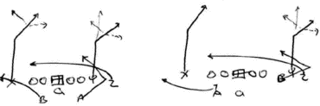
Readers might however find interesting the extended discussion of the concept I previously wrote up here. It is known as the "angle" or "follow" concept. In other words, although the Broncos throw it for the touchdown and conversion to the same guy, the quarterback's secondary reads are to the corner route and the receiver who begins like he's running to the flat but then pivots and comes back inside. The Broncos also use a corner route to the other side as well, unlike the post route I have drawn up in the diagram, above.
Readers might however find interesting the extended discussion of the concept I previously wrote up here. It is known as the "angle" or "follow" concept. In other words, although the Broncos throw it for the touchdown and conversion to the same guy, the quarterback's secondary reads are to the corner route and the receiver who begins like he's running to the flat but then pivots and comes back inside. The Broncos also use a corner route to the other side as well, unlike the post route I have drawn up in the diagram, above.
Tuesday, May 19, 2009
Hello! Plaxico is going to jail
 The Chicago Tribune reports that the Bears are interested in signing Plaxico Burress, who "has a June 15 hearing stemming from felony gun charges." That is a bit of an understatement. Yet, the NFL community -- and not just fans -- seem rather blind to the reality that Plaxico faces gun charges with a mandatory minimum sentence and the prosecutors do not appear interested in granting him grace, and so he is going to serve some real jail time. Who he signs with is rather beside the point. As sentencing law expert Doug Berman has observed:
Given that New York state prosecutors seem disinclined to let Burress plead to anything that does not include at least a year in prison, I find it strange (and perhaps telling) that NFL teams and reporters still do not seem to fully realize that Burress could end up spending as much if not more time behind bars as Vick has simply for possessing a gun in the wrong place and the wrong time.
Friday, May 15, 2009
Week in Review - May 9 - 15, 2009
Normally I don't put up a "Week in Review," but then again I normally don't publish eleven articles in seven days. So this is just a review for those of you who only check the site irregularly.
Check out all four parts in the series:
Triple Shoot - Coach Manny Matsakis guest appeared this week to put up a series of posts on his "Triple Shoot" offense. (Sample flavor diagram and video below.)
Check out all four parts in the series:
- Triple Shoot Part 1: History and Overview
- Part 2: Run game and play-action passes
- Part 3: Passing game and exotics (screens)
- Part 4: Conclusion and timeline
Goliaths, Gladwell, and Davids: I was also somewhat fixated on the new Malcolm Gladwell article. If you can only read one thing, read David strategies and Goliath strategies, though this post highlights a good point as well.
Assortments: Also check out some of the assorted links and notes posts here and here. Lots of good links to other sites in those, and also discussions of Rich Rodriguez and Michigan's quarterback situation, Gus Malzahn, the BCS, and of course, some Mike Leach odds and ends.
That's all for now. I'm out of pocket for the weekend, so feel free to leave any comments discussing any of this or anything else -- including ideas for future posts.
Subscribe to:
Posts (Atom)

 Posts


