Smart Football has moved!

Please check out the new site, smartfootball.com. All future updates will be made there.
Showing posts with label blog buds. Show all posts

Thursday, August 13, 2009

Smart Notes and Links 8/13/2009

1. Advanced NFL Stats weighs in on the evaluating running backs/running games discussion, which I addressed (with assistance from some wonderful comments) here and here. Do read the whole thing, but Brian has, as always, a very interesting take. Drawing on earlier discussion about risky and conservative strategies for underdogs and favorites (see my discussion of the topic here and Brian's here), he asserts:

I want to address an age-old water cooler question that Chris discussed in his post at Smart Football. Consider two RBs, both with identical YPC averages. One however, is a boom and bust guy, like Barry Sanders, and the other is a steady plodder like Jerome Bettis. Which kind of RB would you rather have on your team?

The answer is it depends. Essentially, we have a choice between a high-variance RB and a low-variance RB. When a team is an underdog team, it wants high-variance intermediate outcomes to maximize its chances of winning. And when a team is a favorite, it wants low-variance outcomes. Whether those outcomes occur through play selection, through 4th down doctrine, or through RB style, isn't important. If you're an otherwise below-average team, you'd want the boom and bust style RB. If you're an otherwise above-average team, you'd want the steady plodder. . . .

Further, even if the high-variance RB has a lower average YPC, we'd still want him carrying the ball when we're losing. This is due to the math involved in competing probability distributions.


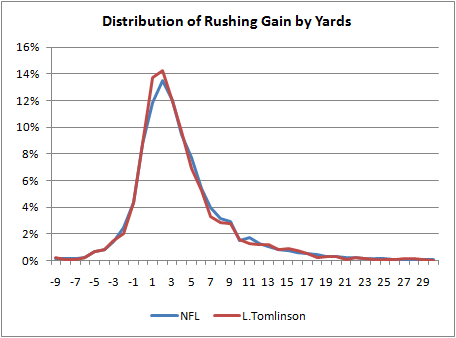
That's just one aspect of it. He uses a handy chart for the distribution of runs for the various backs...


...and notes how curious it is that Tomlinson's distribution looks so much like that of the rest of the NFL. (This same thing ends up holding true for most backs.) What conclusions does Burke draw? With the usual caveats,

[w]hat amazes me is how similar they all are to each other and to the league average. . . . Usually, a RB needs 4 to 5 yards to just break even in terms of his team's probability of converting a first down. What we'd want to see on a RB's distribution is as much probability mass as possible to the right of 4 yards.

So if [Jerome] Bettis' distribution looks so much like Tomlinson's, how does Bettis have a 3.9 career YPC and Tomlinson have a 4.4 career YPC? As others have noted previously, the difference among RB YPC numbers primarily come from big runs. It's the open field breakaway ability that separates the guys with big YPC stats from the other RBs. Of Tomlinson's runs, 1.5% were for 30 yards or more. Bettis' 30+ yd gains comprised only 0.46% of his carries. The other RBs and the league average are as follows:

- NFL 0.91%
- [Jamal] Lewis 0.88%
- [Brian] Westbrook 0.93%
- [Adrian] Peterson 2.20%

Adrian Peterson's 2.2% figure is exceptional. It's interesting because it really suggests that what separates Peterson as a great runner is based on only 2% or so of his runs. Otherwise, he's practically average.


2. Courtesy of Brophy, I have added video of Mike Leach's "settle & noose" drill, which, it will be recalled, is both a great warm-up drill and works on teaching receivers to find holes in the zone and quarterbacks how to deliver the ball to them.


3. Tom Brady muses on life with Bill Belichick. As he tells Details:

"You'll practice on a Wednesday, and you'll come in Thursday morning and he'll have the film up there from practice," Brady says. "Sometimes, during practice, you throw a bad ball—that's the way it goes. But the video comes up and he says, 'Brady, you can't complete a g--damn hitch.' And I'll be sitting there thinking, I'm a [expletive] nine-year veteran, I've won three ---damn Super Bowls — he can kiss my... That's what you're thinking on the inside. But on the outside I'm thinking, You know what? I'm glad he's saying that. I'm glad that's what he's expecting, you know? Because that's what I should be expecting. That's what his style is."


(Ht Shutdown Corner).

4. Bruce Feldman chats with Norm Chow, who materializes into matter from various spectral rays to participate.

5. The NY Times's The Quad Blog chats with Dan Shanoff about, what else, his Tim Teblow blog.

6. Spencer Hall/Orson Swindle to SB Nation. When you get $7 million from Comcast, you better find ways to spend it, and I can't think of a better way than for SBNation (whose official name is "Sportsblogs, Inc.") to lure Every Day Should Be Saturday's Spencer Hall over, including away from the Sporting News. I like everyone else think this is a wise move for both sides, but one underrated aspect is that Mr. Hall/Swindle (Mr. Hall-Swindle? I kind of like that) will be able to focus on just one blog (and probably a book too), which should really let him flourish.

7. Holly over at Dr Saturday remembers Northwestern's magical 1995 season, which is still the only 10 win season in school history. This was a sort of epoch-changing season for NW -- though that is a very relative statement -- in that the Wildcats' history since has been considerably better. Indeed, two years later I saw them play in the Citrus Bowl against Tennessee (this was back in the "You can't spell Citrus without UT" days). Though, most of that game was spent marveling at the show Peyton Manning put on (408 yards, 4 touchdowns, no interceptions) as I sat there telling everyone around me what Peyton Manning's audibles would be (for some reason Northwestern thought it could play man coverage against Tennessee's receivers, so he kept checking to fades and slants). In any event, it is hard to overstate how strange but wonderful that 1995 season was for Northwestern. In football, sometimes the gods are with you.

Monday, August 10, 2009

Assorted Links - 8/10/2009

1. Michigan cast off Justin Feagin was involved in some wild stuff. Mgoblog comments:

Freep FOIA findings:

Feagin told investigators that “when I first started going to (Burke’s) house he had three big jars of weed up in his room. … One day T.J. was talking to me about some illegal stuff. He was under a lot of pressure because of his financial problems.

“I told him that I knew someone who could get him some cocaine. A few days later he asked me if I had talked to the person yet. I called right then and set up a deal.”

Feagin arranged to send $600 to a friend in Florida, whom he identified only as “Tragic.” In exchange, “Tragic” would send an ounce of cocaine to Ann Arbor.

It goes on from there. No cocaine ever showed up, this Burke guy tried to scare/murder Feagin by filling a bottle with gasoline and setting it on fire outside his dorm room, etc, etc, etc. You know, typical college stuff. . . . TJ Burke does what he wants, which is apparently spend up to ten years in prison.

Feagin was a last-minute addition to Michigan's first class under Rodriguez when it became clear that Rodriguez wasn't likely to acquire a higher-rated quarterback recruit. He did not work out, obviously. The Freep article dryly notes that Feagin "struggled to learn the playbook" mere paragraphs after describing Feagin's extensive marijuana habit. . . .

But seriously: it's bad. It's also one guy that Michigan apparently didn't run as thorough of a background check on—or possibly any background check on—as they scrambled to reconfigure Rodriguez's first recruiting class. As long as the incident remains isolated, fine. . . .


2. Mark Sanchez might win the Jets' job, but is he crossing over from confident to arrogant?

3. The NY Times Fifth Down Blog remembers Eagles defensive coordinator Jim Johnson (and includes your humble blogger in its roundup).

4. The pro-football reference blog with Part III of its quest to rank the greatest QBs of all time.

5. Steve Spurrier is very upset: "We've got a lot of guys, I don't even know if they like football." (Ht Blutarsky.)

6. Saurian Sagacity looks at statistical characteristics of BCS champions. This is good and fine, but as Dr Saturday pointed out, the BCS winner hasn't always been the "best" team over time, or even in a given year. This is not a BCS knock -- and on this score I don't think a playoff would reduce the randomness of who gets crowned champion -- but it's worth remembering.

6. The end of the postal service?

7. Callers, tossers, and the odds of the flip.

8. History of the Times New Roman typeface.

Friday, July 31, 2009

Assorted Links

1. Video of Notre Dame coach Frank Verducci coaching up the line. (H/t Blue Gray Sky)

2. Blue Gray Sky then explores the "sprint" or "stretch" run play.

3. Pro Football Reference blog compares AFL and NFL drafts.

4. New Detroit Lions' coach Jim Schwartz refuses to read books written by women. I recommend Margaret Atwood.

5. Creative types flocking to the internet, where fame can be instant but fleeting.

Thursday, July 30, 2009

Breaking down the Oklahoma State offense

...over at Dr Saturday. Check it out here, and feel free to ask questions either here or over there. (I am more likely to see it here, though.)

Smart Links 7/30/09

1. T. Kyle King has an interesting response to my incoherent musings on business and life in college football.

2. Dan Shanoff really doesn't believe Brett Favre.

3. Blutarsky is bringing the Mummepoll back. Get ready.

4. Steve Kragthorpe is determined to purge the University of Louisville of all things Brohm.

5. Captain Leach doesn't twitter, and reiterates his support for a 64-team college football playoff. I will say this: there would be some wild football, with every game a do-or-die. Some frantic, last minute wildness, every week. It might be infeasible, but the more I hear this idea the more I think it does sound fun.

6. Best thing you'll see in awhile.

7. USC's use of coaching consultants is questioned.

8. Finally, I'll be traveling today, but check out Dr Saturday as I should have a post up there later this afternoon, fitting in with the Doc's Big 12 week.

Tuesday, July 28, 2009

Smart Notes and Links 7/28/09

1. Brett Favre is not happy about this and will unretire to prove it. A commemorative decoration (ht Maize 'n Brew, via sconnie.com):


2. How science can save you from choking. This new bit from Jonah Lehrer is a nice complement to my earlier post on football decision making and the brain.

Kenny Perry could taste history. He had a two-shot lead with two holes to go at the 2009 Masters - all he had to do was not make any big mistakes and he would become, at 48, the oldest Masters champion in history. For three days at Augusta, he had played the best golf of his life: on the first 70 holes, he made only four bogeys. But then, at the 71st hole, everything started to fall apart. . . .

We call such failures "choking", if only because a person frayed by pressure might as well not have oxygen. What makes choking so morbidly fascinating is that the performers are incapacitated by their own thoughts. Perry, for example, was so worried about not making a mistake on the 17th that he played a disastrous chip. His mind sabotaged itself.

Scientists have begun to uncover the causes of choking, diagnosing the particular mental differences that allow some people to succeed while others wither in the spotlight. Although it might seem like an amorphous category of failure, their work has revealed that choking is triggered by a specific mental mistake: thinking too much.

The sequence of events typically goes like this: when people get nervous about performing, they become self-conscious. They start to fixate on themselves, trying to make sure that they don't make any mistakes. This can be lethal for a performer. The bowler concentrates too much on his action and loses control of the ball. The footballer misses the penalty by a mile. In each instance, the natural fluidity of performance is lost; the grace of talent disappears.

Sian Beilock, a professor of psychology at the University of Chicago, has helped illuminate the anatomy of choking. She uses golf as her experimental paradigm. When people are learning how to putt, it can seem daunting. There are just so many things to think about. Golfers need to assess the lay of the green, calculate the line of the ball, and get a feel for the grain of the turf. Then they have to monitor their putting motion and make sure that they hit the ball with a smooth, straight stroke. For an inexperienced player, a golf putt can seem unbearably hard, like a life-sized trigonometry problem.

But the mental exertion pays off, at least at first. Beilock has shown that novices hit better putts when they consciously reflect on their actions. The more time they spend thinking about the putt, the more likely they are to hole the ball. By concentrating on their game, by paying attention to the mechanics of their stroke, they can avoid beginner's mistakes.

A little experience, however, changes everything.


3. "SEC offers great drama, even football." The Big 10 media day, however, does not live up to its frat-guy, party school reputation. (And this gets a link solely because of the Dr. Octagon reference.)

4. Can NCAA athletes be denied access to agents? I don't have a ready answer to this question, though read up about it here. (Ht Dr Saturday.)

5. Monte Kiffin would like to remind you again that he will outwork you. You know, just in case you forgot.

6. An inviting summary:

With the ESPN cameras gone and prize money drying up, the glory years of the Lumberjack world championships appear to be long over.


7. Back when I wrote this, I got a fair bit of heat and disagreement:

Hello! Plaxico Burress is going to jail. . . . [T]he NFL community -- and not just fans -- seem rather blind to the reality that Plaxico faces gun charges with a mandatory minimum sentence and the prosecutors do not appear interested in granting him grace, and so he is going to serve some real jail time. Who he signs with is rather beside the point.


Well, it appears to finally be sinking in. The NY Times reports:

Manhattan's district attorney says he wants former Giants wide receiver Plaxico Burress to serve time in prison, the New York Post reported. Robert Morgenthau told the newspaper that Burress, who shot himself with an unlicensed gun in November, was willing to agree to spend a year in jail, but prosecutors insisted on two.

''We've always taken the position that he's going to have to go to jail, whether by trial or by plea,'' Morgenthau told the Post for a story in Monday's edition.


Again, remember that this gun possession charge Burress was hit with has a two-years mandatory minimum. Sure, he can plead for less, but this doesn't seem a particularly difficult charge to prove: he brought the gun into the club and shot himself. That makes this next bit a bit strange to me.

Brafman [Plaxico's lawyer] had previously said he no longer thought the matter would be resolved through a plea agreement and that prosecutors would take the case to a grand jury. He also said Burress would plead not guilty if the case went to trial.


Again, not sure what a not guilty plea would get Plax.

Monday, July 27, 2009

Smart Links and Notes 7/27/09

1. ESPN's Bruce Feldman asks a panel "What makes a great college coach?" (Insider required.)

"He must be able to develop players. Good X's and O's can only put players in a position to succeed; they must also be taught the tools to actually do so. This requires that the coach be a great teacher of technique, drive, and desire (and if he is head coach he must be able to teach his players and his coaches those things as well), and to be a great teacher the players must also know that he cares before they will listen. Styles may differ -- compare Pete Carroll to Bear Bryant -- but the players must be willing to run through a wall for their coach."

That's my answer. Other contributors Feldman asked included former GA coach Jim Donnan, Rod Gilmore of ESPN, Jim Hofher Delaware's OC, and Phil Steele ("My No. 1 judge of a coach is how often they outperform my magazine's expectations."), among others.

2. Brophy chimes in with more on the "robber" coverage, as a jump-off from my recent bit on Va Tech's D for Dr Saturday. He includes some classic coaching tape of Virginia Tech vs. Syracuse in 1998 (McNabb was QB for the Orangemen).


3. The Blue-Gray Sky breaks down -- and is down on -- Notre Dame's use of the draw play. They do a nice job, but I'm confused why they are so down on the draw play. Michael points out that the play's average in 2008 was 4.9, which was down from a high of 5.3 yards per carry in 2005. That's true that it was down, but that's still a pretty good average for a team that averaged a paltry 3.27 yards per carry. (And if you take Jimmy Clausen's 54 "carries" for -74 yards out of the equation, ND still only averaged 3.92 YPC.)

Notre Dame's problems with the rush appear to be two-fold: one, they just need to get better at blocking up front, and maybe BGS is right that just committing to the inside zone or some other play will make them better; and second, the pass game is not as dangerous as it was, as in 2005 Brady Quinn averaged an impressive 8.7 yards per pass attempt (unadjusted). If I were them I would focus on a simpler base of run plays: four or five at the max. Anyway, check out the original post.

4. I agree with the Senator: The Tebow-gate vote scandal was anti-climactic (Spurrier: Uh, I didn't care enough to do it myself and someone else either got cute or lazy and I never looked. In fact, I never look.) As I take the Senator's point to be, do we care if coaches don't really bother with these things? I sure don't. I always figured the "Coaches poll" -- in its various forms -- basically just stood for "someone over there at the coaches office and/or athletic department of that school," and that was good enough for me. It's more of an issue of who else you'd want to ask.

5. File this in the category of strange ideas: Zach Zaremba wants Southern Cal to switch to the spread offense.
The Trojans have the athletes to run this prolific offense, so will they get behind the eight ball, or follow suit as so many teams have already done and install the offense of the 21st century?

Powerhouses such as Texas, Oklahoma, Ohio State, Michigan, Virginia Tech, Penn State, Florida and West Virginia have made the switch. When will the mighty Trojans?


Uh. There's more there, but the argument seems to be that USC isn't scoring as many points as, say, Oklahoma or Florida, and they haven't won a National Title in four years. But that doesn't make much sense: USC lost to Oregon State last year, in a single defensive breakdown, and Stanford the year before, in just a fluke game (many spread offenses have had similar breakdown games). Relatedly, this really can't be an issue of being wide open enough, as USC throws the ball plenty and does -- contrary to what the article says -- use four and five receiver sets (though not with the frequency of a team like Florida).

The other reason of course that USC hasn't won a title game over the last four seasons (aside from facing Vince Young), is that the Pac-10 has let USC down: Florida, which won two of the last three titles, had a loss each season, and LSU lost two games. It's a strength of schedule thing.

Anyway I'm getting off topic. The article is weird, and based on an equally weird premise: "The spread offense is the most popular offense in football today." That, to me, is a good reason not to run the spread. Look, the issue with pro-style offenses versus spread offenses is that spread offenses, where the quarterback is a dynamic runner, can get an arithmetic advantage. But that doesn't make dropback passing obsolete; if your guy is Peyton Manning or Tom Brady -- or the college equivalent, like Leinert or Carson Palmer were -- then you are more than dynamic enough. It's not easy to find guys with that kind of passing ability, but USC definitely can.

Thursday, July 23, 2009

Smart Links - July 23, 2009

1. What am I missing? Everyone is obsessed with finding out who didn't vote for Tebow as first-team all-SEC. It's also a rule that you can't vote for your own guy. Then why isn't the answer that Urban Meyer voted for Jevan Snead? I mean he lost to him and is apparently barred from voting for his own guy. (I also don't know how the not-voting-for-your-own guy rule is compatible with having unanimous selections. If you think your guy is the best, do you just leave the spot blank rather than fill in someone else there?) Again, I must be missing something pretty fundamental here. [UPDATE: As several readers pointed out, "unanimous" equals everyone but your own coach, and Spurrier has admitted that he was the one who didn't. (Though he blames an assistant.)]

2. College Football Playoff Act of 2009, H.R. 390. University of Illinois law professor Christine Hurt (an alumna of Texas Tech and U. of Texas), writing on the legal blog the Conglomerate. Her post, reprinted in full:

In reading all the legislation during the 110th and 111th Congress that contain the word "windfall," (everybody needs a hobby) this definitely wins in the surprise category.

The College Football Playoff Act of 2009 was introduced by Joe Barton (TX), and it has been referred to the Committee on Energy and Commerce. Now, before you start to wonder where Congress gets the power to redesign NCAA football, note how the legislation works. "A bill to prohibit, as an unfair and deceptive act or practice, the promotion, marketing, and advertising of any post-season NCAA Division I Football game as a national championship game unless such game is the culmination of a fair and equitable playoff system."

Hmmm. Next we have the MLB change the name of the World Series unless they actually invite other countries to participate.

So, where does windfall fit in here? In the findings, of course:

Congress finds that. . . the colleges and universities whose teams participate in the post-season football bowls experience significant financial windfall including increased applications for enrollment, recruiting advantages, increased alumni donations, and increased corporate sponsorship that provides s competitive advantage over universities whose teams are ineligible or statistically at a disadvantage from the BCS bowl competitions because of their conference affiliation.


Well, I'll let you quibble with this silliness, but this legislation, even if it passed (which it won't), wouldn't make the NCAA create a playoff. The BCS championship bowl would just have a different name. And it doesn't matter because Texas Tech isn't ever going to make it to the bowl no matter what the name is. You could call it "Bob" or even the "Texas Tech Red Raider Champions of the World Bowl," and Texas Tech would still never make it all the way. OK, that was an aside.


3. SEC media day. Just follow @edsbs on twitter. Thank me later.

4. ESPN will now let its reporters talk about the Ben Roethlisberger case.

5. Michael Vick, underrated? Brian Burke on the NY Times Fifth Down Blog.

6. The Senator asks: How far can the spread, spread? Good stuff, well worth it.

7. More from the NY Times on the O'Bannon vs. NCAA infringment case:

O’Bannon left U.C.L.A. in 1995. Does the N.C.A.A. have the right to continue to make money off O’Bannon and his teammates without compensation?

“Is that part of what an athlete’s grant-in-aid is about?” asked Richard M. Southall, the director of the College Sport Research Institute at the University of North Carolina. “You’ve left the plantation and now 15 years later you have a wife and children and the plantation still owns you, no matter what.”

College merchandise licensing is a $4-billion-a-year industry, and the N.C.A.A. has cornered the market. An N.C.A.A. business partner, Thought Equity Motion, has called the N.C.A.A.’s video content archive “one of the most unique and valuable content collections in the world.” . . .

The N.C.A.A. has had a sweetheart deal for years — using players’ likenesses, selling jerseys with popular players’ numbers and using athletes as uncompensated on-campus entertainment. Of course, athletes and their parents have had their own sweetheart deal, choosing colleges for sports and not for an academic fit.

There is not a lot of sympathy these days for athletes’ woes — at any level. The perception is that scholarship athletes and their families receive a pretty good deal. Yes, the hours are long and daily practices make this a rigorous part-time job.

“The general thinking among the public is that, ‘It could be a heck of a lot worse — you should be just be thankful for what the school has given you,’ ” Southall said. If that means eternal rights to your image, then so be it.

And the public does not care.

Just wait. Come September, college football stadiums from Harvard to Southern California will be filled with fans. Fans do not worry about steroids or licensing issues; they just want to be entertained.

O’Bannon’s case and the others raise an old but still unanswered question: Who protects the college athlete? In the N.F.L., a players association protects players against owners. In major league baseball and the N.B.A., unions look after the players’ interests.

Not so in college.

The N.C.A.A. describes itself as “the organization through which colleges and universities of the nation speak on athletics at the national level.” The N.C.A.A. tries to act as mother, father and paternalistic overseer who supposedly knows what’s best for the young athlete.

But don’t count on it.

Every year, beginning in their freshman season, scholarship athletes are compelled to sign mountains of forms.

How many athletes or parents or guardians read the forms? How many challenge the athletic department? College administrators and coaches pay lip service to “educating the kids,” but how many insist that their new recruits know exactly what they are signing?

More to the point, how many recruits — and parents of recruits — have the nerve to tell Duke’s Mike Krzyzewski or Tennessee’s Pat Summit that, based on a lawyer’s advice, they are not signing anything granting a release of their image.

All involved usually are too filled with gratitude and ego to consider reading between the lines.

“Until someone says something, stuff can go on,” Southall said. “Nobody wants to be the athlete who’s blackballed. Nobody wants to be the test case that’s thrown out.”

Ed O’Bannon wishes he had raised the question and resisted 15 years ago. Perhaps as a result of his suit, future athletes won’t have to.


Again, I think even if the NCAA loses they will just get the players to sign a waiver of their rights as a condition of getting the scholarship.

Tuesday, July 21, 2009

Smart Links - July 21, 2009

1. Ben Cahoon gets all Tyrone Prothro on things. Great catch from the Montreal Alouettes' Ben Cahoon. Love the CFL's motion and super spread with the 12 men -- nothing like four wide while still two-backs in the shotgun. (Ht Shutdown Corner.)


2. "Out of the Blue." A documentary about the Boise State team that wound up upsetting Oklahoma. Quite good.


3. Three plays that shocked the world. Always worth a repeat view.


4. Brian Cook wants to pull his eyes out. ESPN's Lester Munson gets all hysterical and apocalyptic about the Supreme Court's upcoming decision in the American Needle case. The question involves whether the NFL -- composed of 32 different franchises under one umbrella -- should be treated as a "single-entity" for purposes of some of the anti-trust laws. If the NFL the Court deems the NFL a "single-entity" rather than a joint venture (as the lower courts did), it will be immune from some of this anti-trust liability. Munson thinks the world is ending; Cook takes a slightly more reasoned and calm approach, noting that the Supreme Court's ultimate decision is far from knowable (likely at this point even by the Justices). I'm with Brian, and for more insight check out SCOTUSBlog's explanation of the legal issues involved.

5. "A Beautiful Mind." Profile piece by Rob Moseley about Oregon's Chip Kelly. A good, thoughtful piece. Kind of buys into the "coach as genius" meme -- football is pretty simple, and players can always make you look smart -- but a good read.

6. Dutch Meyer on the spread:


In an interview Sammy Baugh gave to the Washington Post, years after he’d gone on to a Hall of Fame NFL career with the Redskins, one can even see a little of Dutch Meyer’s influence on today’s West Coast Offense:

“Dutch Meyer taught us. All the coaches I had in the pros, I didn’t learn a damn thing from any of `em compared with what Dutch Meyer taught me. He taught the short pass. The first day we go into a room and he has three S’s up on a blackboard; nobody knew what that meant. Then he gives us a little talk and he says, `This is our passing game.’ He goes up to the blackboard and he writes three words that complete the S’s: `Short, Sure and Safe.’ That was his philosophy — the short pass. “Everybody loved to throw the long pass. But the point Dutch Meyer made was, `Look at what the short pass can do for you.’ You could throw it for seven yards on first down, then run a play or two for a first down, do it all over again and control the ball. That way you could beat a better team.”


Courtesy of Richard, one of the blog readers, and I believe the write-up is by the inimical coach Hugh Wyatt.

7. Dan Shanoff on the inevitability of ESPN's taking over local sports coverage. Also check out the front-page NY Times article he addresses.

8. Why are we so fat? Elizabeth Kolbert weighs in (zing!) in the New Yorker, and Jonah Lehrer tells us that our brains are biologically wired to prefer more calories over fewer, even when the taste is the same. (P.S. That's not a good thing.)

Monday, July 20, 2009

Smart Links and Notes - July 20, 2009

1. Pistol meets flexbone? Last week I wrote a guest bit for Dr Saturday on Nevada's pistol offense, and I indicated that there were a lot of ways you could go with the pistol set. Nevada's offense is generally a mix of traditional power schemes with the spread zone and veer stuff, but that's not the only option. A reader passed along some video of Muskegon HS (MI), which runs the flexbone (similar to what Paul Johnson does at Georgia Tech) from the pistol set. As a result their shotgun is a bit shorter than Nevada's and the back lines up closer -- the mesh point in the veer all happens a bit faster. Worth taking a look.


2. Tebowliscious. Tebowlitude. sporting savant Dan Shanoff has launched a new blog that will be all-Tebow, all-the-time. Introducing, the TimTeBlog. Enjoy.

3. Rules, rules, rules. I recently mused about the differences in offenses between college and the pros, and Doc Saturday also recently chimed, in wondering why more teams don't use the triple-option, following the lead of the academies. There's much more to say on those topics, but one thing I didn't hit on much is the difference in rules at the various levels. One reason that the flexbone and the option offenses have been successful in college is that, in college, you can cut block downfield. In most states, cut blocking is illegal. (Texas being a notable exception.) See the video below.


Another notable rule that, in my view, limits the incentives for pro teams to be spread is the different rule for the ability of linemen to go downfield on screens. In college and high school, linemen may go downfield and everyone, receivers included, may block defenders right away, so long as the ball is throw behind the line of scrimmage. This leads to some pretty dynamic screen games, which is one of the advantages of being a spread team: you have lots of options for throwing quick screens, jailbreak screens, bubble screens, and even your more traditional ones to the runningback often work well because the defense is expanded out -- you can turn a regular play into a kickoff return. Indeed, screens are still probably the best weapon against the zone blitz.

In the pros, however, linemen may not release downfield on any pass until the ball is caught, and receivers too may not begin blocking until then either or else they will draw a penalty. Now, some teams like the Patriots have found ways to integrate the screens, but it is pretty evident that you can't run these plays as effectively if your linemen can't get downfield quickly and your blockers have to dance and shadowbox for a few counts before they actually start blocking somebody. A play like the TD below to LSU's Early Doucet, with linemen ten yards downfield by the time he catches the ball, would be called back in the NFL.


NFL teams have learned how to push this a bit, but it is still a rather important limit.

4. Juice Williams for Heisman? Bruce Feldman recently discussed Heisman hopefuls other than the "Big Three" (Tebow, Bradford, McCoy), and one name came up that caught my eye: The Illini's Juice Williams. Now, the idea that the owner of the largest noggin in college might win its most prestigious award might sound ridiculous to anyone has, you know, actually seen him play, I have thought about this and find the Juice-for-Heisman argument a legitimate one. One, his stats last year actually were not bad: 3,173 yards, 57.5% completion percentage, and 22 TDs, to go with 719 yards rushing. He did throw 16 picks, but the other thing you notice from the stats is that they definitely trend upward; he has a chance to be decent next year. And Feldman is right that Illinois has a chance to actually upset some of the other teams in the Big 10 -- the conference does not look to have any dominant teams. And, finally, as Phil Steele pointed out, the Illini's poor record seemed somewhat out of whack in light of the stats they put up; Steele pointed out that teams in similar positions tend to bounce back the next year as their won/loss record regresses to the mean. So who knows?

5. Urban Meyer, Tebow, and film study. From an old Q&A between Pete Thamel and Tim Tebow:

Q. Let’s start from the top. How much film did you watch in high school?

A. I was blessed to be at a high school where I had a good high school coach who knew football. We did watch some teams on film. I think it gave me an advanced knowledge of coverages and stuff coming into college. Still, you’re not prepared to come in here and to be able to read defenses and watch film correctly; not just watch as a football player and be like, ‘Oh, nice play.’ But you’re looking at technique and how you would play against them and all those types of things. That’s what I didn’t know and that’s what Coach Mullen has done such a good job of teaching me. In high school I did watch film, but it wasn’t with the same knowledge and diligence that I do now. . . .

Q. Coach Mullen was saying that it’s a three-step process. He watches all the games to get a feel. Then he watches the cut-ups for specifics. Then he re-watches the games to piece it all together.

A. Yeah, most of the time I do it all with him. As far as when we’re game planning for a team like we are right now. Like he was saying he watches it. Watches games to get a feel and then you splice it up and look at all the cut-ups. Then you watch all that. Then you have a good feel for them. Then you put all that back together. Then you can say, ‘This is low defense. This is under G. This is one-hole. This is why they’re doing this, because there’s a tight end on the ball. They’re doing this because there’s an extra slot.’ You can really get a better feel for it like that. If you just start with cut-ups, you wonder how this relates to a game. He’s got a really good method of doing it, obviously, with his success over the years. I try to follow it and learn and do what he does.


And this part sounds to me like a guy who has a reasonable shot in the pros as a quarterback:

Q. I imagine the translation now compared to your freshman year is drastic in terms of how you process things in your mind.

A. Yeah, I can process things a lot more. In a situation like this, my freshman year, I’d be trying to locate. Let’s look at this. (Tebow uses the laser pointer and points to the film he’s watching.) We’ve got a shade 5-9, is it under or are they calling it over to the boundary. The Sam is here, so I know that it’s field under. I know they’re calling the strength of the field, even though it’s double tight. Now I can do it so much quicker. It’s just boom. You see it and you know. It’s quicker, you process things quicker. You don’t have to think, you can just react. Especially the teams that bring pressure a lot and disguise it well. That stuff has gotten so much easier. The teams that do it well as far as changing their calls, disguising blitzes their defenses and bluffing. That has gotten a lot easier to pick up on. You can play fast and you can make a guess and you can go with that. If it’s not there, and you make a wrong call, you still have the ability and knowledge, ‘O.K., I thought it was no-deep and made a no-deep call and they bluffed out of it, all right, where’s my check down, let me go to it now.’ That type of thing. Instead of making the wrong call, and saying, ‘Oh shoot, let me make a play panicked.’ Now I really just know where to go. That’s something I thought I did a lot better in the L.S.U. game this year. That was one of my best times doing that. When they did something like that, this is where I’m going if they come or if they don’t come. Sometimes you’re having two thoughts in your mind. Depending on what’s going to happen.


5. Quick hits. How many wins does it take to secure an NFL playoff berth? ... The Senator takes on everybody's (least) favorite columnist, Stewart Mandel ... Wages of Wins recommends Playbooks and Checkbooks: An Introduction to the Economics of Modern Sports, but Residual Prolixity is not as impressed. ... Sports is in a slump, likely due to mental fatigue ... Is new Detroit Lions' coach Jim Schwartz focusing on the wrong defensive metrics?

5. Good web hosting service? The launch of smartfootball.com is nigh, as the overhaul of the site's design is almost done, as is the transition from Blogger to Wordpress. A question for web-savvy readers, though: Can anyone recommend a good (and cheap) web hosting service? I obviously want something affordable, reliable, and steady. My traffic numbers are okay but not ESPN.com levels, though I am wary of getting only the lowest bandwidth and and crashing out on peak days. This site obviously has a lot of graphics and that tends to inflate my bandwidth as well. Any advice would be appreciated.

Thursday, July 16, 2009

The Nevada Pistol offense over at Dr Saturday

At the Good Doctor's invitation, I guest-posted today over at Dr. Saturday on the Nevada "Pistol" offense, as part of his "Mid-Major" week.

Check it out here, and enjoy.

Tuesday, July 14, 2009

Smart Notes - July 14, 2009

1. More on Bill Walsh, the single-wing, and the wildcat. From ESPN the Magazine:

Howard Cosell wrote, in his 1991 book What's Wrong With Sports, "One thing I have found very interesting in my conversation with (Bill) Walsh is that he regretted he never tried the single-wing formation with the 49ers. He felt that Steve Young could have run the formation to perfection, and that the league's defenses would have had a difficult time stopping the old formation."

Walsh was most likely correct. Even the great Vince Lombardi warned of a possible single-wing resurrection.

"What would happen if someone came out with the single-wing offense?" he asked. "It would embarrass the hell out of us."


2. We want to be different, so we went to the spread? I like Dan Mullen, but isn't this a bit weird, if not, you know, anachronistic? From the Clarion-Ledger:

STARKVILLE — On the billboards that promote Mississippi State football season tickets in coach Dan Mullen and the spread offense's first year, the theme is "Spread The Fun." On the television ads, Mullen is diagramming a play on a white board when he looks over his shoulder and says, with an admirable bit of acting skill, "this is gonna be exciting."

These slogans are no accident.

And this goes beyond merely Mullen. For as much as MSU athletic director Greg Byrne was enamored with Mullen when they met last Dec. 9, there was something else at work.

In the days following Sylvester Croom's forced resignation on Nov. 29, the Mississippi State administration entertained a question bigger than just which coach they could hire. Surveying a century's worth of mostly mediocre football seasons in the ultra-competitive Southeastern Conference, they wondered how best to break the trend.

The conclusion? Be different on offense.

And then - just as much as many schools pick a coach and then learn later what offense he'll run - State all but picked an offense, then went to find a coach to run it.

"We wanted to be unique," Mississippi State athletic director Greg Byrne said. "We wanted to be something that our kids and our fan base would be excited to be a part of." . . .

"We wanted to find the right fit for Mississippi State," Byrne said. "Now, we were definitely interested in finding someone who had a very good offensive pedigree. And one that we felt would be able to highlight an area that we felt like we needed improvement." . . .

"That style of play is as much marketing as it is a concept for offensive football," Stricklin said. "When you have the choice to turn on TV and watch a game, and there's a spread team on one channel and two offenses that's more traditional on another channel, more people, if you don't have a feeling for either team, are going to watch the spread team because it's fun to watch." Later, Stricklin smiled when he admitted this: "Winning's a great marketing tool (too)." . . . .


In the meantime, before that first win or loss, State hopes that Mullen's hire is more than just a way to win games.

It hopes that it's a way to change the program's fortunes, in 2009 and beyond.

"We feel at Mississippi State, we need to be a little bit different," Byrne said. "And this gives us the opportunity to be a little bit different."


Again, I like Dan Mullen, but this is a very strange article to me. The administration basically went out to hire an offense and found a man, versus the other way around. Second, they did so as much for marketing purposes as for anything to do with the football bona fides. And third, like an investor who wanted to get into the market for "flipping houses" in 2006-2007 or into that "dotcom thing" in late 1999, their choice for "being different" was the spread, a philosophy that peaked as a way for underdogs to surprise favorites at least three or four years ago, if not further back.

I do think Mullen can be successful there, but I predict that the offense will be pretty mediocre this fall, if not bad at times. You just can't get a jump on people by being spread anymore -- it's just not that different considering what Florida, Auburn, and others around the country do -- and Mullen will have to build success the old fashioned way: by recruiting players and teaching them well. I think he can definitely do it, but I don't think there will be sudden manna from heaven in the way of fast and easy scoring this year as a byproduct from "being different."

3. More on Monte Kiffin preparing for SEC defenses, including the spread:

Monte Kiffin was watching video of prospective recruits this winter when he got an inkling of what he was up against as a college defensive coordinator. The more he watched, the better he understood why spread-option offenses have become so threatening to college defenses.

It's not just the option. It's the overhead support as well.

"I could not believe it till I started watching all the tape," said the longtime NFL defensive coordinator, who will command Tennessee's defense this fall. "The high school coaches have progressed so much in the passing game." . . . .


And as teacher and schemer:

Joe Barry knows what the rest of Tennessee’s new defensive coaches found out a few months ago: Interviewing for a job with Monte Kiffin is a unique experience to say the least.

“It was grueling,” says Barry, whose father Mike is a former offensive line coach at Tennessee. “It was like no other interview that I’ve ever been a part of.”

Kiffin put Barry in front of a dry-erase board, and then put him through the paces.

“He said, ‘OK, all that stuff that you were just going through on the grease board, how are you physically going to teach Derrick Brooks to tackle?’” Barry said. “Monte was going to be able to see, No. 1, if I knew what the hell I was talking about, but No. 2, he was going to see if I could truly coach, if I could truly teach.”

Barry passed the test and spent six seasons working for Kiffin in Tampa Bay. As it was for others who spent time working with Kiffin, Barry’s tenure in Tampa Bay was more than just a master class in coaching defense. It was a daily lesson in how to teach, something Kiffin places a premium on when it comes to assistant coaches.

“There was not one day in six years where I didn’t wake up and come to work and get better as a coach,” says Barry, who is back in Tampa Bay after a stint as the Detroit Lions’ defensive coordinator. “It’s because of Monte, obviously his knowledge, but his personality. He was very demanding. A lot of times when you say that about guys, they usually do it by being a jerk. Monte did it in such a way that you had so much fun that you didn’t know you were working harder than you’d ever worked before in your life.”

. . .

Although Kiffin downplays his role in the spread of the Cover 2 defense, many consider him to be one the best defensive minds in modern football.

“People had played Cover 2 for quite a few years,” Kiffin says, pointing out that the Minnesota Vikings ran it when Tony Dungy was defensive coordinator under head coach Dennis Green. “Tony left (Tampa Bay) and Jon Gruden came in, and we won the Super Bowl. I think that if we don’t win the Super Bowl, they probably don’t call it ‘Tampa 2.’ I didn’t invent the Cover 2. I don’t want people to think that.”

Kiffin’s wrinkle in the Cover 2 was often dropping the middle linebacker into coverage. But others aren’t as modest when it comes to Kiffin’s impact on the game.

“It’s a universal defense,” says Tampa Bay quarterbacks coach Greg Olson. “When people think of ‘Tampa 2,’ they think of Monte Kiffin. There’s very few guys in the NFL or in college football that actually have come up with a scheme that was so successful it carries over to other teams or that they actually have their name associated with it.”

In Tampa Bay, that reputation only grew. The Buccaneers finished in the top 10 in the NFL in total defense and points allowed in 11 of his 13 seasons. And in 2002, Kiffin’s defense led the league and helped the Bucs win the Super Bowl with a 48-21 victory over the Oakland Raiders, who had the league’s top offense that season.

Yet minutes before the Super Bowl kicked off, Kiffin was tweaking his gameplan, making a few minor adjustments.

That’s classic Kiffin, says Pittsburgh Steelers head coach Mike Tomlin, who spent five seasons with Kiffin as an assistant in Tampa Bay including 2002.

“If you’re kicking the ball off at 1 o’clock on a Sunday, you’re going to be in the shower with Monte at about 10:30 thinking about potential adjustments and things you could make changes to,” Tomlin said. “His mind is always working. He’s always trying to get better. He never breathes a sigh of relief.”


(Ht RockyTopTalk.)

Monday, July 13, 2009

Smart Links and Notes - July 13, 2009

1. Camera angles. Doc Saturday muses about crappy camera angles in football broadcasts. Money quote: "Video games got [it] right immediately."

2. Of video games and publicity rights.
Speaking of Doc Saturday and video games, he was one of the first that I saw to publicly censure the NCAA over its chintzy policy allowing game-makers like EA Sports to include things like "Florida QB #15," complete with all the relevant physical attributes, in its NCAA Football games without compensating the players in any way. The Louisville Courier-Journal's Eric Crawford joins the debate, with what I thought was a nice anecdote:

One of my favorites is an old version of EA Sports' NCAA Football. I like to be Michael Bush, because the former University of Louisville star, in this game, is Superman.

He can do anything. Bounce off tacklers. Run over them. Run through walls of defenders.

Almost every time I play, I think about that moment when Bush went down against Kentucky in the first game of his senior season. And it occurs to me that even while the real Bush was struggling pretty seriously with recovering from that broken leg, little cyber Michael, courtesy of EA Sports, just kept running.

And then there's this: While Bush's financial future was very much in doubt as he sweated his way back through rehabilitation, little cyber Mike kept drawing royalty checks for the NCAA, which has a rights deal with EA Sports.


Fortunately Bush's bounced back (think too of Willis McGahee's horrendous injury, or, say, Tyrone Prothro). One sticking point though with the analysis. Crawford repeats a supposed "problem" with paying players a licensing fee: what to do about the best players (i.e. most highly marketable) versus the bench-warmers? Crawford offers another solution: put the money paid into a trust that is there for players who graduate. I like that idea, and I also don't see why you have to grant the licensing fees based on who is the best player or not.

Sure, EA really just wants Reggie Bush or Tebow, not the benchwarmer on USC's or Florida's roster, but the NCAA, the Universities, and EA should just negotiate a flat fee for use of the whole roster (though giving some players an opt-out, which could create issues). The important point is that the players get something, not that Tebow or Bush gets more than their backup. Plus, if you do the trust idea contingent on graduation, then the player can actually help his teammate who might not have a pro-future when the all-star goes to the NFL: his money remains in the trust, thus enlarging the share for the others.

In any event, what makes this so bizarre is that if you used literally anyone else's likeness, besides an NCAA athlete, the company would have to pay. Yes, companies would be most likely to use a famous person, but it is not permissible to use a person's likeness or identity to promote some other product without their permission. The state of the law isn't quite uniform apparently, but

The Right of Publicity prevents the unauthorized commercial use of an individual's name, likeness, or other recognizable aspects of one's persona. It gives an individual the exclusive right to license the use of their identity for commercial promotion.


Unless of course you're an NCAA athlete.

3. Football Outsiders: Contrary to popular wisdom, Rex Ryan and the Baltimore Ravens "rush" four or fewer players 64% of the time. Yet they nevertheless rushed (i.e. blitzed) five or more "far more than the average team."

4. Trojan Football Analysis continues its wonderful series on Chip Kelly's Oregon rushing attack. The series: Chip Kelly's comments on his run game, inside zone, outside zone, fly sweep, counter, and video of the counter. (Also see this three part bit on a possible midline option or "mystery play" from Oregon: one, two, and three.) For a preview of what you'll find at TFA, check out the cutups of Oregon's offense below.


5. Why is there so much holding in football? It's an issue of the risk of having a penalty called on your holding versus what you have to gain (avoiding a sack, big run play, etc). Money quote: "The bottom line is that the probability of detection at which committing holding is worthwhile is when it is about 4/5 the chance a pass rusher will get a sack if he beats his blocker."

6. Blutarsky chimes in on Spurrier, in response to my recent post on the Ol' Ball Coach. Make sure to check it out due to the good comments (no, I'm not referring to my own).

7. You're watching inferior football and you don't even know it, says Residual Prolixity. Bonus: RP reviews The Pro Football Chronicle: The Complete (Well, Almost) Record of the Best Players, the Greatest Photos, the Hardest Hits, the Biggest Scandals & the Funniest Stories in Pro Football by Dan Daly and Bob O'Donnell.

8. Rollbamaroll reviews The Junction Boys.

9. Who are the most influential sports columnists? Dan Shanoff culls the list from Mediaite's new "power grid" feature.

10. Oldie but goodie: Roger Ebert ripping Jay Mariotti for quitting his job at the Chicago Sun-Times over getting passed over for a column idea.

11. Happy birthday to Mr. Orson Swindle of the Sporting Blog and Every Day Should Be Saturday. The internet does thank you. I started blogging before EDSBS, but without Orson and several others, I might not still be doing it. (Plus go buy the Gators Gridiron 2009, of which he was the editor and I a lowly contributor.)

12. Why aren't people complaining yet about inflated sports salaries?

13. Michael Lewis on AIG: Thank you, Joe Cassano.

14. Economic Principals: "Now We May Perhaps to Begin?"

15. A fitting end. How is it possible for a man to look perpetually uncomfortable yet still we want to hang out with him? So it goes with Mike Leach. (Ht Dawgsports.)

Thursday, June 25, 2009

How to take a team to the woodshed with your spread offense

The spread may not always be the answer to everything, but if you can do what this team does, you don't need anything else. (Warning: This video contains images of putrid tackling, and may not be suitable for public consumption.)


(Ht HueyBoard).

Incidentally, though I generally agree with Dr Saturday that the spread isn't (and need not be) the sine qua non of someone's offense to the exclusion of everything else, practice time must be considered: Division I football teams have a fraction of the practice time allowed in the NFL, but even many high schools have more practice time, counting in summer passing leagues, spring football, and all that. And, with limited practice time, there can be benefits to being a hedgehog like Florida or TTech, and doing one thing extremely well, rather than going for mystical universality by being "pro-style, whereby the players are overloaded.

Monday, June 22, 2009

Assorted links

1. Malzahn follow-on. Lots of follow-ups on the Malzahn post I had last week.

  • Jerry at the Joe Cribbs Car Wash weighs in with his take.
  • Fields of Donahue, too.
  • Roll Bama Roll takes the slightly more cynical view (not surprising, though check out the comments for some great discussion). Only thing I will say about the Malzahn versus Franklin "we've heard it all before" debate is that all sides now admit that there were serious behind the scenes issues at Auburn last year -- regardless of whoever was at fault -- that would contribute to making any offense dysfunctional. And, of course, Auburn's offense ramained poor even after Franklin left. So continuity and support alone ought to make Auburn's offense at least a little better.
  • Blutarsky feels deja vu but also does a little SEC predictin'.

2. Mike High Report on my post about Brandon Marshall's "trade value."

3. mgoblog in a post that should be titled "How to Blog."

4. TeamSpeedKills on why there is no Platonic Ideal "Urban Meyer offense," and why Meyer is more on the "Just win, baby," side of things.

5. Kansas State might be, well, corrupt: "A scathing audit of Kansas State University reveals a pattern of undisclosed payments, conflicts of interest, poor accounting and possible tax problems for the school, several of its former employees and its athletic department. The audit, released by the Kansas Board of Regents on Friday, describes thousands of dollars paid to companies owned by current and former university employees. They include head football coach Bill Snyder; former athletic director Tim Weiser; and Bob Krause, a former vice president for institutional advancement and former athletic director." (Ht Dr Saturday.)

6. Dan Le Betard meets up with now bankrupt ex-football star Bernie Kosar, and it is...interesting:

[Kosar] just learned the other day, after much trying and failing, how to make his own coffee. This is a man who owned his own jet and helped found companies, plural. But when his new girlfriend came over recently and found him trying to cook with his daughters, she couldn't believe what was on the kitchen island to cut the French bread. A saw.
''I was 25 and everyone was telling me that I was the smartest; now I'm 45 and realize I'm an idiot,'' he says. "I'm 45 and immature. I don't like being 45."


(Ht, again, Dr Saturday.) (Le Batard has kind of a buffoonish persona, but he always seems to snare good quotes from people. Last week he had this colloquoy with Jimmy Johnson: "Will you go days without putting on pants, Jimmy? ''Days?'' he says. ``Weeks! . . . ."

7. The Quad previews the Hawai'i Warriors. My take? They had an identity crisis last year while trying to inject more running into their run and shoot offense. The report is that this year they are getting back to basics, and, for a team like this, that should be a good thing.

8. Image of the week, courtesy of Eleven Warriors. (Ht mgoblog.)


Friday, May 15, 2009

Week in Review - May 9 - 15, 2009

Normally I don't put up a "Week in Review," but then again I normally don't publish eleven articles in seven days. So this is just a review for those of you who only check the site irregularly.

Triple Shoot - Coach Manny Matsakis guest appeared this week to put up a series of posts on his "Triple Shoot" offense. (Sample flavor diagram and video below.)


Check out all four parts in the series:

Goliaths, Gladwell, and Davids: I was also somewhat fixated on the new Malcolm Gladwell article. If you can only read one thing, read David strategies and Goliath strategies, though this post highlights a good point as well.

Assortments: Also check out some of the assorted links and notes posts here and here. Lots of good links to other sites in those, and also discussions of Rich Rodriguez and Michigan's quarterback situation, Gus Malzahn, the BCS, and of course, some Mike Leach odds and ends.

That's all for now. I'm out of pocket for the weekend, so feel free to leave any comments discussing any of this or anything else -- including ideas for future posts.

Thursday, May 14, 2009

David strategies and Goliath strategies

Malcolm Gladwell's new New Yorker piece is called "How David Beats Goliath," and professes to describe what strategies underdogs -- or "Davids" -- can use to defeat Goliaths. His basic premise is that Davids all too often fall into the trap of playing Goliath's game, which is rarely going to lead them to victory: there's a reason that Goliaths are Goliaths and Davids are Davids. Instead, they should do something unique (the article's subtitle is "When underdogs break the rules") and risky:

The political scientist Ivan Arreguín-Toft recently looked at every war fought in the past two hundred years between strong and weak combatants. The Goliaths, he found, won in 71.5 per cent of the cases. That is a remarkable fact. Arreguín-Toft was analyzing conflicts in which one side was at least ten times as powerful — in terms of armed might and population — as its opponent, and even in those lopsided contests the underdog won almost a third of the time. . . .

What happened, Arreguín-Toft wondered, when the underdogs likewise acknowledged their weakness and chose an unconventional strategy? He went back and re-analyzed his data. In those cases, David’s winning percentage went from 28.5 to 63.6. When underdogs choose not to play by Goliath’s rules, they win, Arreguín-Toft concluded, “even when everything we think we know about power says they shouldn’t.”


So far so good. This is consistent with what I wrote in my post, "Conservative and Risky Strategies (and Kurtosis)." The problem with Gladwell's argument, however, is that although he recognizes that Davids ought not to employ Goliath strategies because it is a game they can't win -- "Arreguín-Toft found the same puzzling pattern. When an underdog fought like David, he usually won. But most of the time underdogs didn’t fight like David. . . ." -- he nevertheless assumes that Goliaths should all be using these David strategies as well, and can't understand why they don't.

This is incorrect. Just as Goliath strategies are often sub-optimal for Davids, David strategies are often sub-optimal for Goliaths. The reason Gladwell seems to miss it is because he doesn't have a broad theory for what makes a strategy appropriate for an underdog. His primary example is of the decision of a basketball team composed of twelve-year girls to use the full-court press in basketball the entire game. He also cites Rick Pitino as an example of a coach who has successfully used a David strategy at various stops, and as further counterfactual to the unsuccessful coaches who forgo using the press. This example has been much discussed and even derided as a descriptive matter in basketball, though Gladwell responds to the basketball points here.

More importantly though, Gladwell is actually right in a sense: the press (in basketball at least), is a pretty decent example of an underdog strategy. He fails to recognize that what makes it as a good underdog strategy is also what likely makes it inappropriate for Goliaths -- it is a high risk, high reward, high variance strategy. One reason it works for underdogs may have little to do with how good it is on absolute terms; the fact that there is increased variance by itself has value for underdogs because it might give the underdog a chance of actually winning. On the flipside, however, while a full-time press strategy might increase a Goliath's chance of blowing out an underdog, it also might result in them losing a game they shouldn't. I described all this previously, but the WSJ Daily Fix (Carl Bialik) does a nice job summarizing it:

To understand why, imagine that the Goliaths — the nickname of Philistine State’s basketball team — typically beat opponents by 10 points. They’re playing an average opponent in their next game. Strategy A, a low-variance strategy will, two out of three times, yield a Goliaths victory between 5 and 15 points (with the rest of hypothetical games played with that strategy falling outside that range, including a very small number of losses). But a high-variance strategy has a much wider range of outcomes, with two thirds of games ending somewhere between a five-point Goliaths loss and a 25-point rout. The second strategy, then, will lead to more games where the Goliaths lose. And that’s particularly costly in single-game-elimination competitions such as the NCAA tournament.

For true Davids, the full-court press might help, particularly if it’s not always expected so opposing Goliaths can’t know whether to prepare for it.


I used this image to visually represent the higher-variance, flattened bell curve of expected results from an underdog strategy. (I also assumed that the higher risk strategy increased the overall expected points too, though, as stated earlier, we need not make that assumption.)


I previously explained this trade-off for underdogs and favorites. For Davids:

It's a well-worn belief that underdogs -- i.e. the kind of severely outmatched opponent that cannot win without some good luck -- must employ some risky strategies to succeed. This has long been believed but now we have a reason, though it also teaches us that there is a price to this bargain. The underdog absolutely must take the riskier strategy, whether by throwing more and more aggressively, by onside kicking, or doing flea-flickers and trick plays. They have to get lucky. In the process, however, they also increase the chance that they will get blown out, possibly quite badly. But isn't that worth the price of a shot at winning? Florida might pick off the pass and run it back for a touchdown; they might sack the quarterback and make him fumble; they might blow up the double-reverse pass. If so, then things look grim. But what if they didn't? And if the team didn't do those things, how can it beat them by being conservative? By waiting for Florida to make mistakes?


And Goliaths:

Think about when Florida plays the Citadel. The Gators have a massive talent advantage compared with the Bulldogs. As a result, what is the only way they can lose? You guessed it: by blowing it. They can really only lose if they go out and throw lots of interceptions, gamble on defense and give up unnecessary big plays, or just stink it up.

A fan or some uninitiated coach might see this as a lack of effort, but another view might be that Florida used an unnecessarily risky gameplan that cost them a victory. And since we know that they would win almost every time, what did they gain by being more aggressive? Even if they gained in expected points, this is something like the difference between a forty-point and sixty-point victory, which ought to be irrelevant.


So Gladwell accurately identifies the fact that Davids should use underdog strategies -- and thus avoid playing the favorite's game as so many do -- he fails to perceive that the corollary is also true: Goliaths shouldn't necessarily use David strategies, either.

Application to football

Basketball aficionados are all over Gladwell, trying to poke holes in his understanding of the press or basketball or whatever. With Gladwell, that's kind of beside the point. The basic premise is true: underdogs win when they make the game theirs, not the favorite's.

The question then is how to determine what are good underdog strategies. Year2 at TeamSpeedKills concludes:

"The challenges they both [full-court press and Malzahn's offense] present opponents are all the more challenging for their uniqueness."

He should have stopped there, because that's also where Gladwell's argument ends. It's solely about being different.


I disagree. I think being different is merely a dominant strategy: all else being equal, it is better for Goliaths and Davids alike to be be different. Year2 and Gladwell are correct that there are some dominant strategies that Goliaths merely overlook (and I think Gladwell may have assumed incorrectly that pressing the entire game was one of them rather than what it is, a good but high variance strategy).

Jerry of Joe Cribbs Car Wash tries to draw a direct parallel between the press Gladwell discusses and Gus Malzahn's up-tempo no-huddle offense. First, I'm not convinced that going no-huddle is a dominant strategy, better for all teams. A team definitely gains the advantage of endurance, and there is a psychological advantage and all that, but, overall it seems fairly value neutral: it's just the repetition of the same trials over and over again.

Except that it isn't, but in the exact opposite way you'd think. Going extreme hurry-up to get as many plays as possible -- other than endurance, I suppose -- is a Goliath strategy: it decreases variance by increasing the number of trials. The chance of getting only heads and no tails in five coin flips is much higher than it is in a hundred -- i.e. the impact of the law of large numbers or regression to the mean. If Oklahoma has significantly more talent, better schemes, and everything else than the underdog, then the more plays it run the more likely it is to exhibit its raw dominance over the underdog; the underdog is less likely to "steal" a few good plays and get the heck out of dodge. The principle is the same as the difference between an underdog winning a game in a single-elimination tournament and trying to win a seven-game series: the seven-game series is far less likely to produce upsets.

So mere up-tempo, no-huddle is not an underdog strategy (and may in fact be a better strategy for Goliaths).

But what strategies would be good underdog, high-variance strategies? Here are some possibilities.

  • Passing. It's very clear that passing is a higher-variance (and higher reward) strategy than running. The nature of passing can vary (if you only throw bubble screens that does not entirely count) but passing repeatedly is an underdog strategy. Now, good passing teams can reduce risk, throw safer passes, and the like. All good. And there is an open question with what mix of passes: Deep ones? Short ones? What blend is correct? That can be sorted out later. The bottom line though is that passing is a high variance strategy that can give an underdog a better chance of winning -- and a better chance of messing up and getting creamed.

  • Reducing the length of the game and the total number of plays. As explained above, the higher variance and thus David-favoring strategy is to reduce the number of "trials" -- i.e. plays. This is where a passing strategy and a strategy that involves "shortening the game and keeping it close" might run counter to each other. Incomplete passes typically stop the clock (I can't keep the college clock rules in my brain anymore), as do plays where the ballcarrier goes out of bounds, which is more common on passes (same with the clock rules). If an underdog were to get an early lead, they obviously would love it if the game effectively ended right there. Yes, there is much to say about the problems inherent in not playing to lose and all that, but those are means questions, not ends. And all can agree that an underdog would love to get an early lead in a game against a favorite and have the clock run out as fast as possible.

  • High variance defense. This is a difficult question. On the one hand, the defense could go for a blitzing, press type defense that might grab turnovers and get opportune stops, on the theory that you only need a few of these to get an underdog advantage. On the other hand, to an underdog each touchdown given up could be backbreaking, and in any event shortening the game by forcing the offense to march the ball up the field methodically, using up the clock, might be better. Yes people like to talk about "if we have the ball, they can't score" but that mistakes time of possession with possessions. If the underdog can force the favorite to use up a lot of clock and, at minimum, not score a touchdown, and then the underdog can somehow pull of a touchdown itself, then huge advantage to the underdog. On the other hand, pressing defenses that give up big plays periodically might play right into the Goliath's hands because it can score without taking much time off the clock. There is more to this but that is enough for some preliminary thoughts. Likely some mixed strategy is best.

  • Other high variance strategies. Although much of the focus is on offensive and defensive strategies, the best bet for the David strategies is likely in the realm of truly high-variance strategies like trick plays or onside kicks. Onside kicking is particularly promising, because it is something an underdog can get better at, would be unique, and can be disguised. There's at least a chance -- unless data proves that it remains a fool's strategy, like throwing lots of hail marys (high risk but not beneficial) -- that a high percentage of routine onside kicking can give underdogs a real chance. Because when it works, it both gives the offense decent field position and steals a possession. When it doesn't, that's bad, but hey, we're talking underdog strategies.
So those are some options. Interestingly, it could be argued that on offense, the best strategy might be something like the flexbone or another triple-option offense like Paul Johnson uses: it has big play potential (and thus can be a substitute for passing), yet carries the benefit of keeping the clock going, which works against pass-first underdogs.

In any event, it's an interesting discussion, and an eternal one: how do underdogs beat the big guys? How do the big guys keep from getting beat? Gladwell of course can't resist bringing up that greatest of underdog stories, the American Revolution, where a definite David strategy birthed a nation. And now we're the hegemony, the Goliath. I don't necessarily think any of this is relevant to our country's place in the world, but there's a reason why it all fascinates us so.