Smart Football has moved!

Please check out the new site, smartfootball.com. All future updates will be made there.

Thursday, July 30, 2009

What is old is new again


Look like the bunch formation to anyone else? That's from Percy Duncan Haughton's 1922 book, Football and How to Watch It.

H/t CoachHuey.

Breaking down the Oklahoma State offense

...over at Dr Saturday. Check it out here, and feel free to ask questions either here or over there. (I am more likely to see it here, though.)

Smart Links 7/30/09

1. T. Kyle King has an interesting response to my incoherent musings on business and life in college football.

2. Dan Shanoff really doesn't believe Brett Favre.

3. Blutarsky is bringing the Mummepoll back. Get ready.

4. Steve Kragthorpe is determined to purge the University of Louisville of all things Brohm.

5. Captain Leach doesn't twitter, and reiterates his support for a 64-team college football playoff. I will say this: there would be some wild football, with every game a do-or-die. Some frantic, last minute wildness, every week. It might be infeasible, but the more I hear this idea the more I think it does sound fun.

6. Best thing you'll see in awhile.

7. USC's use of coaching consultants is questioned.

8. Finally, I'll be traveling today, but check out Dr Saturday as I should have a post up there later this afternoon, fitting in with the Doc's Big 12 week.

Wednesday, July 29, 2009

Assorted links


1. Above is Joe Paterno's diagram and coffee. Read all about it. (Ht Black Shoe Diaries.)

2. Why do players hold out of training camp? And what agency is doing all this holding out?

3. And the cat came back, thought he was a goner.

4. “No one should feel sorry for Bob,” said Kansas Coach Mark Mangino, a former assistant at Oklahoma under Stoops, “because he doesn’t feel sorry for himself.”

5. "These camps run by schools and their coaching staffs have become critical components in the recruiting process, allowing coaches to measure heights and weights, get 40-yard dash times and meet players up-close before deciding whether to offer a scholarship."

The quarterback

Some things never change.

The quarter[back] is, under the captain, the director of the game. With the exception of one or two uncommon and rare plays, there is not one of any kind, his side having the ball, in which it does not pass through his hands. The importance of his work it is therefore impossible to overstate. He must be, above all the qualifications of brains and agility usually attributed to that position, of a hopeful or sanguine disposition. He must have confidence in his centre himself, and, most of all, in the man to whom he passes the ball. He should always believe that the play will be a success.


That is Walter Camp, in his 1893 book, American Football.

Saban on Tebow, the Gators' O

[Excerpts from Nick Saban's transcript at the SEC media days. Thanks to deaux of CoachHuey for the pointer.]

On Tim Tebow at the next level . . .

Q. As somebody who has coached in the NFL, I was wondering what your take is on Tebow’s NFL prospects? Do you think he’s talented enough to warrant a top 10 pick?

COACH SABAN: Well, you know, I don’t think it’s fair for me to judge that because I can’t really judge who the other guys in the top 10 are. Being involved in the draft before, if you’re not involved in the total body of work, it’s very difficult to make those kind of predictions.

But I will say this: I think Tim Tebow is an outstanding quarterback, an outstanding leader. I have no questions about his ability to throw the ball. He made some outstanding throws in good coverage in critical times in our game last year in the SEC championship game. So I have a tremendous amount of respect for him as a quarterback, as a leader, as an athlete, in every regard. I think he is a winner. I think he will be a winner in the NFL.

But I think everybody needs to understand that the NFL struggles to evaluate people who don’t do in college what they look for guys to do in the pros. And I don’t think they should be criticized for that. It’s a difficult evaluation when you play a little different kind of offense. I think Florida has a great offense. I think it’s very difficult to defend. I think they do a great job of executing it and coaching it. So I’m not being critical.

But it is different. And that makes it more difficult. You know, a general manager sent me a letter saying, How are you learning all the spread quarterbacks, how the dynamics of the critical factors of the quarterback position have changed because this offense has changed, what are you doing differently to evaluate quarterbacks, because we’re having a more difficult time evaluating players that play in that offense?

It affects everyone. The quarterback, as well as the left tackle. If somebody told me we don’t know how to evaluate this guy because he’s never played in a three point stance because he always plays in a two point stance because they’re no huddle, and they’re always in a spread. So it’s every position that is different from what they would like to see because they have a defined prototype they would like to evaluate toward. When you play in a different type of offense, it makes it more difficult to evaluate.

I don’t think anybody is disrespecting him, I guess is what I’m trying to say. I think it’s just a little more difficult to try to evaluate.

On the "Spread" offense . . .

Q. Talk about the impact of the spread offense on defenses in college football.

COACH SABAN: Well, I just think that it’s very difficult to defend. I think when the quarterback’s a runner, you create another blocker, or a receiver that you have to cover. So that kind of creates another gap on defense. And I think that that’s very difficult to defend.

But I think it’s like anything else: the multiples of what you have to defend are what make it more difficult to defensive players. Just like in the old days when they used to run the wishbone. When you had to play against the wishbone, that was really different. So it was difficult to get the picture and look of what you needed to do to get your team prepared to be able to play against it.

I think to some degree the spread offense is the same way. A no huddle offense is the same way. How do you get a scout team in practice to be a no huddle team to get any kind of execution so that the defensive players start to develop the mentality they need to be able to change their routine and play without a huddle?

So I think the concept of the spread offense is outstanding because it makes the quarterback an 11th gap on defense, I always say. If you only had to defend that all the time, I think we could all get a little better at it. It’s the multiple of the different things you see throughout the season that make it more difficult.

On the disruption of an inexperienced QB . . .

Q. From a defensive point of view, when you’re facing a quarterback that doesn’t have much experience, how do you try to take advantage of that? At the same time with an inexperienced quarterback this year, how do you try to guide him through games until he gets that experience?

COACH SABAN: Well, you know, I think that everyone develops at a little different pace and rate, depending on their ability to learn the knowledge and experience, how they learn from their lessons. And I think specifically in our case Greg McElroy learns very quickly and has had some experience. But I also understand that until he makes plays in the game, he’s not gonna fully have, you know, the trust and respect of all of his teammates, even though they really, really like him and they really like him as a leader.

I think the biggest mistake you can make in development of any new player, young player, inexperienced player, is give him too many things to do, and increase the multiples of the kind of mental errors that they can make.

I think that it depends, from a defensive perspective, who the guy is that you’re trying to defend. If he’s a smart guy, if you try to pressure him, you may enhance his chances of making plays because he understands it, he sees it, and his reads actually become a little easier.

If you try to play all coverage against him and don’t pressure him and he’s a good runner, he may hurt you with his feet.

So I think to really answer that question effectively, you’d have to know the specifics of who you were trying to defend.

On the Bluegrass Miracle, I missed out on the relevance of this question . . . (Video below)


Q. Can you tell us a little bit about the 2001 game between you and Kentucky and talk about the last play specifically.


COACH SABAN: Well, what I remember, most people don’t remember the little things and the details of why things happen sometimes, but there was about a 30 mile an hour wind that day, and we were fortunate to be able to game manage to get the wind in the fourth quarter by the way the coin toss went and all that stuff. We practice these two plays every Thursday at the end of practice. I forget the exact seconds, but we ran the first play because we could stop the clock and gained about 15 or 20 yards. Hit Michael Clayton on an in route, then had to go up top.

But the ball sailed and almost went 70 yards in the air because we had a big wind. The Kentucky players actually misjudged the ball. That’s what created the tip. Devery Henderson was the key running guy that’s supposed to play the tip. And it just worked out that way.

But what I remember the most from it was not that play. I’ve always been told by mentors, that the worst thing your team can do is play poorly and win. And we played poorly that day and won. And we got our rear ends kicked in the worst defeat in all the time I was at LSU the next week because of that. That’s what I remember the most.

So you didn’t expect that answer, did you (smiling)?

Tuesday, July 28, 2009

Blitz-master Jim Johnson dies

Jim Johnson, Philadelphia Eagles defensive coordinator extraordinaire, has passed away due to cancer. Johnson coached some great defenses, and of course his legacy will be carried on by guys like Steve Spagnuolo who learned under him.

Johnson was a 4-3 guy, and while his protégés took many lessons from him, he will be remember for his aggressive, blitzing defenses. Spagnuolo is more of a zone-blitz guy, but Johnson was always willing to play man defense and blitz safeties and linebackers from anywhere. Indeed, as I've mentioned before, Johnson essentially put the first nail in Steve Spurrier's coffin when his Eagles defense blitzed Spurrier's Redskins -- fresh off a thirty-point game in their opener -- into utter oblivion. From then on, every coach in the league had that tape to put in. Johnson figured out exactly what protections Spurrier was using, and dialed up the right blitzes. But Spurrier was hardly alone in being schooled by Johnson.

He will be missed.


UPDATE: Brophy passes along some great game film (below), and Rock M Nation tips me off to this.


Responses to responses about David and Goliath Strategies

Tomahawk Nation responds to my earlier post on David & Goliath Strategies. See parts one and two of TN's responses. (See also my post on conservative and risky strategies and kurtosis.) Both pieces are well worth the read (I am a supporter of anything that combines football and six sigma). But a couple basic thoughts:

First, I completely agree with the idea of reducing variation, particularly negative variation. That really is the genius of Bill Walsh's passing game: what he brought to the game was a reduction of risk related to passing. Passing had been the quintessential "underdog" or David strategy; he reduced risk so much it arguably stopped being a David strategy and became a dominant one.

But I'm not sure if I agree with this:

Think of UF. To me, the Urban Meyer offense at Utah is a prime example of a David strategy. As he moved to Florida, he helped a Goliath school with Goliath resources begin to think like a David. People said that his offense would never work in the SEC, the QB would get killed, defenses were too fast, etc. But Meyer knew that his approach took advantage of a weakness in defenses, and if executed properly wouldn't be nearly as risky as people thought. Think back to the Ole Miss game from 2 years ago (the game that might have won Tim Tebow the Heisman). When the basic structures of the Meyer offense failed to work against the Ole Miss defense (Goliath being unable to hit David with his sling), and Ole Miss still allowed UF to stay in the game (Goliath managing to fight to a draw with David in a slingshot battle), UF was able to run Tim Tebow left/Tim Tebow right to win the game (Goliath is able to fall back on his superior size and strength combination to win the battle). . . .

...Gladwell highlighted the press in basketball as an example of a David strategy. Why is this a David strategy? Because Goliath doesn't focus on beating the press as much as David focuses on executing it. Because it takes Goliath out of his comfort zone. And honestly, because frequently the top point guards in the country have a certain level of confidence/cockiness in themselves that makes them want to beat the press by themselves and not rely on their teammates. The goal of the press is also to force the ball into someone's hands who is not used to handling the ball-- an inefficiency in Goliath's approach. This is how a team can use the David strategy to capitalize on an advantage. It's a risk, but if executed correctly it's not just a risk for the sake of being risky.


But is that really a David, or underdog strategy? Or is it a dominant strategy? I.e. better no matter who you are? One of the reasons I wrote my post was that I thought Gladwell confuses this point too, and I also concede at the end of the post that one conceptual difficulty is that some strategies are better for favorites (Goliaths conservative, low variance strategies), some solely for underdogs (risky David strategies), but some strategies are simply better no matter who you are (dominant), or inferior (punting on first down).

The things Tomahawk Nation is focusing on are, to me at least, dominant: better matchups, an unusual strategy the favorite is not ready for, etc. Admittedly, Gladwell confuses these two concepts -- or at least doesn't tease them out -- but I do think it's important.

To better illustrate what I mean, Advanced NFL stats showed that David strategies are often beneficial for underdogs even when they are basically inferior overall. In other words, even if a strategy would result in fewer expected points, it still would benefit the underdog because it still could get lucky. As ANFL explains:

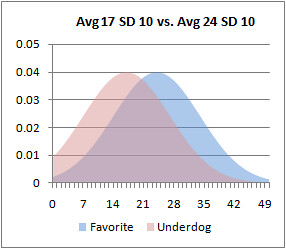
Here’s why underdogs should play aggressive and risky gameplans. Take an example where one team is a 7-point favorite over its underdog opponent. Say the favorite would average 24 points and the underdog would average 17 points. With a SD of 10 points for each team, the underdog upsets the favorite 31.5% of the time. The favorite’s scoring distribution is blue and the underdog’s is red.


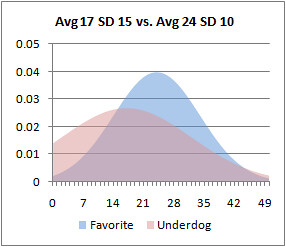
But if the underdog plays a more aggressive high-variance strategy, increasing its SD to 15 points, it would upset the favorite 35.3% of the time.


Note that I haven’t increased the underdog’s average score in any way, just its variance. The increase in its chance of winning results due to more of its probability mass moving to the right of the favorite’s mean score of 24. In fact, the higher the variance, the wider the probability mass will be spread. Consequently, more mass will be to right side of the favorite’s average score. But more mass will also be to the left, meaning there is a higher risk of an embarrassing blowout.

Even if employing a high-variance strategy is non-optimum, it can still help an underdog. In other words, even if an aggressive gameplan results in an overall reduction in average points scored, it often still results in a better chance of winning.


Yet would there be any reason for a Goliath to use this strategy? No, not at all. All it would be doing is inviting variance that would result in a few more upsets, and in fact might make the team worse (though could give the illusion of success because, again, of its high variance, resulting in a few high-scoring output games).

This is the biggest problem with the example TN uses:

Goliath University believes in the old Big Ten philosophy, 3 yards and a cloud of dust. Let's say they've even perfected their approach to the point that they can get exactly 3.3333 yards every time without ever turning the ball over. There is no risk involved and they know exactly what they are going to get with every play. Per play, they expect to get around .23 points. In true Goliath fashion, however, they run a quick, no-huddle offense in order to maximize the number of trials on the field. Over the course of the game this translates (assuming about 100 plays per game) to about 23 points and let's say a little over 30 minutes T.O.P. They'd win most of their games, but they'd lose any game where their defense gave up 24 or more due to random variation in the amount of time their opponent held the ball.

Goliath State University instead takes a more wide open approach, similar to Tulsa's offense. They throw the ball a lot more often, and go downfield more frequently as well. There is a lot more uncertainty associated with this approach, as there are many possible outcomes to their plays. However, through the strength of their preparation, they have a 50% chance of completing any given pass. Each of their 5 options (4 receivers and a QB run) has a 10% chance of success.

* If the QB runs, there is a 70% chance he will gain 4 yards, a 25% chance he will gain 14, and a 5% chance he scores
* Receiver A is running our deep fly, and there is a 50% chance he gets a 40 yard completion and a 50% chance he scores
* Receiver B is running the post, and there is a 80% chance he will get a 14 yard completion and a 20% chance he scores
* Receiver C is running the out, there is a 95% chance he gets 7 yards and a 5% chance he scores
* Receiver D is running the drag, there is a 95% chance he gets 4 yards and a 5% chance he scores

The expected point value of this play is:

.5*.1*((.7*.23+.25*1+.05*7)+(.5*3+.5*7)+(.8*1+.2*7)+(.95*.5+.05*7)+(.95*.23+.05*7)) = .468 expected points per play

Again, this is simply a better strategy, which is different than being a David strategy. Risk does not automatically equal David, and very conservative does not equal Goliath. Sometimes there is still better or worse.

To be fair, there is some indication in the TN pieces that this comes through. It repeatedly discusses the need to reduce the riskiness of these strategies "through film study, personnel decisions, and practice." Again though, I would argue that (a) these extra resources are themselves often a Goliath strategy (this becomes evident at high school for sure, but also in college with big differentials in resources, film equipment, practice materials, etc), and (b) practice and preparation is the quintessential dominant strategy -- it neither favors the underdog nor favorite, it's just a good idea!

The upshot is that these are two very good pieces, and well worth the read. I just want to emphasize my earlier point that I am using David and Goliath strategies in a very specific way, and one that differs slightly from Gladwell (it may not even be correct, it's just how I am using it). A true "David strategy" is one that, by definition, would not be good for a Goliath, because it is riskier. I used the example of extra fake punts, onside kicks, going for it on fourth, trick plays, etc. Relatedly, some Goliath strategies are low variance but that doesn't mean they have to be literally three-yards and a cloud of dust.

But the important point that TN clearly does get is that, Goliaths may nevertheless act suboptimally, and it is the underdogs and Davids that might discover the better, dominant strategies. The dominant ones will be adopted by those Goliaths (think of the spread of the spread, with its ability to push boundaries while keeping risk low), and others, though derided mightily as "gimmicks," simply might be appropriate for an underdog. It's not always easy to tell the difference, but this is an idea definitely worth continued exploration.

Smart Notes and Links 7/28/09

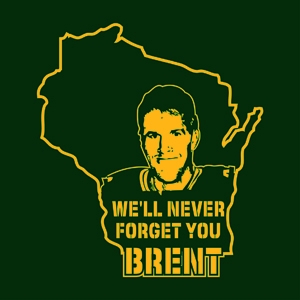
1. Brett Favre is not happy about this and will unretire to prove it. A commemorative decoration (ht Maize 'n Brew, via sconnie.com):


2. How science can save you from choking. This new bit from Jonah Lehrer is a nice complement to my earlier post on football decision making and the brain.

Kenny Perry could taste history. He had a two-shot lead with two holes to go at the 2009 Masters - all he had to do was not make any big mistakes and he would become, at 48, the oldest Masters champion in history. For three days at Augusta, he had played the best golf of his life: on the first 70 holes, he made only four bogeys. But then, at the 71st hole, everything started to fall apart. . . .

We call such failures "choking", if only because a person frayed by pressure might as well not have oxygen. What makes choking so morbidly fascinating is that the performers are incapacitated by their own thoughts. Perry, for example, was so worried about not making a mistake on the 17th that he played a disastrous chip. His mind sabotaged itself.

Scientists have begun to uncover the causes of choking, diagnosing the particular mental differences that allow some people to succeed while others wither in the spotlight. Although it might seem like an amorphous category of failure, their work has revealed that choking is triggered by a specific mental mistake: thinking too much.

The sequence of events typically goes like this: when people get nervous about performing, they become self-conscious. They start to fixate on themselves, trying to make sure that they don't make any mistakes. This can be lethal for a performer. The bowler concentrates too much on his action and loses control of the ball. The footballer misses the penalty by a mile. In each instance, the natural fluidity of performance is lost; the grace of talent disappears.

Sian Beilock, a professor of psychology at the University of Chicago, has helped illuminate the anatomy of choking. She uses golf as her experimental paradigm. When people are learning how to putt, it can seem daunting. There are just so many things to think about. Golfers need to assess the lay of the green, calculate the line of the ball, and get a feel for the grain of the turf. Then they have to monitor their putting motion and make sure that they hit the ball with a smooth, straight stroke. For an inexperienced player, a golf putt can seem unbearably hard, like a life-sized trigonometry problem.

But the mental exertion pays off, at least at first. Beilock has shown that novices hit better putts when they consciously reflect on their actions. The more time they spend thinking about the putt, the more likely they are to hole the ball. By concentrating on their game, by paying attention to the mechanics of their stroke, they can avoid beginner's mistakes.

A little experience, however, changes everything.


3. "SEC offers great drama, even football." The Big 10 media day, however, does not live up to its frat-guy, party school reputation. (And this gets a link solely because of the Dr. Octagon reference.)

4. Can NCAA athletes be denied access to agents? I don't have a ready answer to this question, though read up about it here. (Ht Dr Saturday.)

5. Monte Kiffin would like to remind you again that he will outwork you. You know, just in case you forgot.

6. An inviting summary:

With the ESPN cameras gone and prize money drying up, the glory years of the Lumberjack world championships appear to be long over.


7. Back when I wrote this, I got a fair bit of heat and disagreement:

Hello! Plaxico Burress is going to jail. . . . [T]he NFL community -- and not just fans -- seem rather blind to the reality that Plaxico faces gun charges with a mandatory minimum sentence and the prosecutors do not appear interested in granting him grace, and so he is going to serve some real jail time. Who he signs with is rather beside the point.


Well, it appears to finally be sinking in. The NY Times reports:

Manhattan's district attorney says he wants former Giants wide receiver Plaxico Burress to serve time in prison, the New York Post reported. Robert Morgenthau told the newspaper that Burress, who shot himself with an unlicensed gun in November, was willing to agree to spend a year in jail, but prosecutors insisted on two.

''We've always taken the position that he's going to have to go to jail, whether by trial or by plea,'' Morgenthau told the Post for a story in Monday's edition.


Again, remember that this gun possession charge Burress was hit with has a two-years mandatory minimum. Sure, he can plead for less, but this doesn't seem a particularly difficult charge to prove: he brought the gun into the club and shot himself. That makes this next bit a bit strange to me.

Brafman [Plaxico's lawyer] had previously said he no longer thought the matter would be resolved through a plea agreement and that prosecutors would take the case to a grand jury. He also said Burress would plead not guilty if the case went to trial.


Again, not sure what a not guilty plea would get Plax.

Monday, July 27, 2009

Smart Links and Notes 7/27/09

1. ESPN's Bruce Feldman asks a panel "What makes a great college coach?" (Insider required.)

"He must be able to develop players. Good X's and O's can only put players in a position to succeed; they must also be taught the tools to actually do so. This requires that the coach be a great teacher of technique, drive, and desire (and if he is head coach he must be able to teach his players and his coaches those things as well), and to be a great teacher the players must also know that he cares before they will listen. Styles may differ -- compare Pete Carroll to Bear Bryant -- but the players must be willing to run through a wall for their coach."

That's my answer. Other contributors Feldman asked included former GA coach Jim Donnan, Rod Gilmore of ESPN, Jim Hofher Delaware's OC, and Phil Steele ("My No. 1 judge of a coach is how often they outperform my magazine's expectations."), among others.

2. Brophy chimes in with more on the "robber" coverage, as a jump-off from my recent bit on Va Tech's D for Dr Saturday. He includes some classic coaching tape of Virginia Tech vs. Syracuse in 1998 (McNabb was QB for the Orangemen).


3. The Blue-Gray Sky breaks down -- and is down on -- Notre Dame's use of the draw play. They do a nice job, but I'm confused why they are so down on the draw play. Michael points out that the play's average in 2008 was 4.9, which was down from a high of 5.3 yards per carry in 2005. That's true that it was down, but that's still a pretty good average for a team that averaged a paltry 3.27 yards per carry. (And if you take Jimmy Clausen's 54 "carries" for -74 yards out of the equation, ND still only averaged 3.92 YPC.)

Notre Dame's problems with the rush appear to be two-fold: one, they just need to get better at blocking up front, and maybe BGS is right that just committing to the inside zone or some other play will make them better; and second, the pass game is not as dangerous as it was, as in 2005 Brady Quinn averaged an impressive 8.7 yards per pass attempt (unadjusted). If I were them I would focus on a simpler base of run plays: four or five at the max. Anyway, check out the original post.

4. I agree with the Senator: The Tebow-gate vote scandal was anti-climactic (Spurrier: Uh, I didn't care enough to do it myself and someone else either got cute or lazy and I never looked. In fact, I never look.) As I take the Senator's point to be, do we care if coaches don't really bother with these things? I sure don't. I always figured the "Coaches poll" -- in its various forms -- basically just stood for "someone over there at the coaches office and/or athletic department of that school," and that was good enough for me. It's more of an issue of who else you'd want to ask.

5. File this in the category of strange ideas: Zach Zaremba wants Southern Cal to switch to the spread offense.
The Trojans have the athletes to run this prolific offense, so will they get behind the eight ball, or follow suit as so many teams have already done and install the offense of the 21st century?

Powerhouses such as Texas, Oklahoma, Ohio State, Michigan, Virginia Tech, Penn State, Florida and West Virginia have made the switch. When will the mighty Trojans?


Uh. There's more there, but the argument seems to be that USC isn't scoring as many points as, say, Oklahoma or Florida, and they haven't won a National Title in four years. But that doesn't make much sense: USC lost to Oregon State last year, in a single defensive breakdown, and Stanford the year before, in just a fluke game (many spread offenses have had similar breakdown games). Relatedly, this really can't be an issue of being wide open enough, as USC throws the ball plenty and does -- contrary to what the article says -- use four and five receiver sets (though not with the frequency of a team like Florida).

The other reason of course that USC hasn't won a title game over the last four seasons (aside from facing Vince Young), is that the Pac-10 has let USC down: Florida, which won two of the last three titles, had a loss each season, and LSU lost two games. It's a strength of schedule thing.

Anyway I'm getting off topic. The article is weird, and based on an equally weird premise: "The spread offense is the most popular offense in football today." That, to me, is a good reason not to run the spread. Look, the issue with pro-style offenses versus spread offenses is that spread offenses, where the quarterback is a dynamic runner, can get an arithmetic advantage. But that doesn't make dropback passing obsolete; if your guy is Peyton Manning or Tom Brady -- or the college equivalent, like Leinert or Carson Palmer were -- then you are more than dynamic enough. It's not easy to find guys with that kind of passing ability, but USC definitely can.

Friday, July 24, 2009

What makes a good running back? How do you evaluate how good a team's run game is?

The pro-football reference blog recently mentioned something I found fascinating:

What about rushing? . . . .In modern times, most RBs have a median carry length of three yards. I suspect that’s been the case for the majority of RBs for a long time. LenDale White and his 3.9 YPC last season? Median rush of 3 yards. Adrian Peterson and his 4.8 YPC? Median rush of 3 yards.


I think this has powerful implications. If most runningbacks tend to have the same median rush, then those who are more effective -- and hence have higher averages -- would be almost exclusively based on their big-play ability. (That big-play ability could still come in different forms, i.e. the guy who consistently can turn five yarders into 15 yarders, or the guy who can break every 10th or 15th rush into a 50 yarder.)

But this would imply that the powerback, or at least the powerback who is not considered so explosive, is overrated. (Earl Campbell could run you over and break off big gains.) The point is just that the premium would not be on the player's results on the average plays, but instead on the longer ones. Some of this too can be the surrounding cast. Indeed, as Homer Smith has said, a runningback who gets 130 yards on 20 carries plays in a better offense (either because of him or for whatever other reason) than a guy who gets 145 on 35 carries.

But this does all assume that average yards per carry is the most important stat. I'm not sure all would agree that it is. (In fact, I think the PFR Blog folks might not agree, as they ranked runningbacks and included their total carries and pure total yards as a key factor.) I'm not convinced that more carries means a better back or better running game, as that depends on the game situation (does the team get a lot of leads?) and also that the play-calling is optimal. I can also buy that on 3rd and 3, or third and goal, the point is to convert, not to help the average.

Yet then how else can we evaluate running backs, or even a running game more generally? A perusal of the best offenses and running games in college tends to show that the best all have high yards per carry; not too many BCS teams have averaged fewer than 4.5 yards per carry, and several have averaged well over five yards per rush attempt (including sacks, which count against the run game total in college).

So I'm opening the floor to better ideas. IF yards per attempt is the best metric (for either an individual back or a team's run game), and IF the median truly is right around 3 yards for great and average backs alike, then the difference between good and mediocre runningbacks and rushing teams would seem to be wholly in the explosiveness of the upper 50% of plays: a good team or player can rip off big gains, and turn big gains into touchdowns, while the average plays for both is about the same. (And maybe negative plays are overrated.)

But I'm interesting in everyone's thoughts on this question. How do you evaluate the running game?

What I'm reading

1. 2009 Coach of the Year Clinic Manual. Nothing revolutionary, but some good stuff. Chip Kelly of Oregon has a good article (which is actually available here), as does Monte Kiffin, now of Tennessee (about his famous "Tampa Two," of course). Paul Johnson of Georgia Tech has a good one too, which includes this gem:

We give teams that play that kind of front [i.e. try to read the A-back's block to give them cues on what kind of blocking scheme Georgia Tech is using to block the various defenders "assigned" to the different possible ballcarriers in the option] something a little funky. When they play the eight-man front on defense, they tie the safety and outside linebacker to the release of the playside slot. They tell the linebacker if the slot runs straight up the field, the strong safety takes the quarterback and the free safety runs for the pitch. If the slot arcs, the linebacker stays outside on the slot and the safety runs the alley for the quarterback. That is not a bad way to play and is probably smart. If we find them doing that, we automatic with a safety call. We run the slot on the inside release, but he passes the linebacker and blocks the safety. [In other words he basically fakes blocking one guy and blocks a different guy, though it is subtle and designed to defeat what the defenders were taught all week to look for as a blocking tendency.] The defense has two defenders on the quarterback and no one on the pitch. We did that a bunch against Georgia in our last regular season game.

Yup. The insight here is that it's not necessarily that Georgia didn't know the option, it's that they maybe overthought the whole thing, trying to guess and calculate what was coming when. Sometimes the answer is just to keep it simple, read and react, and play football.

2. Consider the Lobster: And Other Essays, by David Foster Wallace. The guy could write.

3. Harper's Magazine. Just got a subscription.

4. The Most Of P.G. Wodehouse (Collection of P.G. Wodehouse stories). Another guy who could flat write. Many of these stories are ridiculous but that's often where their fun lies.

5. In Fed We Trust: Ben Bernanke's War on the Great Panic, by David Wessel (the Wall Street Journal's economics editor). It's not out yet, but looks good, and I will be reading it. I've avoided most of the new books on the economic collapse, but it appears this is the one to read (at least so far). I've also always enjoyed Wessel's work.